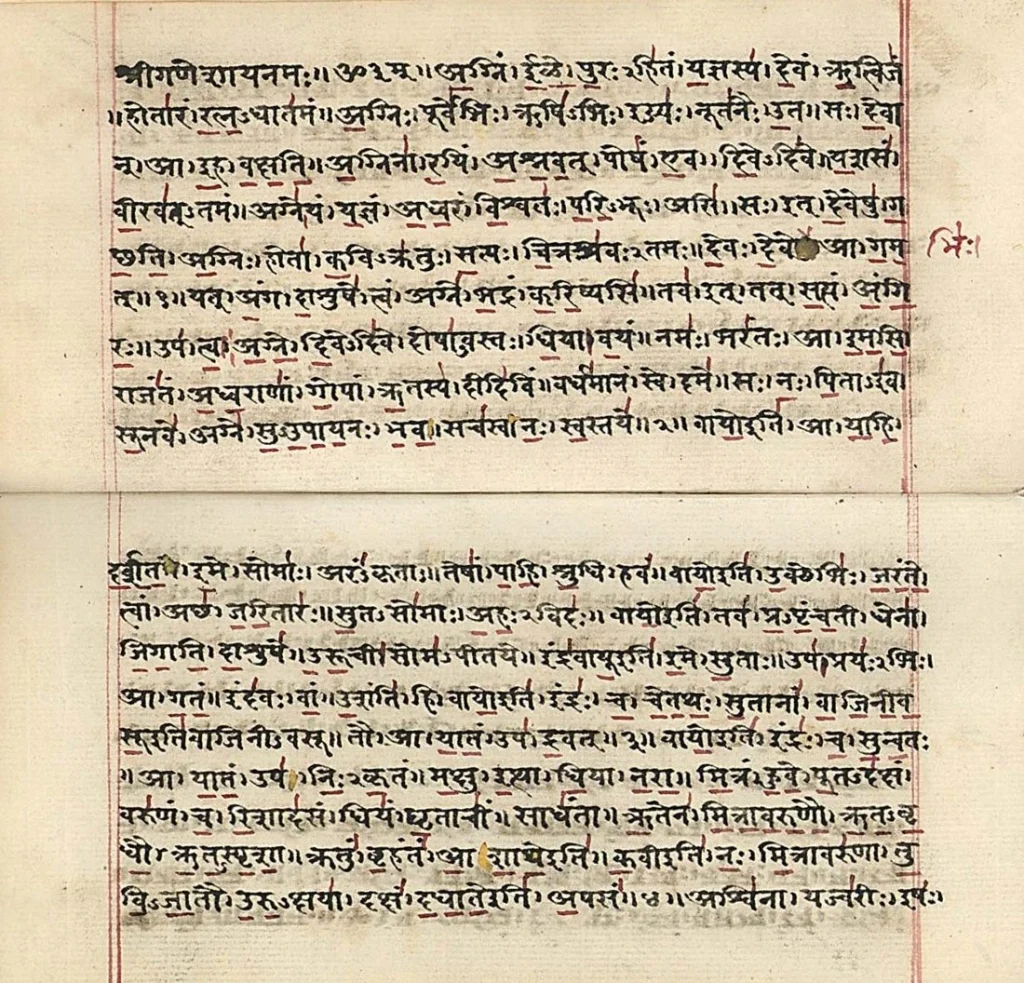
The Vedas are the foundational sacred corpus of Vedic tradition, while the Upanishads are texts within the later or concluding portions of that corpus that concentrate on questions about reality, the self, knowledge, death and liberation. In everyday speech, “Vedas” often means the four collections of hymns and formulas—the Rig, Sama, Yajur and Atharva Vedas—whereas in a broader scholarly and traditional sense each Veda includes layers such as Samhitas, Brahmanas, Aranyakas and Upanishads. Therefore, “Vedas versus Upanishads” is a useful comparison of emphasis, but not a comparison of two entirely unrelated scriptures.
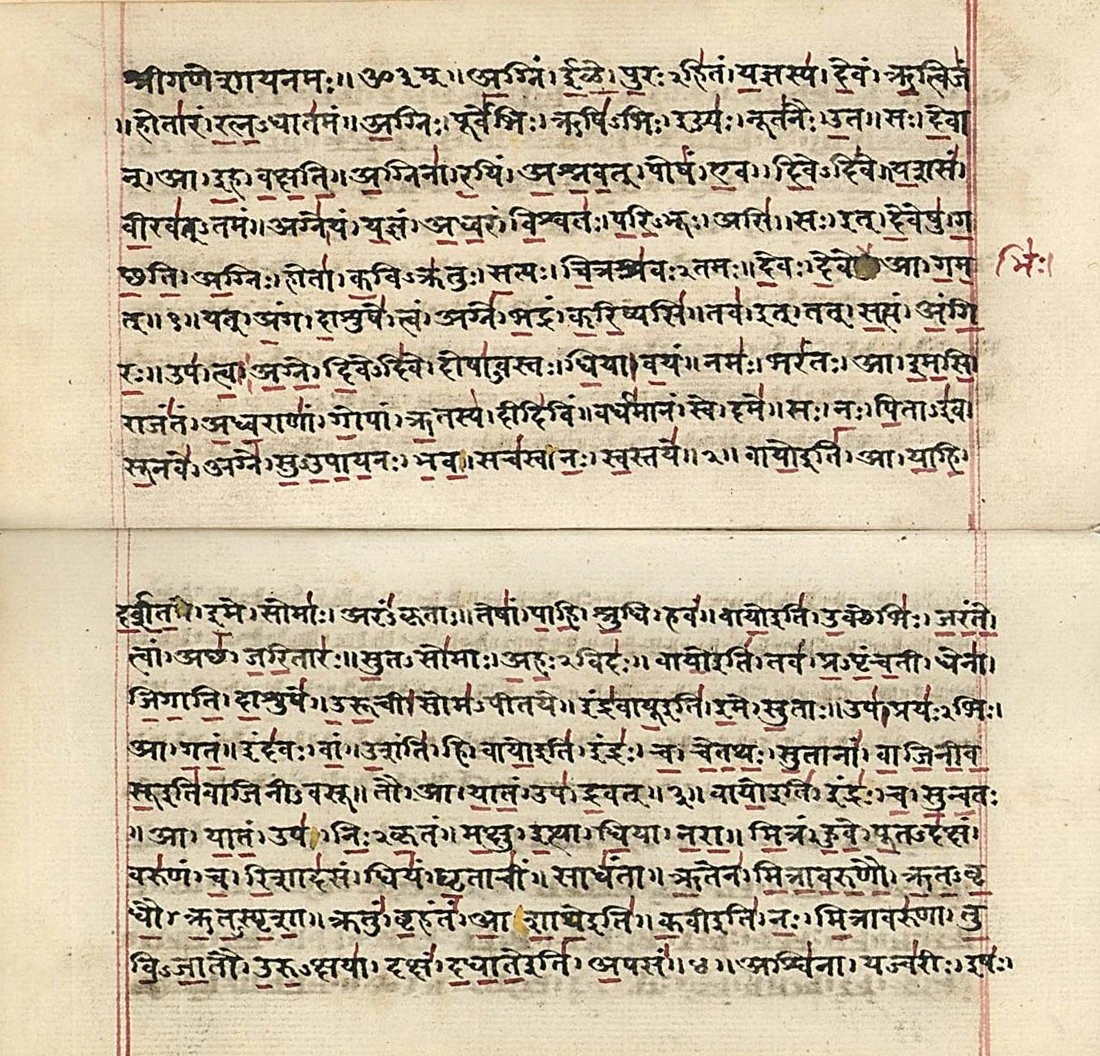
Vedas and Upanishads at a glance
| Question | Vedas | Upanishads |
|---|---|---|
| What does the name mean? | Veda means knowledge; the term names Hinduism’s foundational revealed corpus. | Upanishad is traditionally associated with sitting near a teacher; its exact etymological explanation is debated. |
| What texts are included? | In the narrow sense, four Samhitas: Rig, Sama, Yajur and Atharva. In the broad sense, the complete Vedic textual complexes. | Numerous works attached to different Vedic schools; a group of early or “principal” Upanishads became especially influential. |
| Main forms | Hymns, invocations, sacrificial formulas, chants, ritual exposition and speculation. | Dialogues, teachings, narratives, symbolic interpretation and concentrated reflection. |
| Major concerns | Deities, cosmic order, praise, sacrifice, ritual efficacy, prosperity, protection and the relation between human and cosmic worlds. | Atman (self), brahman (ultimate reality), knowledge, rebirth, karma, death, meditation and liberation. |
| Historical position | The oldest layers precede the early Upanishads; the corpus developed over centuries. | The earliest Upanishads form late Vedic strata; many later Upanishads were composed after the Vedic period. |
| Traditional status | Shruti, “that which is heard” or revealed tradition. | Also classed as shruti when part of the Vedic corpus. |
| Relationship | The larger textual and ritual heritage. | Often called Vedanta, the “end” or culmination of the Veda. |
What are the Vedas?
The word Veda refers both to a body of sacred knowledge and to specific textual collections preserved through highly disciplined oral transmission. UNESCO recognizes the tradition of Vedic chanting as intangible cultural heritage and notes its elaborate techniques for preserving the texts.[5] The Indian government’s Vedic Heritage Portal documents recensions and chanting traditions as a living textual heritage.[4] This oral dimension is essential: the Vedas are not simply old books. Sound, accent, sequence and teacher-to-student transmission have religious and textual importance.
Encyclopaedia Britannica describes the Vedas as a collection of poems or hymns composed in archaic Sanskrit and transmitted orally, forming the earliest layer of Hindu sacred literature.[1] “Authorless” (apaurusheya) is an influential traditional description: the Veda is understood not as ordinary human invention but as revealed or eternally valid knowledge perceived by ancient seers. Hindu philosophical schools differ in how they explain that authority.
The four Vedas
- Rig Veda: collections of metrical hymns addressed to deities and concerned with praise, cosmic order, ritual and human hopes.
- Sama Veda: verses, many drawn from the Rig Veda, arranged for melodic chanting in sacrifice.
- Yajur Veda: prose formulas and verses used by ritual specialists, preserved in multiple recensions often grouped as “Black” and “White” Yajur Veda traditions.
- Atharva Veda: hymns, prayers and formulas addressing healing, protection, household concerns, royal rites and cosmic themes, among others.
How is the Vedic corpus organized?
| Layer | Typical content | Why it matters |
|---|---|---|
| Samhita | Hymns, chants and sacrificial formulas | Usually what people mean by the “four Vedas” in a narrow comparison. |
| Brahmana | Ritual explanations, correspondences, myths and interpretations | Explains sacrificial acts and links ritual details to cosmic meaning. |
| Aranyaka | “Forest” teachings, symbolic ritual interpretation and contemplation | Often bridges formal ritual exposition and inward or speculative teaching. |
| Upanishad | Teachings about self, reality, knowledge, death, meditation and liberation | Forms the textual basis for much later Vedanta philosophy. |
This four-layer model is a helpful map, not a rigid publishing sequence. Texts overlap, classification can vary, and an Upanishad may be embedded within an Aranyaka or Brahmana. The boundaries developed within different Vedic schools rather than through one central canon-making institution.
What are the Upanishads?
The Upanishads are a diverse body of teachings associated with the Vedas. Britannica characterizes them as texts concerned with the connection between humanity and the cosmos and as foundational to later Hindu philosophy.[2] The oldest include the Brihadaranyaka and Chandogya Upanishads; other widely studied principal texts include the Kena, Katha, Isha, Mundaka, Mandukya, Taittiriya, Aitareya, Prashna and Shvetashvatara. Lists differ, especially when later sectarian Upanishads are included.
The Internet Encyclopedia of Philosophy explains that Hindu philosophy has deep roots in the Vedas and Upanishads while developing into multiple schools with distinct arguments.[3] This is important because the Upanishads do not deliver one modern textbook system. They contain many voices, teaching situations and formulations. Later thinkers—especially Shankara, Ramanuja and Madhva—read shared passages through sharply different Vedanta frameworks.
Central Upanishadic questions
- What, if anything, remains constant through bodily and mental change?
- What is atman, the self, and how is it related to brahman, ultimate reality?
- What happens after death?
- How do action (karma), knowledge and rebirth relate?
- What kind of knowledge frees a person from ignorance or repeated suffering?
- How can speech, mind, breath, meditation and ethical discipline support insight?
Not every Upanishad answers these questions alike. The famous statements later called mahavakyas, or “great sayings,” gain meaning from their textual contexts and from the commentarial traditions that interpret them. Quoting “tat tvam asi” (“you are that”) as a free-floating slogan can hide both its narrative setting in the Chandogya Upanishad and centuries of debate about what “that” and “you” signify.
Five key differences between the Vedas and Upanishads
1. The Upanishads are part of the wider Vedic tradition
The simplest correction to the word “versus” is that Upanishads are not outside the Vedas in the way the Bhagavad Gita or Puranas are. Early Upanishads belong to Vedic textual branches and share shruti status. Yet “Vedas” is often used narrowly for the Samhitas, which makes a practical contrast possible.
2. Their dominant literary forms differ
Samhitas foreground hymns, chants and formulas, while Brahmanas expound ritual. Upanishads frequently use dialogue, paradox, analogy and teacher-student instruction. Neither side is uniform: the Rig Veda contains profound speculative hymns, and Upanishadic discussions may reinterpret sacrifice rather than reject it.
3. They emphasize different religious questions
Many early Vedic passages address praise, sacrifice, prosperity, protection and cosmic order. Many Upanishadic passages ask what knowledge overcomes death and ignorance. It is tempting to label this “outer ritual versus inner spirituality,” but that formula is too neat. The later texts often transform ritual correspondences into contemplative ones while retaining Vedic vocabulary and authority.
4. Their historical layers are not identical
The oldest Vedic hymns are earlier than the oldest Upanishads. However, “the Upanishads” span a long period: later works bearing the name can be much younger and may focus on yoga, renunciation, a particular deity or a sectarian theology. A claim about one Upanishad should not automatically be generalized to all.
5. Their later influence developed in different ways
Vedic ritual traditions continued through recitation, domestic rites and temple-related adaptations, while the Upanishads became primary sources for Vedanta interpretation. The Bhagavad Gita and Brahma Sutras are conventionally studied with the Upanishads as the threefold foundation (prasthana-traya) of Vedanta. That later framework does not erase the independent ritual, poetic and liturgical life of the Vedas.
How to begin reading responsibly
- Choose a complete, reputable translation. Prefer a university press or an edition that names the Sanskrit text, translator and textual recension.
- Read the introduction critically. A translator’s philosophy affects word choices for atman, brahman, dharma and yajna.
- Keep the textual layer visible. Do not treat a hymn, Brahmana explanation and Upanishadic dialogue as if they belong to one speaker or date.
- Read passages in context. Note who teaches, who asks, what ritual or social setting is assumed, and how the argument develops.
- Compare commentaries. Advaita, Vishishtadvaita, Dvaita and other schools can interpret the same sentence differently.
- Use oral guidance where appropriate. Accurate Vedic recitation cannot be learned reliably from romanized text alone. Work with a qualified teacher and respect lineage rules around specialized chanting.
Frequently asked questions
Are the Upanishads the fifth Veda?
No. They are traditionally associated with branches of the four Vedas and are often called Vedanta. “Fifth Veda” is an honorific applied in other contexts to works or bodies of knowledge, not a standard classification that turns the Upanishads into a separate fifth collection.
Which came first, the Vedas or the Upanishads?
The oldest Vedic Samhita layers came first. The earliest Upanishads arose in the late Vedic period, but later Upanishads continued to be composed for centuries. Precise dates are debated.
Is the Bhagavad Gita an Upanishad?
The Gita is part of the Mahabharata, not the Vedic Upanishad collections. Its chapters are styled as an “Upanishad,” and it draws on Upanishadic themes, which signals spiritual status and teaching form rather than textual placement inside a Veda.
Do all Upanishads teach that atman and brahman are identical?
No single sentence summarizes every Upanishad, and later Vedanta schools disagree about the relationship among self, world and ultimate reality. Advaita emphasizes nonduality; Vishishtadvaita and Dvaita articulate different relationships while affirming Vedic authority.
How many Upanishads are there?
The number depends on the list and period. A traditional list called the Muktika names 108, while scholars often focus on a smaller group of early or principal Upanishads. “108” should not be mistaken for a universally fixed ancient canon.
Sources and further reading
- Encyclopaedia Britannica, “Veda” — supports the definition, oral transmission and broad structure of Vedic literature.
- Encyclopaedia Britannica, “Upanishad” — supports the Upanishads’ place, themes and influence.
- Internet Encyclopedia of Philosophy, “Hindu Philosophy” — scholarly overview of Vedic and Upanishadic roots and the diversity of later schools.
- Indira Gandhi National Centre for the Arts, Vedic Heritage Portal — Indian institutional resource for Vedic texts, recensions, chanting and heritage.
- UNESCO Intangible Cultural Heritage, “Tradition of Vedic Chanting” — supports the importance and preservation techniques of oral transmission.
- World History Encyclopedia, “Upanishads” — accessible supplementary overview; use after the reference and academic sources above.
Related internal-link suggestions
- Sacred Texts of Hinduism: A Reader’s Map — link from the opening definition.
- What Is the Bhagavad Gita? — link from the influence and FAQ sections.