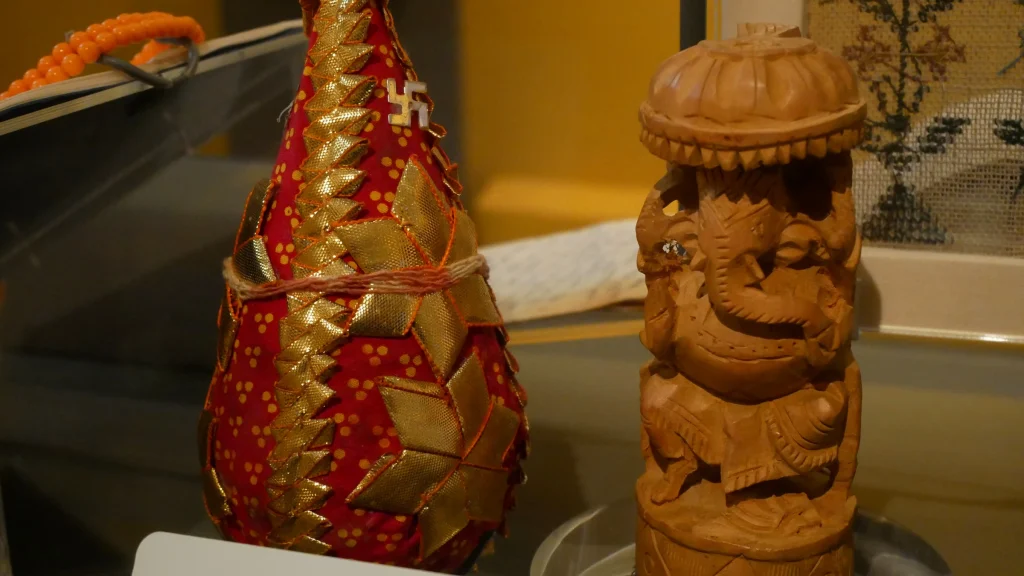
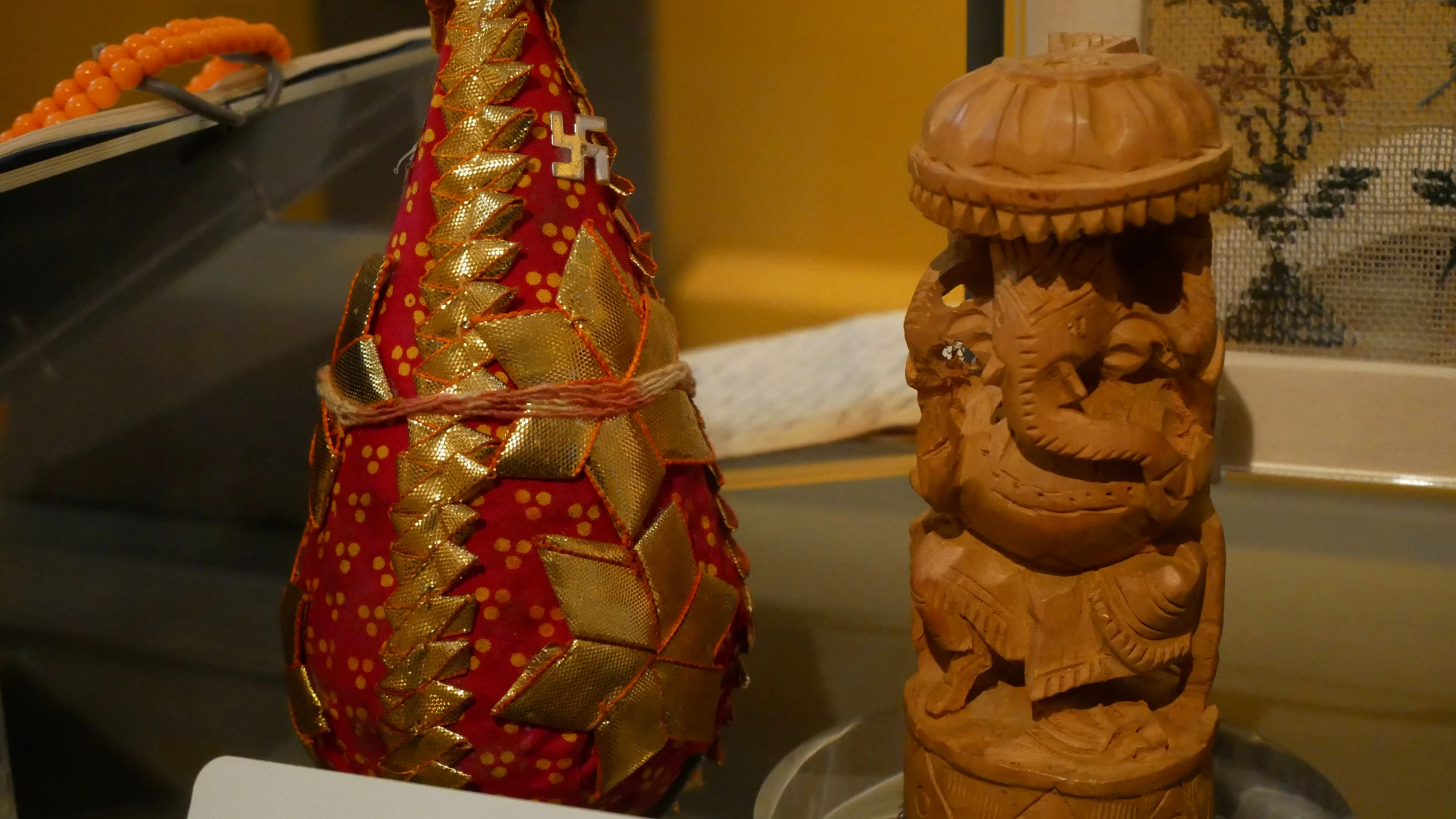
Sacred objects in Hindu worship help devotees focus attention, make offerings, invoke memory and relate to the divine through sight, sound, fragrance, touch and taste. Common examples include a murti or sacred image, diya (lamp), bell, incense, water vessel, flowers, food, conch, mala, tilak materials and ritual tray. Their meanings are not fixed across all Hindu traditions: an object may be a consecrated embodiment of divine presence in one context, a devotional aid in another, or simply an ordinary item until it is prepared and offered.
Why are objects used in Hindu worship?
Hindu worship is often sensory and relational. The Smithsonian’s Puja: Expressions of Hindu Devotion explains that a worshipper’s connection with a deity is frequently facilitated through an object such as a natural element, sculpture, vessel, painting or print.[1] Britannica, Harvard’s Pluralism Project and contemporary Hindu institutional guidance also place images and offerings within the wider practice of puja.[3][4][5] The object can support concentration, make hospitality visible and allow devotion to be expressed through practical care.
This does not mean Hindus agree that “God is trapped in a statue.” Understandings range from the deity’s real, ritually established presence to a material focus through which the transcendent becomes approachable. The term murti means a form or embodiment and is usually more accurate than the polemical word “idol.” In many temples, a formal consecration called prana-pratishtha establishes the image for worship. Such rites belong to trained specialists and should not be copied from a short online checklist.
Objects also create a language of hospitality. Water refreshes, flowers honor, fragrance pleases, light reveals, food nourishes and cloth adorns. The point is not that the divine lacks these things; the acts cultivate attention, gratitude and a relationship of giving and receiving.
Common sacred objects and what they mean
| Object | Common use | Meaning and variation |
|---|---|---|
| Murti, picture or icon | Receives attention, offerings, adornment and darshan. | May be consecrated divine presence, a devotional form or a visual aid, depending on theology and setting. |
| Diya or deepa (lamp) | Lit at the beginning of worship or moved during arati. | Often associated with knowledge, auspiciousness and the removal of darkness. An LED lamp is a valid safety accommodation for informal worship. |
| Ghanta (bell) | Rung at the opening of puja or during arati. | Marks sacred attention and contributes sound to worship. Not every household uses one. |
| Incense or dhupa | Offered for fragrance. | Can symbolize a pleasing offering or an atmosphere of reverence. It is optional and should be omitted when smoke is unsafe. |
| Kalasha or kalash (vessel) | A pot filled with water and sometimes topped with leaves and a coconut. | Used in many rites as an auspicious vessel and seat of invoked sacred presence; arrangement and symbolism vary. |
| Shankha (conch) | Sounded in some ceremonies; may also hold or pour water. | Strongly associated with Vishnu in iconography but used more widely. Some household or temple customs distinguish blowing and ritual conches. |
| Puja thali (tray) | Holds a lamp, flowers, powders, rice or other offerings. | A practical arrangement rather than one universally prescribed design. |
| Flowers and sacred leaves | Placed before or on a sacred form. | Express beauty and devotion. Preferences can be deity-specific—for example, tulsi is especially important in many Vaishnava settings and bilva leaves in many Shiva traditions. |
| Naivedya and prasad | Food is presented and later received or shared. | Naivedya names food offered; prasad names the graciously received offering. Ingredient rules vary. |
| Japa mala | Counts repetitions of a mantra or divine name. | Materials, bead counts and handling rules differ by lineage. A mala worn as jewelry is not automatically a practice mala. |
| Tilak, kumkum, sandal paste or vibhuti | Applied to the deity, objects or forehead. | Can mark blessing, devotion or sectarian belonging. Shapes and substances differ; not every red powder is interchangeable. |
| Yantra | Geometric sacred diagram used in worship or meditation. | May embody a deity or cosmic pattern in a specific tradition. Complex installation and mantra practice can require initiation. |
| Sacred text | Recited, displayed, carried in procession or honored with offerings. | The text may be revered as a form of sacred knowledge or divine presence; keep books clean and elevated according to household custom. |
The murti: image, embodiment and presence
A murti may be made from stone, metal, clay, wood or another authorized material, or appear in a painting or print. The Metropolitan Museum of Art’s overview of Hindu art emphasizes that images participate in religious practice rather than functioning only as objects for detached viewing.[2] Clothing, bathing, flowers, lamps and food can express care for the deity as an honored and living presence.
Darshan—seeing and being seen by the divine—is central to understanding why sight matters. The worshipper is not merely studying iconographic attributes. The encounter is devotional. For this reason, photography, touching or moving a sacred image can be inappropriate even when the object looks like art to an outsider.
Not all Hindu worship uses anthropomorphic images. A Shiva linga, shaligrama stone, yantra, flame, river, tree, sun or uncarved stone may serve as a focus. Some Hindus emphasize the formless absolute while still honoring forms; others prefer worship without images. Hindu thought has long held multiple approaches rather than one mandatory visual theology.
Water, vessels and ritual purity
Water may be offered for welcome, purification, bathing or sipping in traditions that prescribe it. A small spoon and vessel can keep offered water separate from ordinary household use. A kalasha may hold water and be decorated with leaves, thread, a coconut or symbols according to the ceremony. It can temporarily serve as a locus for invoked sacred presence.
“Purity” in ritual contexts should not be confused with a judgment that some people have less human dignity. Traditions have rules about cleanliness, food preparation and who handles consecrated objects, but these rules differ and have also been debated and reformed. State a temple’s policy as that institution’s practice rather than declaring it universal Hindu law.
Flowers, leaves and food offerings
Fresh flowers and leaves are among the simplest offerings. Deity-specific associations are meaningful, but online charts often overstate them as absolute prohibitions. Use what your tradition recommends, what is legally and ethically available, and what will not cause harm. Do not take plants from private land, protected habitats or temple grounds without permission.
Food placed before the deity is commonly called naivedya; after being accepted in worship, it is received as prasad. Many pujas use fruit, sweets or cooked vegetarian food, but rules differ by deity, region and lineage. Temple prasad may contain dairy, nuts, wheat, sesame or other allergens. A sacred status does not remove medical risk, so ask before eating or sharing.
Dispose of remnants responsibly. Compost plain flowers and leaves if local rules allow. Do not release plastic-wrapped offerings, synthetic cloth, metal, painted objects, lamp oil or ash into rivers, oceans or drains. Environmental care is more respectful than reproducing a disposal custom in a place where it causes pollution.
How to handle sacred objects respectfully
- Ask before touching. Permission is especially important in temples and other people’s homes.
- Use clean hands and a clean surface. Keep worship items separate from shoes, dirty laundry and food waste.
- Do not place sacred items directly on the floor. Use a cloth, shelf or stand when the tradition expects elevation.
- Learn object-specific rules. A temple murti, home picture, japa mala and consecrated yantra do not have identical care requirements.
- Avoid careless photography. Follow posted rules, and never stage sacred objects as props for mockery, fashion or advertising.
- Use safe materials. Check lamp stability, ventilation, skin products, food allergens and choking risks.
- Repair or retire items thoughtfully. Ask the temple or family tradition about damaged consecrated objects. Do not put metal, glass, plastic or painted items into natural water.
Why meanings vary
There is no central authority that standardizes every Hindu object. Smithsonian educational material likewise presents Hindu belief and practice as internally diverse.[6] Agama and Tantra traditions, regional customs, temple lineages, family inheritance and modern diaspora conditions all shape practice. A South Indian temple, a Bengali household during Durga Puja, a Caribbean Hindu home and a Himalayan Shaiva shrine may use overlapping objects in distinct ways.
Meanings also change by ritual role. Good explanations name the context: “In many Vaishnava homes…” is more accurate than “Hindus always…”
Frequently asked questions
Is a Hindu murti the same as an idol?
“Idol” often carries a dismissive implication of worshipping mere matter. Murti, sacred image or divine form is usually more respectful. Hindu explanations of presence differ, so ask how a particular community understands its image.
Does an object have to be consecrated to be sacred?
Not always. Formal temple murtis undergo consecration, while a family photograph or prayer book may become sacred through dedication, use and relationship. Some objects are revered because tradition identifies them directly with a deity or sacred place.
Can I buy and display sacred objects as decoration?
Context matters. Ordinary artisan-made images may be displayed respectfully, but consecrated or ritually restricted objects should not be treated as décor. Avoid placing sacred forms on floors, shoes, bathroom items, alcohol packaging or other disrespectful products.
What is the most important object for puja?
There is no universal answer. A sacred image or symbol often provides focus, and a lamp is common, but simple worship may use only water, a flower or heartfelt prayer. Tradition and intention matter more than collecting equipment.
Can damaged sacred objects be thrown away?
Do not discard a consecrated object casually. Ask a priest, temple or knowledgeable family elder about repair, transfer or retirement. Whatever the custom, comply with environmental law and do not put hazardous or non-biodegradable materials into water or soil.
Sources and further reading
- Smithsonian National Museum of Asian Art, “Puja: The Act” — supports the role of natural and crafted objects in devotional connection.
- The Metropolitan Museum of Art, “Hinduism and Hindu Art” — supports the religious function and iconographic setting of Hindu images.
- Encyclopaedia Britannica, “Puja” — supports discussion of offerings, images and ceremonial worship.
- Harvard University Pluralism Project, “Puja” — supports the broader worship context in which objects are offered and received.
- Hindu American Foundation, “Hindu Puja Instructions” — contemporary Hindu institutional guidance showing one practical set of puja materials and actions.
- Smithsonian National Museum of Asian Art, “Hindu Belief and Practice” — background on divine forms, worship and Hindu religious plurality.
Related internal-link suggestions
- How to Perform Puja at Home — link from the opening table and handling checklist.
- The Meaning of Om — link from a future section on sacred sound or symbols.
- What Does the Shiva Linga Mean? — link from the linga section.