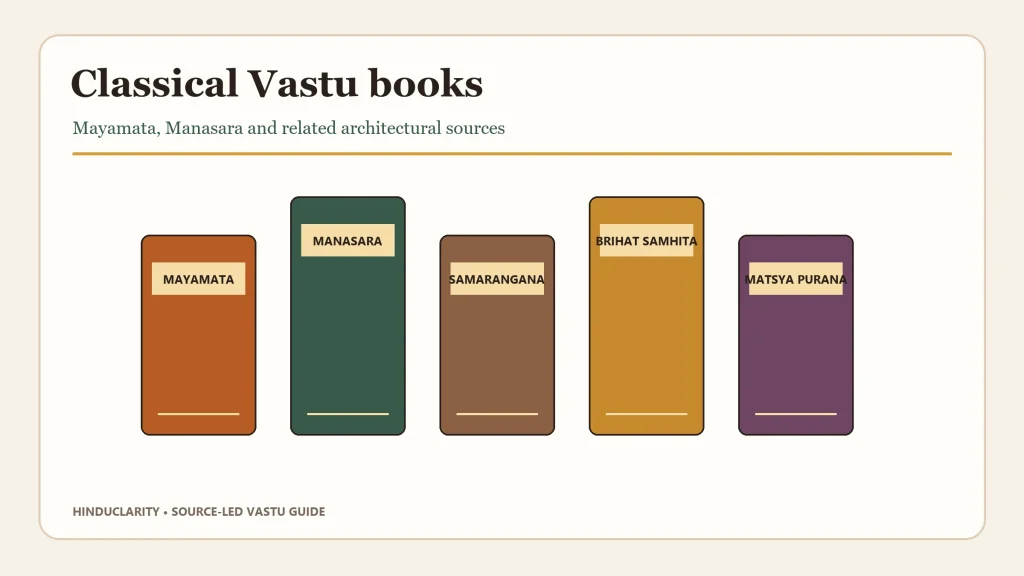
Vāstu Śāstra is not a single, unified manual or a universal rule set; rather, it is an umbrella term for a diverse collection of texts including architectural treatises, astronomical compendiums, Puranic literature, and regional manuals. Because these works vary in purpose and origin, specific rules must be attributed to the particular text from which they are derived.
There is no single Vastu scripture
The term “Vāstu Śāstra” encompasses a wide range of literary traditions rather than a single, monolithic book. Because the tradition is composed of various genres—including architectural treatises, jyotisa (astronomy/astrology) compendiums, and Puranic chapters—the rules found in one text may not appear in another. For example, a text focused on ritual requirements may differ significantly from a manual focused on structural measurements or site selection. Consequently, it is necessary to identify the specific work when discussing any particular architectural prescription. This diversity means that “Vastu” is not a uniform system but a collection of distinct traditions that have been preserved in different forms over time.
Mayamata
Bruno Dagens’s 1994 edition presents the Mayamata as a Sanskrit work combining architecture and ritual and associated with South Indian Śaiva architectural traditions. At the level checked for this article, its chapter map places site and soil material in Chapters III–V, orientation in Chapter VI, site grids in Chapter VII, and houses in Chapter XXVII Dagens, ed./trans., Mayamatam (1994), chs. III–VII and XXVII. This is a chapter-map summary, not verification of every prescription inside those chapters: the accessible scan’s font-mapped OCR is unusable, and exact rules or quotations require inspection of the printed page images. The work must therefore be read on its own terms rather than treated as a universal construction standard.
Mānasāra
The Mānasāra is a broad Sanskrit śilpa and Vastu compendium. Its contents range from architects and measurements through sites, soil, orientation, plans, settlements, houses, palaces, building components, and images Prasanna Kumar Acharya, Architecture of Mānasāra (1934), contents pp. ix–xi, chs. I–LXX. Its compilation date and textual layering are debated; an uncertain, probably medieval compilation is the cautious description used here. Acharya’s proposed dating should not be treated as settled fact, and this evidence packet does not support a claim that particular layers correspond to particular regions.
Samarāṅgaṇa Sūtradhāra
The Samarāṅgaṇa Sūtradhāra is an 11th-century Sanskrit royal encyclopedia attributed to the Paramara king Bhoja of Malwa. It covers a wide range of topics, including settlement planning, house design, palace construction, and temple architecture Samarāṅgaṇa Sūtradhāra. The verified scan is Sanskrit, and this evidence packet did not establish a dependable complete English translation; detailed English rule claims therefore remain on hold pending Sanskrit review.
Bṛhat Saṃhitā
The Bṛhat Saṃhitā is a 6th-century Sanskrit jyotiṣa (astronomy/astrology) and encyclopedic compendium. Its architecture material is one section rather than a standalone manual for domestic construction. In the 1946 English translation by V. Subrahmanya Sastri and M. Ramakrishna Bhat used here as the checked accessible witness, Chapter 53 gives status-specific house dimensions at 53.4–17, an 81-square plan at 53.42–50, and a 64-square alternative at 53.51–56. The same edition’s OCR misreads the deity total at 53.42; the correct number, 45, must be checked against the page image, Sanskrit, and arithmetic rather than copied from the OCR.
Matsya Purāṇa
The Matsya Purāṇa is a Puranic text that contains several chapters dedicated to architecture. The dated 1917 witness provides a narrative and ritual framework for construction, including traditional teachers in Chapter 252, site and soil observations at 253.13–18, house forms at 254.1–14, and further house, door, and site-layout material in Chapters 255–257 The Matsya Puranam, Part II, trans. “A Taluqdar of Oudh,” ed. B. D. Basu (1917), chs. 252–257. As a Puranic work, it is considered a tradition-based transmission rather than a single, unified manual of architectural rules.
| Text Name | Primary Classification | Key Architectural Focus | Source Reference |
|---|---|---|---|
| Mayamata | Ritual & Architecture | Chapter map: sites/soil III–V, orientation VI, grids VII, houses XXVII; page-image verification required for exact rules | Dagens, ed./trans., Mayamatam (1994) |
| Mānasāra | Sanskrit Silpa/Vastu Compendium | Site selection, orientation, plans, palaces | Mānasāra (Acharya) |
| Samarāṅgaṇa Sūtradhāra | 11th-century Royal Encyclopedia | Settlement, palace, temple, and images | Samarāṅgaṇa Sūtradhāra |
| Bṛhat Saṃhitā | 6th-century Jyotisa Compendium | House measures, 81/64-square plans | Sastri and Bhat, trans., Bṛhat Saṃhitā (1946), ch. 53 |
| Matsya Purāṇa | Puranic Tradition | Ritual, teacher lists, house forms, doors | The Matsya Puranam, Part II (1917), Chapters 252–257 |
How to evaluate a Vastu claim
When evaluating claims made regarding Vastu, it is important to distinguish between the text’s prescriptions and actual historical practices. The presence of a rule in a text like the Mānasāra or the Mayamata indicates what that specific tradition prescribed at the time, but it does not necessarily prove that every building in history followed those exact rules. Furthermore, certain terms, such as “Vishvakarma,” refer to traditional and divine authority within the texts rather than a single human author or a unified school of thought.
Because these works are diverse, any specific architectural rule must be tied back to its source. For example, status-ranked house measurements occur in the checked 1946 Sastri–Bhat translation of the Bṛhat Saṃhitā at 53.4–17, while site tests in the dated 1917 translation of the Matsya Purāṇa occur at 253.13–18. This distinction matters because a learned jyotiṣa compendium and Puranic architectural chapters have different genres and evidentiary limits. Named editions and locators keep those contexts visible.
A useful evidence ladder begins with an inspected passage in a named edition, followed by philological or architectural scholarship that explains its textual setting. Catalog records can establish that a book or edition exists, but they cannot support a detailed rule when the text itself has not been checked. Likewise, an OCR layer can help locate a chapter without being reliable enough for quotation. These distinctions prevent a bibliographic lead from being presented as verified scripture.
Frequently Asked Questions
Is there one “official” book for Vastu?
No. Vāstu Śāstra is a collection of various texts, including the Mayamata, Mānasāra, and others. Each serves different purposes, such as ritual, architecture, or astronomy.
What is the difference between the Bṛhat Saṃhitā and other Vastu texts?
The Bṛhat Saṃhitā is a 6th-century jyotiṣa (astronomy/astrology) and encyclopedic compendium. Its Chapter 53 includes architecture, but the whole work is not a dedicated manual for home construction.
What does “Vishvakarma” mean in these texts?
Tradition attributes authority to Vishvakarman. That attribution does not establish a single human author, composition date, or school.
Does the Mānasāra cover only room layouts?
No, the Mānasāra is much broader; it includes site selection, soil tests, orientation, and the design of palaces and public structures in addition to house plans.
Sources and editions
- Bruno Dagens, editor and translator, Mayamatam, 2 vols., Kalamulasastra Series 14–15 (IGNCA and Motilal Banarsidass, 1994). The available scan requires page-image checking because its OCR is unreliable.
- Prasanna Kumar Acharya, Architecture of Mānasāra: Translated from Original Sanskrit, Mānasāra Series 4 (Oxford University Press, 1934).
- T. Ganapati Sastri, editor, Samarāṅgaṇa Sūtradhāra, Gaekwad’s Oriental Series 25 and 32 (Baroda, 1924–1925). The verified scan is Sanskrit; detailed English rule claims remain on hold.
- Varāhamihira, Bṛhat Saṃhitā, translated by V. Subrahmanya Sastri and M. Ramakrishna Bhat (Bangalore, 1946), Chapter 53. This is the accessible edition checked for the locators on this page; its English and OCR are dated, and wording or numbers must be checked against the page image and Sanskrit. M. Ramakrishna Bhat’s 1981–1982 translation is the preferred modern edition but was not the wording witness used here.
- The Matsya Puranam, Part II, translated by “A Taluqdar of Oudh,” edited by B. D. Basu (Allahabad, 1917). Its architectural chapters are used cautiously because the English is dated and unstable.
- Stella Kramrisch, The Hindu Temple, 2 vols. (University of Calcutta, 1946), used for temple-centered historical and symbolic context rather than universal domestic rules.