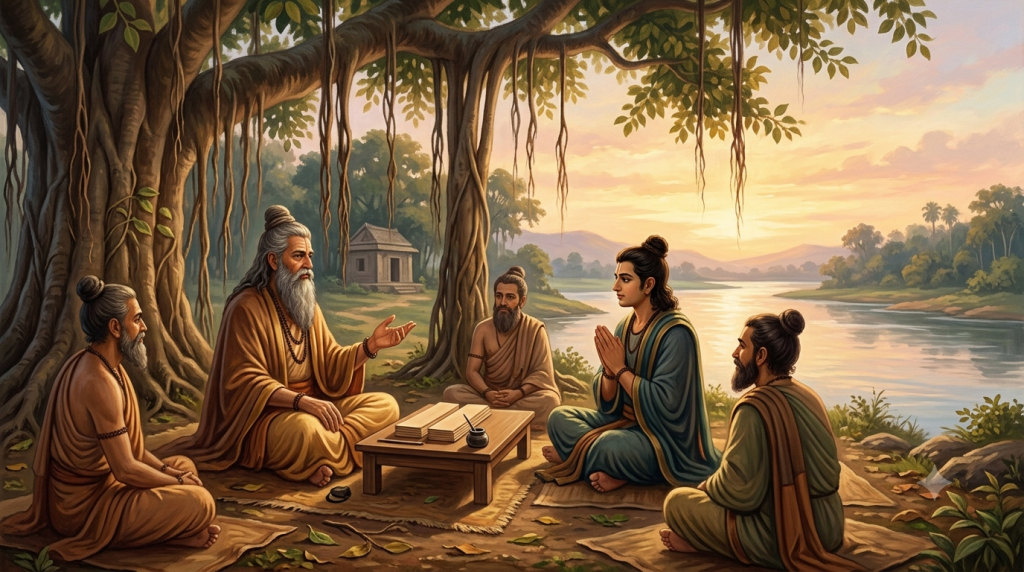
The Vishnu Purana (Viṣṇu Purāṇa) is one of the most influential Sanskrit Mahāpurāṇas and a foundational source for Vaiṣṇava cosmology, sacred history, devotion, and teachings about Lord Vishnu. Organized into six aṃśas or books, it moves from creation and divine manifestations through geography, time cycles, royal and sage lineages, Krishna’s life, Kali Yuga, dissolution, and liberation.
Textual note: The Vishnu Purana is more tightly organized than many encyclopedic Purāṇas, but it remains a transmitted, layered work rather than a modern single-author book. Dates and verse totals vary in scholarship and editions. This guide follows the received six-aṃśa structure without claiming that every manuscript is identical.
What Is the Vishnu Purana?
The work is framed primarily as sage Parāśara’s teaching to Maitreya. Parāśara explains the origin, ordering, preservation, and dissolution of the universe; the deeds of divine manifestations; the cycles of Manus; genealogies of gods, sages, and kings; and the path beyond repeated birth. Viṣṇu is presented as the supreme all-pervading reality who manifests without being exhausted by any single form.
The text is devotional but not merely a story collection. It draws together Sāṃkhya-like cosmology, Vedāntic reflection, ritual and social teaching, sacred geography, royal history, yoga, and bhakti. Lakṣmī is inseparable from Viṣṇu, and other deities function within a shared cosmic order rather than a simplistic contest of fandom.
Date, Formation, and Manuscripts
Traditional attribution connects the Purāṇa with Vyāsa and its narration with Parāśara. Modern scholars usually identify layers formed across the first millennium CE and later transmission, but proposed dates differ. Some material may preserve relatively early Purāṇic formulations, while the extant text reflects editing and theological development. Claims for one exact century should therefore be treated cautiously.
The received text is often said traditionally to contain 23,000 verses, while surviving printed editions contain far fewer. Chapter and verse counts depend on manuscript and edition. Structural statements should name the edition rather than turning a traditional total into a universal modern count.
The Six Aṃśas
| Book | Main contents |
|---|---|
| First Aṃśa | Creation, cosmic principles, Varāha, Dhruva, Pṛthu, Prahlāda, and the relationship of Viṣṇu to the universe. |
| Second Aṃśa | The earth, oceans, continents, mountains, heavenly bodies, time, Bharata, and sacred cosmological geography. |
| Third Aṃśa | Manvantaras, Vedas and their divisions, Vyāsas, duties, rites, and spiritual discipline. |
| Fourth Aṃśa | Solar and lunar dynasties, kings, sages, and genealogies preparing for Krishna’s lineage. |
| Fifth Aṃśa | Krishna’s birth, childhood in Vraja, conflicts with Kaṃsa and other adversaries, Mathurā, Dvārakā, and major deeds. |
| Sixth Aṃśa | Kali Yuga, forms of dissolution, suffering and impermanence, spiritual practice, and liberation through knowledge and devotion. |
Major Stories and Teachings
Varāha Raises the Earth
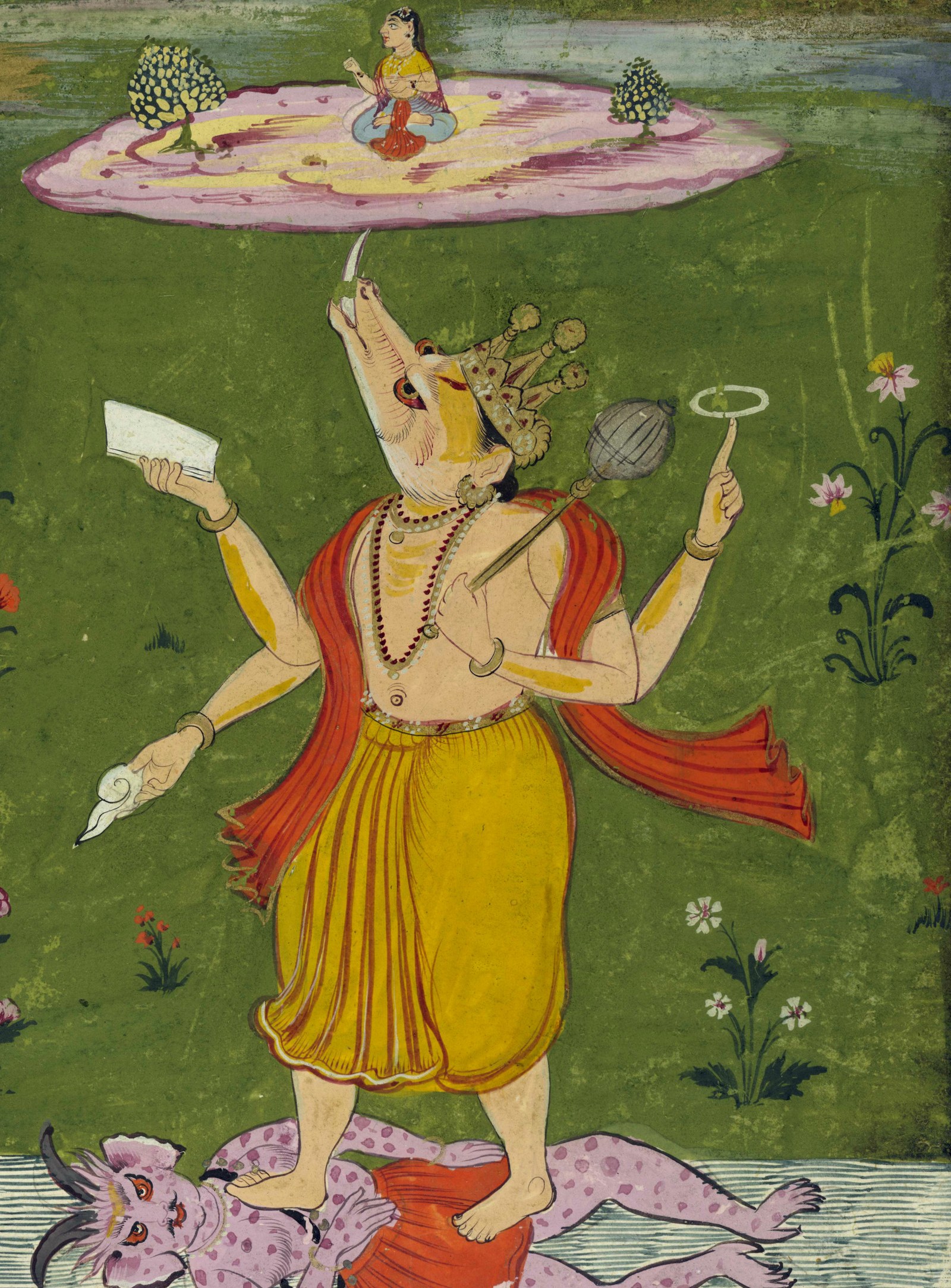
When the earth is submerged in the cosmic waters, Viṣṇu manifests as Varāha, the mighty boar, and raises her. The episode portrays preservation as the restoration of order when the world has become uninhabitable. Parallel Varāha accounts appear in several Purāṇas and differ in combat details, theology, and the personification of Earth as Bhūdevī.
Dhruva’s Devotion
The young prince Dhruva, wounded by rejection, seeks a position no one can take away. Guided toward worship of Viṣṇu, he undertakes disciplined meditation. Divine encounter transforms his original ambition, and he becomes associated with the steadfast pole star. His story teaches perseverance, the redirection of desire, and a stability grounded in the divine rather than status.
Prahlāda and the Presence of Viṣṇu
Prahlāda remains devoted despite Hiraṇyakaśipu’s hostility. Viṣṇu’s presence cannot be confined by the tyrant’s categories. The Narasiṃha manifestation breaks the apparent protections of the boon and restores moral order. Prahlāda’s lack of hatred is as important as his survival: devotion does not require becoming cruel toward one’s persecutor.
Pṛthu and Responsible Kingship
King Pṛthu’s relationship with the Earth explores governance, nourishment, and reciprocal responsibility. The earth yields her resources when properly protected and ordered, not when exploited without restraint. Later readers often find ecological resonance here, though a modern environmental interpretation should be identified as interpretation rather than quoted as the text’s own terminology.
Krishna in the Fifth Aṃśa
The fifth book recounts Krishna’s birth under Kaṃsa’s threat, life among the cowherds, defeat of dangerous beings, lifting of Govardhana, departure for Mathurā, defeat of Kaṃsa, and later life connected with Dvārakā. Compared with the Bhagavata Purana, the narrative is often more concise and genealogically integrated. The two texts should be compared rather than blended into one chapter sequence.
Cosmology, Time, and Sacred Geography
The Vishnu Purana describes recurring creation, vast units of time, Manus and their ages, continents and oceans, heavenly realms, planetary movement, and the relation of the body, world, and cosmic person. These descriptions express a sacred universe ordered through rhythm and correspondence. They should be studied historically and theologically rather than forced into one-to-one identity with modern astronomy or geography.
Theology, Bhakti, and Liberation
Viṣṇu is both immanent and transcendent: present as the inner self and cosmic order while exceeding the manifested universe. Creation and dissolution do not diminish the Supreme. Bhakti, right action, knowledge, meditation, and detachment are connected rather than isolated. The final goal is freedom from ignorance and repeated birth through realization of the highest reality.
The text’s discussion of Kali Yuga is frequently quoted selectively. Its purpose is not merely to predict social decline, but to expose impermanence and direct attention toward accessible spiritual practice. Fear-based claims assigning every modern event to one verse should be checked against the Sanskrit context and edition.
Mantras
Oṃ Namo Nārāyaṇāya — ॐ नमो नारायणाय
Traditional use: reverence and surrender to Nārāyaṇa, devotional remembrance, and steadying attention on Viṣṇu.
Oṃ Namo Bhagavate Vāsudevāya — ॐ नमो भगवते वासुदेवाय
Traditional use: devotion to Vāsudeva/Krishna, contemplation of the indwelling Lord, and prayer for spiritual clarity.
Śāntākāraṃ Bhujagaśayanaṃ Padmanābhaṃ Sureśam
Traditional use: a widely recited meditation verse praising Viṣṇu’s peaceful form and seeking freedom from fear. It is relevant devotional practice but should not be falsely assigned to a specific Vishnu Purana chapter without edition evidence.
How to Read the Vishnu Purana Responsibly
- Identify the edition before quoting chapter and verse numbers.
- Distinguish traditional sacred history from modern historical reconstruction.
- Compare Krishna and Varāha narratives with parallel Purāṇas instead of merging their details.
- Read genealogy as theological and cultural memory, not a complete modern chronological database.
- Treat social and ritual prescriptions in historical context.
- Separate modern symbolic or ecological interpretation from the words of the Sanskrit text.
Common Questions
Is the Vishnu Purana the same as the Bhagavata Purana?
No. Both are Vaiṣṇava Mahāpurāṇas and share narratives, but they are distinct works with different structures, emphases, and styles.
Does it contain the complete story of every Vishnu avatar?
No single Purāṇa supplies every later detail. Avatar traditions developed across the epics, several Purāṇas, regional texts, temple traditions, and commentaries.
Does it predict exact modern political events?
Claims of exact modern prediction often detach verses from context or rely on uncertain translations. The Kali Yuga passages are best read as religious teaching about decline, impermanence, and practice.
Continue exploring: Visit the Hindu Puranas guide for the conventional eighteen Mahapuranas and related illustrated guides.
Sources and Further Reading
Source note: The guide has only one external link while making claims about the received six-aṃśa structure, Parāśara-Maitreya frame, cosmology, dynasties, Krishna, Kali Yuga, dating, and traditional versus extant verse totals.
- H. H. Wilson (trans.), The Vishnu Purana (1895 digitized edition) — Supports direct edition-level checks of the Parāśara-Maitreya dialogue, six-book organization, creation and Varāha, Dhruva and Prahlāda, sacred geography, time cycles, genealogies, Krishna's narrative, Kali Yuga, dissolution, and liberation.
- Viṣṇu Purāṇa Sanskrit e-text (GRETIL, University of Göttingen) — Supports Sanskrit-text verification of the six-aṃśa structure and the principal narrative, cosmological, genealogical, devotional, and liberation materials represented in the received text.
- Ludo Rocher, The Purāṇas (1986) — Supports cautions about the Vishnu Purana's formation and dating, traditional attribution, textual transmission, manuscript and edition differences, and the mismatch between traditional verse totals and shorter extant printed texts.
Editorial statement: This is an educational, recension-aware overview rather than a complete translation. Narrative details are independently paraphrased.
Explore More Purana Guides
Continue your study of the eighteen Mahapuranas with these related guides on HinduClarity.
- Hindu Puranas: Guide to the 18 Mahapuranas — the complete overview and index.
- Bhagavata Purana
- Garuda Purana
- Varaha Purana
- Matsya Purana
- Padma Purana