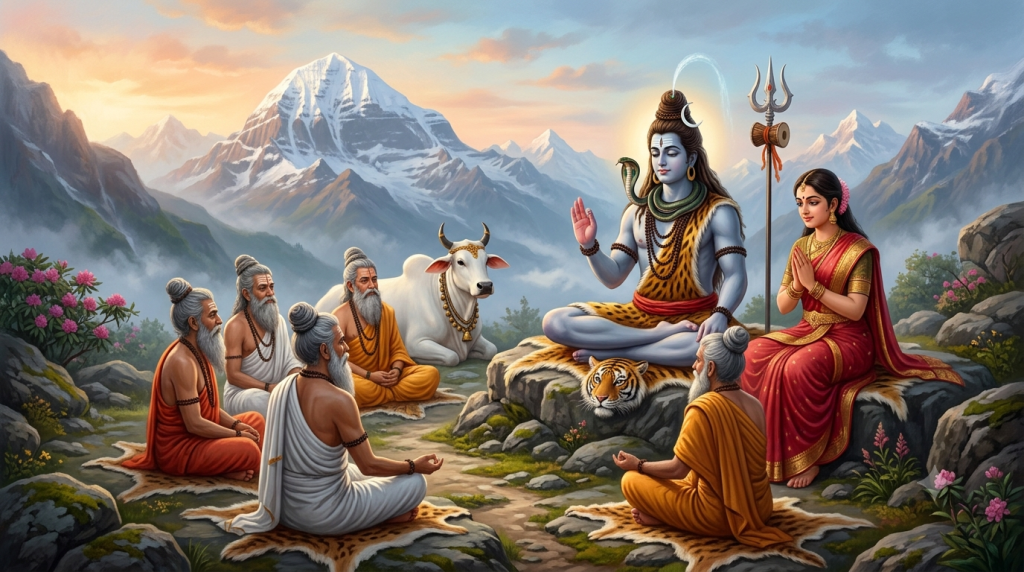
The Shiva Purana (Śiva Purāṇa) is one of the major Sanskrit Purāṇas associated with Shaivism. Framed as sacred teaching passed through sages, it presents Lord Shiva not only as a deity within the cosmos but as the supreme reality from which creation, preservation, dissolution, concealment, and liberating grace arise. Its stories include the infinite pillar of light, Satī and Dakṣa’s sacrifice, Pārvatī’s tapas, the birth of Skanda, Tripura’s destruction, the descent of the Gaṅgā, and the appearance and worship of important liṅgas. Alongside narrative, the text teaches devotion, ethics, yoga, pilgrimage, ritual, mantra, and liberating knowledge.
Textual note: There is no single manuscript whose contents represent every Shiva Purana in circulation. The work grew through transmission and revision, and surviving recensions differ in organization, chapter count, and some material. This guide follows the widely translated seven-Saṃhitā recension while identifying major differences rather than blending every version into a falsely uniform text.
What Is the Shiva Purana?
The word Purāṇa means an ancient account or lore. Purāṇic works commonly combine cosmology, genealogies, sacred geography, ritual instruction, theology, ethics, and stories told through nested conversations. The Shiva Purana belongs to this living literary world. It is strongly Shiva-centered, yet it also honors Pārvatī/Śakti, Viṣṇu, Brahmā, Gaṇeśa, Skanda, and many other divine beings. Its central vision is not simple rivalry among gods: the narratives repeatedly use divine forms and relationships to explore the one sacred reality, the power of devotion, and the removal of spiritual ignorance.
The text describes itself as an abridgment of a much larger revelation. Traditional accounts speak of an original 100,000 verses in twelve Saṃhitās, condensed under Vyāsa’s authority. This is a theological account of transmission, not a modern publication history. The manuscripts that survive are much shorter and differ substantially.
Date, Growth, and Recensions
The Shiva Purana does not have a single securely known human author or date. Purāṇas were transmitted, expanded, reorganized, and localized over centuries. Scholars therefore date layers rather than imagining one moment of composition. Published scholarship commonly places much of the extant Shiva Purana in the medieval period, with some surviving material probably taking shape around the early second millennium CE and other passages added or revised later. Such estimates are provisional and concern the manuscripts available to scholars, not the antiquity of every tradition preserved in them.
Three broad manuscript organizations are often discussed:
- A seven-Saṃhitā recension, used in the well-known English translation edited by J. L. Shastri: Vidyeśvara, Rudra, Śatarudra, Koṭirudra, Umā, Kailāsa, and Vāyavīya. Its printed arrangement contains 457 chapters.
- A six-Saṃhitā recension: Jñāna, Vidyeśvara, Kailāsa, Sanatkumāra, Vāyavīya, and Dharma, with a printed arrangement of 290 chapters.
- A two-part recension organized as Pūrva-khaṇḍa and Uttara-khaṇḍa.
The seven-book recension itself divides the Rudra Saṃhitā into five narrative sections: Creation, Satī, Pārvatī, Kumāra, and Battle. Verse totals are especially unstable across claims, manuscripts, and counting methods, so this article does not present one modern verse count as universal.
The Seven Saṃhitās at a Glance
| Saṃhitā | Main emphasis in the seven-book recension |
|---|---|
| Vidyeśvara | The greatness of the Purana; forms of worship; the liṅga; sacred observance; devotion and religious foundations. |
| Rudra | The largest narrative unit: creation; Satī and Dakṣa; Pārvatī’s birth and tapas; Shiva’s marriage; Skanda; Gaṇeśa; battles and divine interventions. |
| Śatarudra | Many forms and manifestations of Rudra-Shiva, devotional teaching, and the presence of Shiva through diverse sacred forms. |
| Koṭirudra | Liṅga worship, sacred sites, vows, and celebrated manifestations often associated with jyotirliṅga traditions. |
| Umā | Instruction associated with Umā/Pārvatī; cosmology, ethics, the body, after-death consequences, generosity, vows, and spiritual discipline. |
| Kailāsa | Renunciation, initiation, Praṇava (Oṃ), contemplative worship, knowledge, and liberation. |
| Vāyavīya | A broad theological and philosophical conclusion presented through Vāyu’s teaching, including cosmology, Pāśupata themes, yoga, devotion, and liberating knowledge. |
The Great Narratives
The Infinite Pillar of Light
One of the text’s defining stories presents a dispute between Brahmā and Viṣṇu over supremacy. An immeasurable column of fire appears. Viṣṇu descends in boar form to seek its base, while Brahmā rises in swan form to find its summit. Neither can reach the limit. The fiery axis reveals Shiva’s unbounded reality. The narrative explains why the liṅga can signify the formless made approachable in worship: not merely a crafted object, but a symbol of the beginningless and endless divine presence. Versions and details of this myth also appear in other Shaiva sources, especially the Liṅga Purana.

Satī, Dakṣa, and the Sacrifice
Satī, daughter of Dakṣa, chooses Shiva as her husband. Dakṣa’s pride and hostility toward Shiva culminate in a sacrifice to which the couple is not properly invited. Satī attends despite Shiva’s warning and is devastated by the insult directed at her lord. Through yogic power she gives up the body born from Dakṣa. Shiva’s grief and righteous fury lead to the manifestation of Vīrabhadra and the disruption of the sacrifice. Dakṣa is ultimately restored, chastened rather than eternally condemned. The cycle teaches the danger of arrogance, the sanctity of sincere devotion, and the cost of treating outward ritual as superior to reverence and humility.
Pārvatī’s Tapas and the Divine Marriage
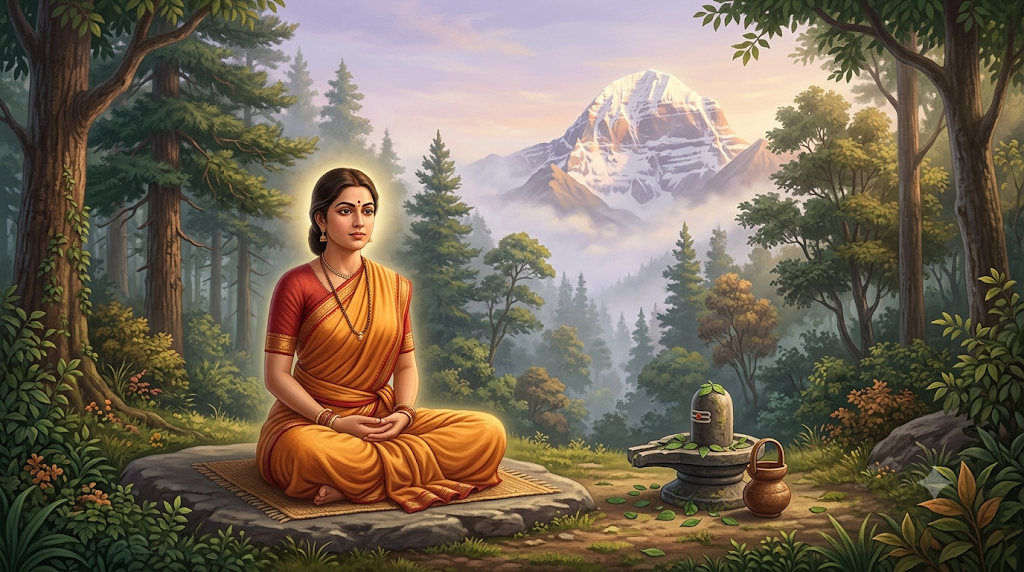
Satī is reborn as Pārvatī, daughter of Himālaya and Menā. The gods need a son of Shiva capable of overcoming the asura Tāraka, but Shiva remains absorbed in meditation. Kāma attempts to awaken desire and is burned by Shiva’s third eye; later traditions emphasize his restoration in bodiless form. Pārvatī does not win Shiva through attraction alone. She undertakes severe tapas, demonstrates unwavering devotion, and recognizes the ascetic who tests her resolve in disguise. Their marriage joins ascetic consciousness and creative power—Shiva and Śakti—without reducing either partner to a mere accessory of the other.
Skanda and the Defeat of Tāraka
The divine power associated with Shiva’s seed is too intense for ordinary containment and passes through a chain of cosmic bearers often involving Agni, Gaṅgā, and the Kṛttikās. Skanda—also called Kārttikeya, Kumāra, Guha, and Ṣaṇmukha—emerges as commander of the gods and defeats Tārakāsura. Details vary among Purāṇas and regional traditions. The Shiva Purana’s version belongs to a wider network of Skanda narratives rather than being the only authoritative telling.
Gaṇeśa: Birth, Conflict, and Restoration
Pārvatī creates a guardian who obeys her command not to admit anyone while she bathes. The boy, not yet knowing Shiva, blocks him. Conflict escalates and the guardian is beheaded. Pārvatī’s grief and power compel restoration; an elephant’s head is joined to the body, and the child is honored as Gaṇeśa, leader of Shiva’s hosts and a deity worshipped before auspicious undertakings. The episode is theologically rich: it affirms Pārvatī’s independent creative power, the seriousness of duty, the transformation of conflict through grace, and Gaṇeśa’s place at the threshold between obstacle and blessing.
Tripura and the One Arrow
Three fortified cities belonging to powerful asuras can be destroyed only when they align. The gods combine their powers into a cosmic chariot and weapon, but Shiva is the one who releases the decisive arrow. The story is not only a battle tale. Shaiva interpretation often reads the three cities as layers of bondage—such as impurity, karma, and māyā, or the physical, subtle, and causal conditions—that are overcome when divine knowledge pierces them together. The precise allegory belongs to later interpretation unless a passage explicitly states it.
The Descent of Gaṅgā
When the celestial Gaṅgā descends with overwhelming force, Shiva receives the river in his matted locks and releases her in a manageable flow. This protects the earth and permits the sacred river to fulfill her purifying mission. The account links Shiva with compassion, sacred geography, pilgrimage, and the controlled descent of transformative power. The wider Bhagiratha story is told with important variations across the Rāmāyaṇa and several Purāṇas.
Liṅga, Jyotirliṅgas, and Sacred Geography
In the Shiva Purana, the liṅga is a central focus of worship and theology. It may be approached as a visible emblem of the invisible, limitless Shiva. Worship commonly includes bathing the liṅga, offering water, milk according to local practice, bilva leaves, flowers, incense, light, and mantra. The text praises devotional intention while also preserving detailed ritual prescriptions intended for particular religious contexts.
The Koṭirudra Saṃhitā is an important source for the celebrated twelve jyotirliṅga tradition. Lists, spellings, site identifications, and narrative details may differ across texts and local traditions. The often-recited list names Somnāth, Mallikārjuna, Mahākāla, Oṃkāreśvara, Kedāra, Bhīmaśaṅkara, Viśveśvara, Tryambakeśvara, Vaidyanātha, Nāgeśa, Rāmeśvara, and Ghuśmeśvara. Competing identifications for some sites should be treated as living traditions, not dismissed by pretending that one modern map resolves every manuscript and regional claim.
Theology: Shiva and Śakti
The text moves between personal devotion and nondual insight. Shiva is praised with attributes—as compassionate lord, yogi, householder, teacher, and destroyer of bondage—and also as the attributeless reality beyond speech and conceptual form. Śakti is not external to Shiva; consciousness and power are mutually inseparable. Creation unfolds through this unity, while liberation comes through recognizing the deepest Self and receiving divine grace.
The Shiva Purana does not teach only one technique. It integrates bhakti (devotion), jñāna (knowledge), yoga, righteous action, worship, mantra, pilgrimage, generosity, and guidance from a qualified teacher. Different passages address householders, ritual practitioners, devotees, yogins, and renouncers. Modern readers should therefore resist extracting one verse as though it cancels the text’s broader, layered path.
Ethics, Yoga, and Liberation
- Humility over status: Dakṣa’s sacrifice shows that ritual prestige without reverence can become spiritually empty.
- Steadfast devotion: Pārvatī’s tapas represents disciplined intention, not passive waiting.
- Self-control: Shiva’s mastery of desire and anger models power governed by awareness.
- Compassion and restoration: Dakṣa and Gaṇeśa are restored after catastrophe; divine justice is not portrayed only as destruction.
- Seeing unity: philosophical sections treat divisive perception as ignorance and connect knowledge of the Self with freedom.
- Grace and practice together: worship and yoga prepare the practitioner, while Shiva’s grace removes bondage.
Mantras
Oṃ Namaḥ Śivāya — ॐ नमः शिवाय
Meaning: “Oṃ, reverence to Shiva.” This five-syllabled formula after Oṃ is one of the central Shaiva mantras. Traditional use: remembrance of Shiva, devotional japa, mental purification, and steadying the mind. Formal initiation and lineage-specific pronunciation may be taught by a guru, while simple reverent repetition is widespread.
Mahāmṛtyuñjaya Mantra — Rigveda 7.59.12
ॐ त्र्यम्बकं यजामहे सुगन्धिं पुष्टिवर्धनम् ।
उर्वारुकमिव बन्धनान्मृत्योर्मुक्षीय मामृतात् ॥
Transliteration: Oṃ tryambakaṃ yajāmahe sugandhiṃ puṣṭivardhanam; urvārukam iva bandhanān mṛtyor mukṣīya mā’mṛtāt.
Traditional use: prayer for healing, protection, freedom from the fear and bonds of death, and orientation toward immortality. It should not be presented as a guaranteed medical cure.
Oṃ Tatpuruṣāya Vidmahe Mahādevāya Dhīmahi Tanno Rudraḥ Prachodayāt
Traditional use: a Shiva Gāyatrī form used to contemplate Mahādeva and pray that Rudra illumine the understanding. Wording varies across transmitted liturgical sources; practitioners should follow their family or lineage tradition where applicable.
How to Read the Shiva Purana Responsibly
- Identify the edition. Chapter numbers from one recension may not match another.
- Distinguish text from interpretation. A modern symbolic reading can be valuable without being falsely attributed to every Sanskrit verse.
- Compare parallel accounts. Satī, Skanda, Gaṇeśa, Gaṅgā, and Tripura appear in multiple texts with meaningful differences.
- Read prescriptions in context. Medieval ritual, social, medical, or cosmological passages are historical religious literature, not automatic substitutes for present-day law, medicine, or science.
- Respect living traditions. Regional temple identifications and devotional retellings may preserve community authority even when manuscripts disagree.
Common Questions
Is the Shiva Purana the same as the Vāyu Purana?
No. Older cataloging and scholarly debate sometimes connected or confused the titles, but modern scholarship generally treats the extant Shiva Purana and Vāyu Purana as distinct works.
Does it contain exactly 24,000 verses?
Traditional and printed claims vary, while surviving recensions differ. It is more accurate to name the edition and manuscript organization than to state one count as a fact about every Shiva Purana.
Is every popular Shiva story found here?
No. Hindu narrative tradition is distributed across Vedas, epics, Purāṇas, Āgamas, regional texts, temple traditions, oral teaching, and later devotional literature. A familiar retelling may combine several sources.
Continue exploring: Visit the Hindu Puranas guide for the conventional eighteen Mahapuranas and related illustrated guides.
Sources and Further Reading
Source note: The guide has only one external link while presenting a seven-Saṃhitā structure, alternate recensions, major narratives, theology, ritual and mantra claims that require edition-specific primary and specialist support.
- J. L. Shastri (ed.), The Śiva Purāṇa, Part 1, Ancient Indian Tradition and Mythology — Supports direct checks of the seven-Saṃhitā printed recension's opening material, Vidyeśvara and early Rudra sections, liṅga theology and worship, the fiery-column narrative, creation, Satī/Dakṣa, and Pārvatī narratives.
- J. L. Shastri (ed.), The Śiva Purāṇa, Part 2, Ancient Indian Tradition and Mythology — Supports direct checks of later Rudra-saṃhitā narrative material in the named seven-Saṃhitā edition, including Kumāra/Skanda, Gaṇeśa, battles, and related Shaiva teaching.
- Ludo Rocher, The Purāṇas (1986) — Supports the article's distinction among the seven-Saṃhitā, six-Saṃhitā, and two-part organizations and its cautions about composition, medieval textual growth, chapter counts, traditional verse claims, and recension-specific structure.
Editorial statement: This page is an educational overview, not a complete translation or a replacement for study with a qualified teacher. Sanskrit names are given in familiar English forms with selected scholarly transliteration. Narrative details are paraphrased to avoid copying modern translations.
Explore More Purana Guides
Continue your study of the eighteen Mahapuranas with these related guides on HinduClarity.
- Hindu Puranas: Guide to the 18 Mahapuranas — the complete overview and index.
- Linga Purana
- Skanda Purana
- Kurma Purana
- Markandeya Purana
- Brahmanda Purana