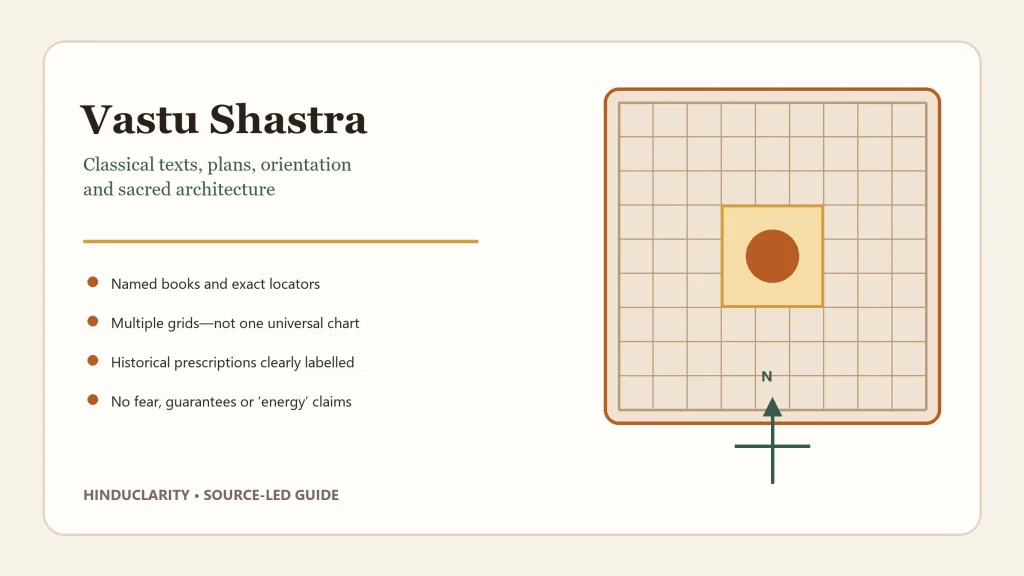
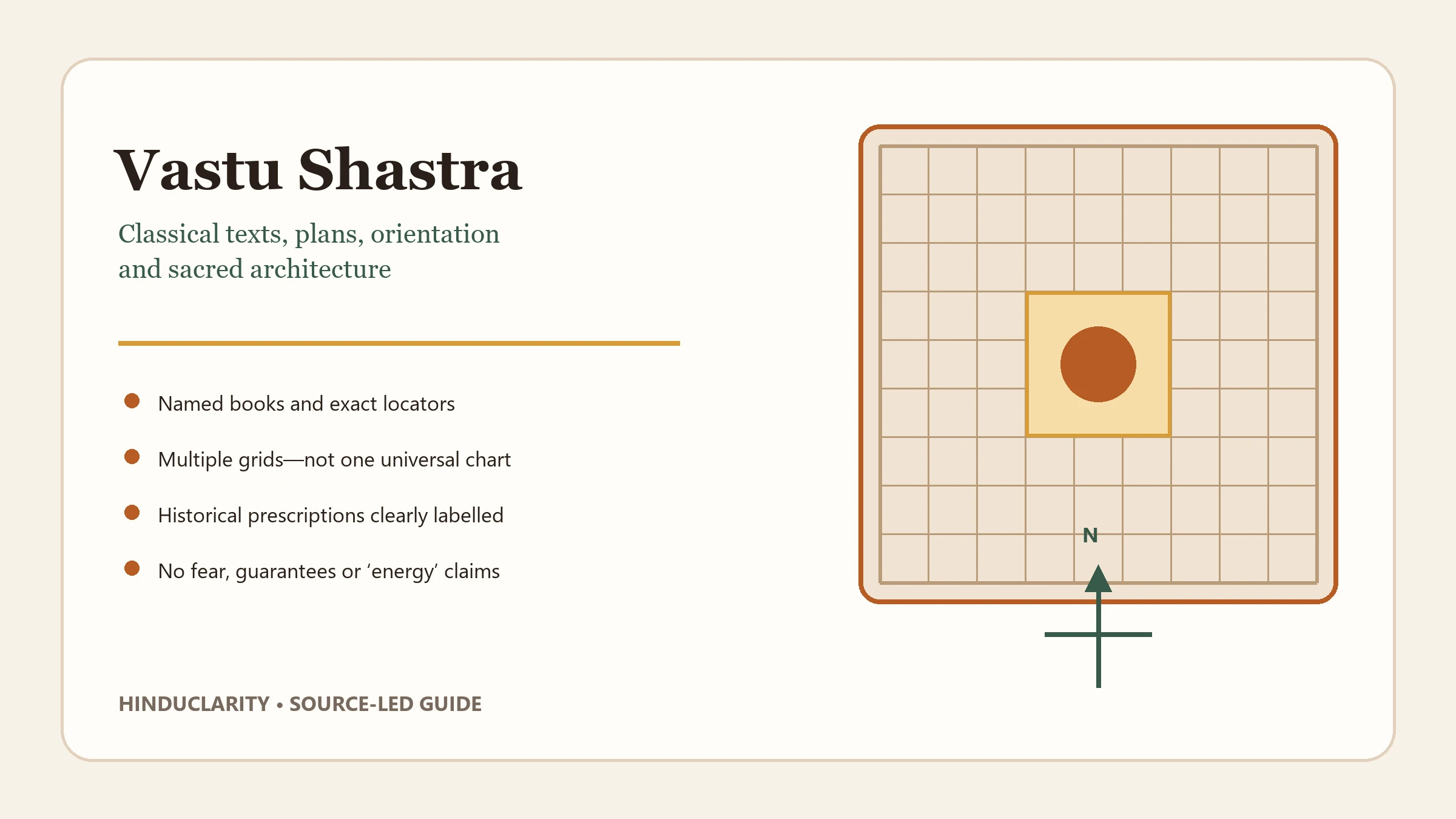
Vāstu Śāstra refers to a collection of traditional Indian architectural treatises that provide guidelines for site selection, orientation, material choice, and the spatial organization of buildings. Rather than a single, uniform manual, it is an umbrella term encompassing various regional traditions, Puranic chapters, and technical manuals that address both residential and sacred structures Mayamata (Dagens), Mānasāra (Acharya), Samarāṅgaṇa Sūtradhāra, Bṛhat Saṃhitā, Chapter 53, Matsya Purāṇa, architectural chapters.
What Vāstu Śāstra means
Vāstu can refer to a site, dwelling, or built environment, while śāstra denotes an authoritative treatise or disciplined body of teaching. In this section, “Vāstu Śāstra” is an umbrella label for a bounded group of architectural texts rather than the title of one universal scripture. The Mayamata (Dagens) and Mānasāra (Acharya), for example, are distinct works with their own scopes and textual histories.
The verified corpus includes dedicated architectural treatises, an architectural chapter within the Bṛhat Saṃhitā, Chapter 53, and architectural chapters in the Matsya Purāṇa, architectural chapters. Their genres, building contexts, grid systems, and social assumptions differ. A claim about a door, soil test, or planning grid must therefore identify the work and passage that supplies it.
These works are prescriptive: they record how a particular textual tradition says a site or building should be organized. That does not by itself prove how every historical house or temple was actually built. HinduClarity distinguishes textual prescription from archaeological, architectural, and social history.
The classical source families
To understand this bounded Vastu corpus, each primary work must be considered separately. Genre, date, scope, and evidence status are stated work by work rather than converted into a single composition history.
Bruno Dagens’s 1994 edition associates the Mayamata with South Indian Śaiva architectural traditions. The verified chapter map lists classification in Chapter II, sites and soil in III–V, gnomon orientation in VI, grids in VII, and houses in XXVII. This is not claim-level verification: the accessible scan’s font-mapped OCR is unusable, so exact rules or quotations require inspection of the printed page images.
The Mānasāra is a broad Sanskrit śilpa and Vastu compendium. Its compilation date and textual layering are debated; an uncertain, probably medieval compilation is the cautious description used here. Acharya’s 1934 English edition, contents pp. ix–xi, maps material from architects and measures through sites, soil, orientation, plans, settlements, houses, palaces, building components, and images. His conjectures and the text’s discriminatory social hierarchy require disclosure.
In the checked 1946 translation by V. Subrahmanya Sastri and M. Ramakrishna Bhat, Bṛhat Saṃhitā 53.4–17 and 42–56 treats status-specific house dimensions and both 81- and 64-square plans. It belongs to a sixth-century Sanskrit jyotiṣa and encyclopedic compendium, not an all-purpose domestic manual. The 1946 witness is distinct from M. Ramakrishna Bhat’s 1981–1982 translation.
The Matsya Purāṇa, architectural chapters preserves Puranic material on Vastu narratives, teachers, sites, grids, house forms, doors, and temples in Chapters 252–258. The accessible 1917 English translation is dated and unstable, so it is used for bounded comparison rather than direct quotation or deterministic outcome advice.
The Samarāṅgaṇa Sūtradhāra is an eleventh-century Sanskrit royal architectural work attributed to King Bhoja. It is important evidence for the breadth of the corpus, but the verified scan is Sanskrit and no dependable complete English translation was established; detailed rules from it remain on hold.
What the texts actually cover
The primary texts of Vāstu Śāstra focus on several core areas: site selection, orientation, grid systems, and building components. They are source-specific prescriptions that may combine measurement, ritual, status, and omen assumptions.
Site selection includes historical observations and tests concerning land and soil in Acharya’s Mānasāra IV–V, pp. 13–19 and the dated 1917 translation of Matsya Purāṇa 253, pp. 292–295. The Mayamata chapter map assigns this topic to III–V, but exact prescriptions remain page-image pending. Orientation precedes planning in the Mānasāra sequence; Acharya’s Chapter VI.22–47, pp. 24–27, describes a gnomon and shadow-circle construction, while his notes question some numerical corrections.
Planning grids divide and symbolically order a site. The checked 1946 Sastri–Bhat Bṛhat Saṃhitā 53.42–50 describes an 81-square plan and 53.51–56 a 64-square alternative, while Acharya’s 1934 Mānasāra VII.2–50, pp. 33–42 preserves a larger sequence. These passages support geometry, allocation, and ritual meaning—not a measurable modern “energy field.” The 1946 OCR’s “465” deity reading at 53.42 is erroneous; 45 requires page-image, Sanskrit, and arithmetic checking.
The following table summarizes the primary focus areas across several key texts:
| Text | Primary Context | Key Prescriptions |
|---|---|---|
| Mayamata | South Indian tradition | Verified chapter map only: classification II, sites/soil III–V, orientation VI, grids VII, houses XXVII; exact rules remain page-image pending. |
| Mānasāra | Broad architectural compendium | Sites IV, soil tests V, orientation VI, plans VII, houses XXXVI, and doors XXXVIII–XXXIX. |
| Bṛhat Saṃhitā | 6th-century encyclopedic work | Status-specific house measurements at 53.4–17 and 81-/64-square plans at 53.42–56 in the checked 1946 Sastri–Bhat translation. |
| Matsya Purāṇa | Puranic transmission | Vastu narrative, teachers, sites, grids, house forms, doors, and temples in Chapters 252–258. |
Vāstu Puruṣa Mandala
The Vāstu Puruṣa Mandala is an important planning and ritual framework in several textual traditions. A square grid can coordinate measurement, deity allocation, orientation, and the symbolic ordering of a site, but the grid size and details vary by text and building context.
The verified passages do not support one universal Mandala chart. The checked 1946 Sastri–Bhat Bṛhat Saṃhitā 53.42–56 presents both 81- and 64-square plans, while Acharya’s 1934 Mānasāra VII.2–50 supplies a larger sequence. Stella Kramrisch discusses the Mandala chiefly in relation to temple sites and symbolism in The Hindu Temple, vol. 1, Part I; that temple-centered interpretation should not be converted automatically into a domestic room rule.
What Vastu does not prove
Because Vāstu Śāstra is a collection of ancient and medieval texts, it is important to distinguish between what the texts say and what they “prove” in a modern context.
The key distinction is between textual prescription and demonstrated historical or modern effect. The sources do not supply one universal rule set, do not prove that all historical buildings followed their prescriptions, and do not establish a measurable magnetic, quantum, or vibration mechanism. Some passages predict favourable or adverse outcomes; those statements are historical religious or omen language, not reliable modern causal evidence.
How to use this section
Start with the source guide, then use the focused pages on grids, orientation, sites, houses, entrances, and modern limits. Each guide distinguishes a named text’s prescription from broader tradition and from present-day professional requirements.
Frequently asked questions
Is Vāstu Śāstra a single book?
No. The label covers several architectural treatises, chapters in broader works, later manuals, and regional traditions. A reliable explanation names the particular source behind each rule.
Does the Vāstu Puruṣa Mandala describe an energy field?
The sources used here present grids for planning, deity allocation, and ritual meaning. They do not establish a measurable magnetic, quantum, or other physical energy mechanism.
Do classical Vastu texts replace modern building standards?
No. Their historical prescriptions do not replace structural engineering, fire safety, accessibility, sanitation, surveying, geotechnical review, or local law.
How do the Mayamata and Mānasāra differ?
They are distinct architectural works with different textual histories and scopes. Their prescriptions should be cited separately rather than merged into one universal chart.
Sources
- Mayamata Mayamata (Dagens) – Bruno Dagens, ed./trans., Mayamatam, 2 vols. (New Delhi: IGNCA and Motilal Banarsidass, 1994).
- Mānasāra Mānasāra (Acharya) – Prasanna Kumar Acharya, Architecture of Mānasāra: Translated from Original Sanskrit (London: Oxford University Press, 1934).
- Samarāṅgaṇa Sūtradhāra Samarāṅgaṇa Sūtradhāra – T. Ganapati Sastri, ed., Samarangana-sutradhara, Gaekwad’s Oriental Series (Baroda, 1924–1925).
- Bṛhat Saṃhitā — V. Subrahmanya Sastri and M. Ramakrishna Bhat, trans. (Bangalore, 1946), Chapter 53. This is the checked accessible witness used for the locators on this page; its English and OCR are dated. M. Ramakrishna Bhat’s 1981–1982 translation is the preferred modern edition but was not used here as the wording witness.
- Matsya Purāṇa Matsya Purāṇa, architectural chapters — The Matsya Puranam, Part II, Chapters 129–292, translated by “A Taluqdar of Oudh,” edited by B. D. Basu, Sacred Books of the Hindus XVII.II (Allahabad, 1917), especially Chapters 252–258. Basu is the editor, not the translator; the English is dated and unstable, so close quotation or positive rules require Sanskrit checking or a more dependable witness.
- Dagens introduction to Mayamata Dagens, Mayamata – Bruno Dagens, introduction and notes in Mayamatam vol.1 (1994).
- The Hindu Temple Kramrisch, The Hindu Temple – Stella Kramrisch, The Hindu Temple, 2 vols. (University of Calcutta, 1946; Motilal reprints).
- Vastu-Sastra vol. I Shukla, Vāstu-Śāstra – D. N. Shukla, Vastu-Sastra, vol.I: Hindu Science of Architecture (Lucknow, 1960/1961).
Explore the Vastu guides
Compare the classical sources, grids, orientation methods, sites, houses, entrances, and the limits of modern application.