The Vāstu Puruṣa Mandala is a geometric and symbolic grid that named architectural texts connect with site planning, deity allocation, embodiment, and ritual. The Mānasāra, Bṛhat Saṃhitā, and Matsya Purāṇa preserve distinct configurations and accounts. They do not establish a modern energy map or one universal room plan.
What the mandala is
In the sources reviewed here, the Vāstu Puruṣa Mandala links a site and plan with deity allocations, an embodied site-being, and ritual (Mānasāra VII; Bṛhat Saṃhitā 53.42–56; Matsya Purāṇa 253.19–48). It is a textual, symbolic, planning, and ritual framework—not evidence for a measurable force field or magnetic mechanism.
Acharya’s 1934 translation of Mānasāra VII enumerates a sequence of site-plan grids and deity allocations. The accessible 1946 English verifier of Bṛhat Saṃhitā 53.42–56 separately presents an 81-square plan, deity allocations, embodiment, and a 64-square alternative. These claims should remain source-specific rather than being merged into one universal program.
The deity allocations establish named positions within particular textual grids. The reviewed passages do not support invented examples such as storage zones, movement zones, rooms, or corridors, nor do they establish a modern functional program. Their supported roles are planning, deity mapping, embodiment, and ritual, with the details attributed to each work.
The 81-square plan
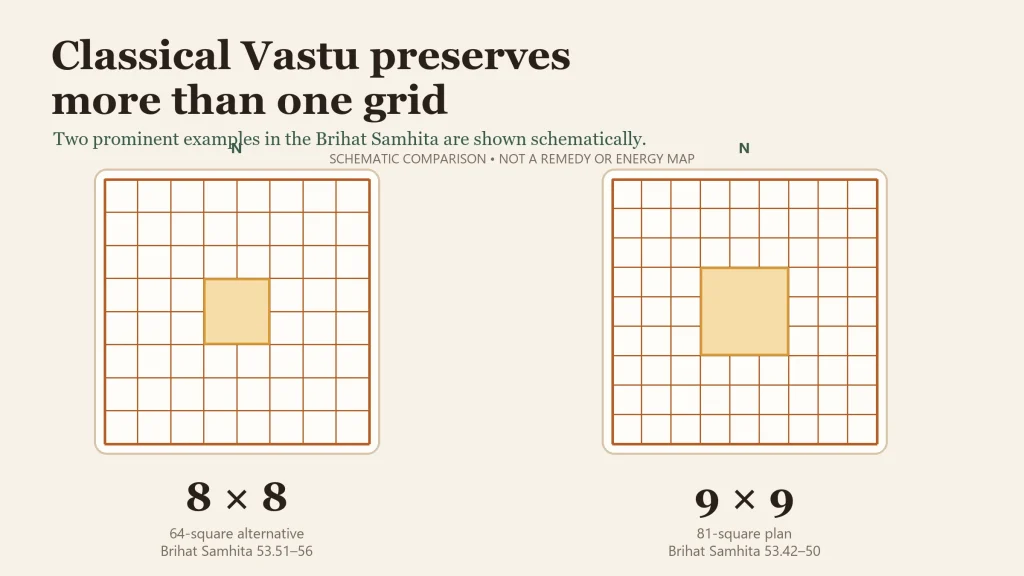
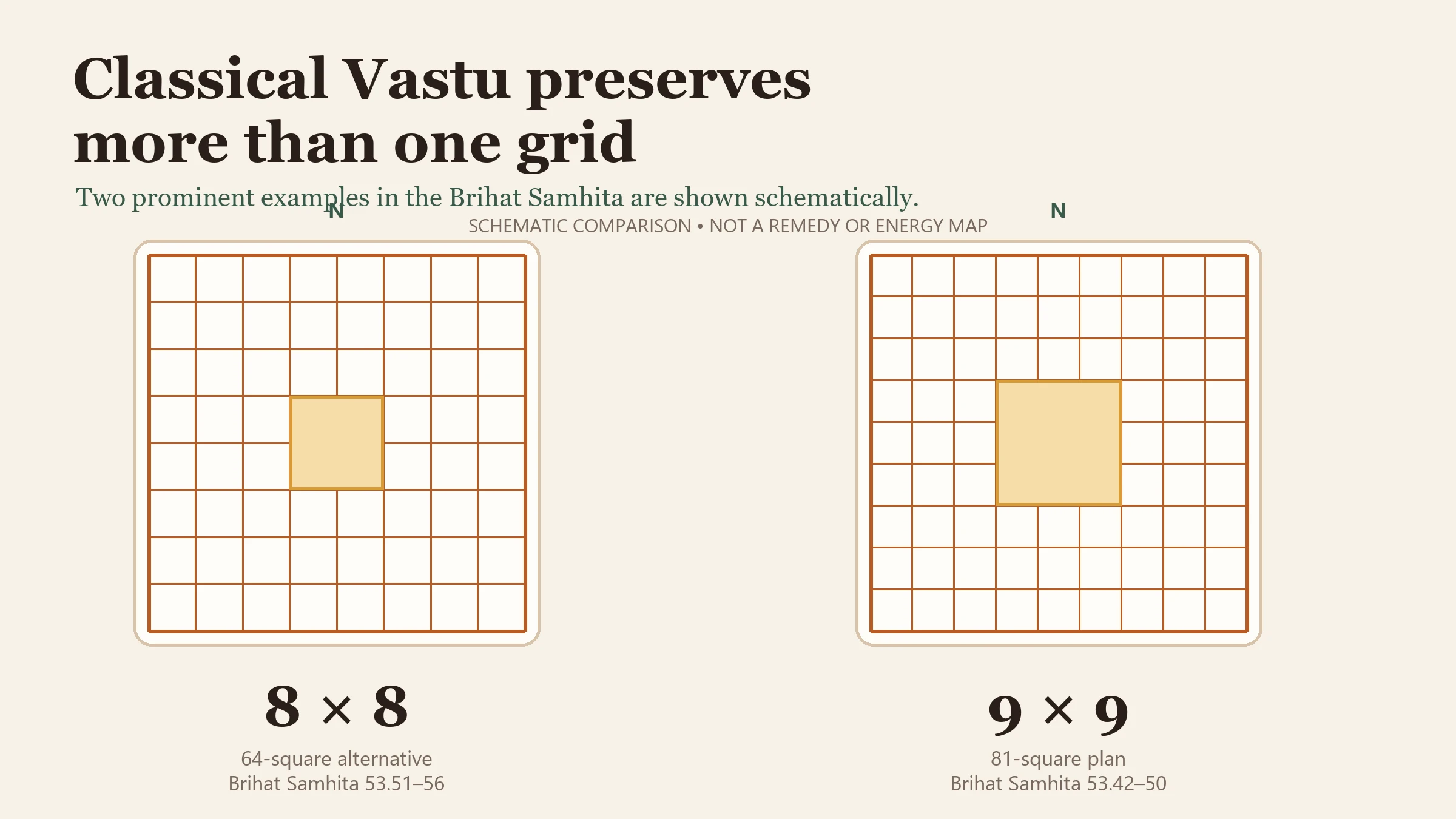
Bṛhat Saṃhitā 53.42–50 (pp. 434–436 in the 1946 verifier) preserves a 9 × 9, 81-square plan with 45 deities. The OCR layer reads “465” at 53.42; “45” follows the passage’s 13 + 32 count and must be confirmed against the scanned page image and Sanskrit before any direct quotation.
The dated 1917 translation of Matsya Purāṇa 253.19–48 (pp. 293–295) also preserves 81-pada deity material. In the chapter sequence, it follows timing and site-test prescriptions at 253.1–18. This Puranic witness and the Bṛhat Saṃhitā are distinct sources and should not be treated as one harmonized grid system.
The 9 × 9 count means eighty-one squares; it does not establish “nine primary directions,” room types, or corridor locations. In Bṛhat Saṃhitā 53.42–56, the supported claims are the plan, deity allocations, embodiment, and the adjacent 64-square alternative.
The 64-square alternative
The same chapter also preserves a 64-square, 8 × 8 alternative at 53.51–56 (pp. 437–438 in the 1946 verifier). The passage establishes both configurations but does not supply the structural requirements, architectural goals, or practitioner preferences that would select one over the other.
The bounded evidence supports one careful conclusion: Bṛhat Saṃhitā Chapter 53 preserves both configurations. It does not establish why a practitioner selected either plan or whether the plans competed in historical practice.
No selection rule between the 8 × 8 and 9 × 9 plans is supplied by the verified passage. Residential-versus-other-building use, structural criteria, and design preference should therefore not be inferred from their mere inclusion.
| Text and locator | Plan | Safe conclusion |
|---|---|---|
| Bṛhat Saṃhitā 53.42–50 | 81 squares (9 × 9) | One documented configuration with deity allocations. |
| Bṛhat Saṃhitā 53.51–56 | 64 squares (8 × 8) | An alternative in the same chapter. |
| Mānasāra VII.2–50 | A larger sequence of square plans | The corpus cannot be reduced to one universal grid. |
More than one grid
The evidence reviewed here is not limited to the 81- and 64-square plans. Acharya’s translation of Mānasāra VII.1–154 enumerates thirty-two named site-plan types and assigns deities in selected grids. One diagram therefore should not be presented as the only Vāstu mandala.
Acharya’s editorial notes to Mānasāra VII, pp. 36–37, report variant or reconstructed deity allocations while comparing the Mayamata, Śilparatna, and Samarāṅgaṇa Sūtradhāra. The notes also identify supplied or missing material. They do not prove that every difference reflects a regional school rather than transmission or editorial problems; a primary Sanskrit comparison remains pending.
The thirty-two named plan types in Mānasāra VII.1–154 show the breadth of that translated chapter. They do not prove actual historical use or prevalence. Any reproduced grid should identify its work, passage, edition, and reconstruction status.
The Vāstu Puruṣa narratives
Varāhamihira’s Bṛhat Saṃhitā 53.1–3 (pp. 421–422 in the 1946 verifier) narrates a restrained being who becomes the House-God or Vāstupuruṣa. The passage provides the chapter’s mythic account; it should not be expanded into an invented “nature to culture” symbolism or a physical-energy explanation.
The 1917 translation of Matsya Purāṇa 252.1–19 (pp. 291–292) gives a Vāstu Deva origin account and, at 252.2–4, enumerates eighteen traditional teachers of vāstuśāstra. This is a traditional enumeration, not evidence establishing historical authorship, dates, surviving works, or an unbroken lineage of practice.
These two narratives belong to distinct works and should remain separately attributed. They provide traditional mythic and teacher-list material; they do not demonstrate a scientific mechanism, historical transmission chain, or modern construction requirement.
What the diagram does not prove
It is essential to distinguish between the symbolic role of the Vāstu Puruṣa Mandala and modern interpretations of physics or “energy.” The mandala is a system for site, plan, deity placement, and ritual; it is not evidence of a measurable force field, vibration, radiation, or any other quantum or magnetic mechanism.
The presence of a grid does not provide scientific proof of the efficacy of a layout. While the Matsya Purāṇa includes soil tests and timing considerations (Matsya Purāṇa 253.1–18), these are presented as traditional prescriptions rather than modern geotechnical or agricultural predictions. Similarly, the narratives in the Bṛhat Saṃhitā regarding the “restrained being” are mythic frameworks, not physical-energy explanations.
The inclusion of deities within a grid is textual symbolic and ritual mapping. Some architectural passages in this literature do attach prosperity, illness, death, or family outcomes to choices, but such statements are historical prescriptive or omen rhetoric—not demonstrated causation. A schematic grid does not prove those outcomes and cannot replace modern building codes, fire safety, accessibility, or structural engineering.
Frequently asked questions
Which classical grid sizes are prominent in the Bṛhat Saṃhitā?
Chapter 53 describes an 81-square plan at verses 42–50 and a 64-square alternative at verses 51–56. Other texts preserve additional grids.
Does the mandala prove an energy or magnetic field?
No. The evidence supports planning, deity allocation, and ritual symbolism—not a measurable radiation, magnetic, quantum, or vibration mechanism.
Why do mandala diagrams differ?
Texts and editorial reconstructions preserve different grid sizes, deity allocations, and centre arrangements. A diagram should therefore identify its source, edition, and reconstruction status.
What do the Vāstu Puruṣa narratives explain?
They supply source-specific mythic and ritual accounts. They should not be recast as explanations of modern building physics or as proof of a historical transmission chain.
Sources
- Prasanna Kumar Acharya, trans., Architecture of Mānasāra: Translated from Original Sanskrit, Mānasāra Series 4 (London: Oxford University Press, 1934), Chapter VII, pp. 33–42 and editorial notes at pp. 36–37. The translation includes conjectural/supplied material; OCR is locational evidence, and direct quotations require a scan-image check.
- Varāhamihira, Bṛhat Saṃhitā, Chapter 53, accessible English verifier translated by V. Subrahmanya Sastri and M. Ramakrishna Bhat (Bangalore, 1946), 53.1–3 and 42–56, pp. 421–422 and 434–438. The preferred modern translation is M. Ramakrishna Bhat (Motilal Banarsidass, 1981–82), but its wording was not inspected here. At 53.42 the OCR reads “465”; the “45 deities” reading requires the page image, Sanskrit, and 13 + 32 context check before quotation.
- The Matsya Puranam, Part II, translated by “A Taluqdar of Oudh,” edited by B. D. Basu, Sacred Books of the Hindus XVII.II (Allahabad, 1917), 252.1–19 and 253.19–48, pp. 291–295. This dated, unstable translation is summarized cautiously and not quoted directly.
- Stella Kramrisch, The Hindu Temple, 2 vols. (University of Calcutta, 1946), vol. 1, Part I, “The Site.” This temple-focused study supplies interpretive context and is not a domestic rulebook.