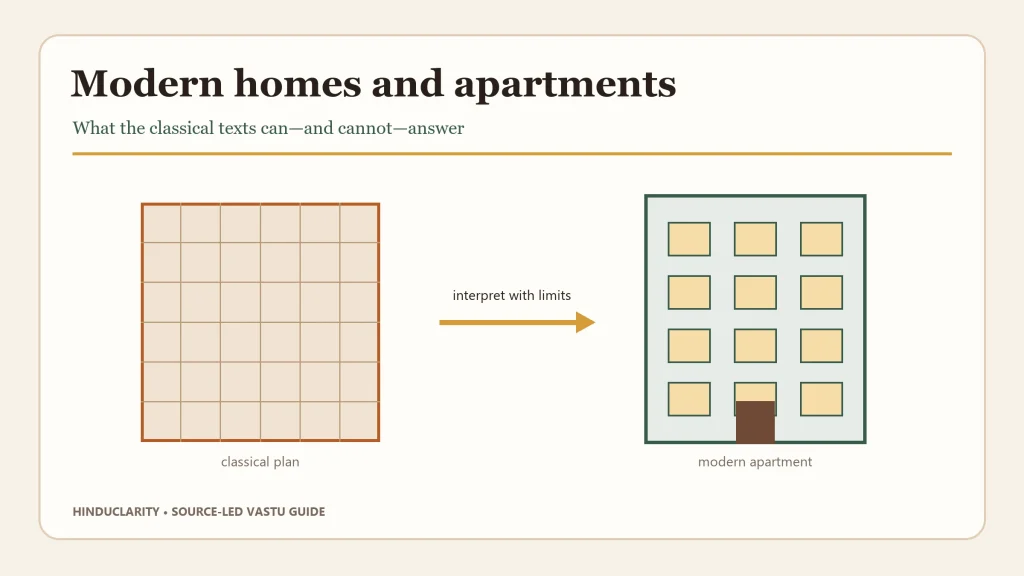
Classical Vastu texts can be studied to understand historical systems of house planning, orientation, grids and ritual, but the passages reviewed here do not supply a code for modern apartments. Do not convert their deity sectors, status rules or outcome predictions into personalized room, furniture, purchase or renovation advice. For a present home, law and professional safety decisions come first.
What ancient texts do not describe
The sources reviewed for this page address houses, sites, grids, dimensions, rooms, entrances and rites in premodern textual settings. No verified instruction in the inspected passages addresses high-rise fire stairs, lifts, shared plumbing, common ownership, strata or condominium rules, parking structures, modern electrical systems, reinforced frames, tenant alteration rights or contemporary accessibility requirements as such.
That is a bounded statement about the passages and editions reviewed here, not a claim that no Sanskrit architectural work could contain a remotely comparable feature. It means a consultant who gives an ancient textual verdict on a balcony, lift, shared corridor or tower is making a modern interpretation unless an exact, relevant witness is produced. Such an interpretation cannot displace current law, the building’s approved design or advice from responsible professionals.
A prescription is also not proof of practice. When Mānasāra XXXVI says a house or function should occupy a sector, it tells us what that chapter prescribes. It does not prove that all historical households complied, that one plan prevailed across regions, or that a modern flat inherits the same planning unit.
What can be studied responsibly
Mānasāra XXXVI.1–29 (pp. 398–399) can be studied as a historical dwelling-house scheme. It introduces residences in settlements including villages, cities, trading centres and hermitages, marks an 81-plot plan, and assigns houses or functions to named plots and quarters. The same section explicitly ranks occupants through caste/status categories. That discriminatory premodern hierarchy must be visible in an accurate account and must not be recommended for present planning.
One useful textual counterexample concerns simplified modern slogans. Mānasāra XXXVI.26 places kitchens in the north, northeast or a named Parjanya sector. This shows only that “the kitchen must always be southeast” is not a universal rule of this particular witness. It does not turn north or northeast into HinduClarity’s recommendation, and the named sector should not be casually converted into a compass point without the chapter VII grid.
The chapter also assigns wells and dining places in XXXVI.27–28 and main doors through named deity sectors with an occupant-specific exception in XXXVI.66–68. These are evidence of a grid-dependent and socially differentiated textual system, not modern plumbing, health, fire-egress or entrance advice. They should remain objects of historical study.
Matsya Purāṇa 256.33–34, in the dated 1917 English translation, does not align neatly with every Mānasāra room placement. Because its syntax is unstable, this comparison supports only the narrow conclusion that the inspected witnesses vary; it does not support a new positive room rule.
What Mānasāra XXXVI.84–86 actually supports
Acharya’s translation says that a distinction between larger and subordinate houses relates to building cost and that, otherwise, the main building may depend on the master’s liking (XXXVI.84–86, p. 403). That is a narrow alternative within the chapter’s own house scheme. It does not describe apartments, furniture zoning, rental constraints or a general doctrine that any modern arrangement becomes textually compliant.
Likewise, “patron preference” should not become a remedy or adaptation rule. The passage can show that this chapter contains an alternative and a role for choice; it cannot authorize moving a sofa, defining an apartment “zone,” or selecting a high-rise unit in the name of the ancient text. Those applications would require independent modern reasoning and should be presented simply as ordinary design choices, not textual Vastu.
New build and existing apartment: the same priority boundary
Whether someone is commissioning a house or living in an existing flat, the classical prescriptions remain historical study. A new-build owner should not use Mānasāra deity sectors as instructions for a present floor plan. An apartment resident should not be told that furniture can correct a plan because XXXVI contains alternatives. Neither application is established by the cited passage.
The practical difference is legal and professional, not scriptural. A new build generally involves planning consent, site evidence, design coordination and code compliance. An existing unit has an approved structure, ownership or tenancy restrictions and building-wide systems that an occupant may not alter. In either case, a qualified local architect or engineer and the responsible authority or building management must determine what is lawful and safe.
Do not panic or demolish
Historical texts do contain severe outcome rhetoric. Mānasāra passages attach prosperity, loss, destruction or other adverse outcomes to site and orientation choices. The older Bṛhat Saṃhitā house-building witness includes predictions involving wealth, disease, death and family destruction in its entrance material. These claims should not be erased or softened into a false statement that the literature never linked architecture with life outcomes.
They also are not demonstrated modern causation. A room, doorway or orientation does not become evidence that a resident caused illness, bereavement, debt or conflict. Historical omen language must not be used for fear, victim-blaming, purchase pressure, paid-remedy sales or demands to demolish or structurally alter a home. Physical danger is established through present evidence and competent inspection, not through a predicted outcome in a historical text.
Before paying for a cure, ask for the exact work, edition and passage and then ask what modern evidence establishes efficacy. In the Mānasāra XXXVI, Bṛhat Saṃhitā house-building and Matsya Purāṇa 252–257 passages and editions reviewed for this page, no verified support was found for claims that commercial crystals, pyramids, colours or movable products can neutralize a modern apartment “defect” or change health, wealth or success. This is a bounded source-review result, not a claim about every Vastu corpus or later practice.
Keep textual findings separate from modern applications
The responsible use of these passages is descriptive: identify the named work; give the chapter and edition; state the prescription; expose status, ritual and omen assumptions; and note variation. The irresponsible move is to harmonize selected verses into one universal compass chart and sell that chart as a diagnosis for every household.
| Modern claim | What the reviewed source supports | Limit |
|---|---|---|
| Every kitchen must be southeast | Mānasāra XXXVI.26 is a counterexample, naming north, northeast and a Parjanya sector. | Do not turn its alternatives into new universal advice. |
| Every entrance needs a simple east/north verdict | Mānasāra XXXVI.66–68 uses named deity sectors and an occupant-specific exception. | Grid and discriminatory status context matter; this is not modern entrance guidance. |
| Cost and preference make apartment adaptations textual | XXXVI.84–86 narrowly discusses main/minor houses, cost and the master’s liking. | It does not support furniture, rental or apartment applications. |
| A purchasable object neutralizes a defect | No verified efficacy support was found in the page’s bounded inspected passages. | Do not generalize the search beyond this corpus; do not promise outcomes. |
A safe decision order
- Immediate safety: If there may be structural damage, fire, gas, electrical, sanitation or other danger, contact the relevant qualified professional or emergency authority. Do not wait for a textual consultation.
- Law and approvals: Follow current building, planning, fire, accessibility, tenancy, ownership and heritage requirements that apply to the property.
- Professional evidence: Use licensed local architects, engineers and other specialists for site, structure, services, ventilation and alteration decisions. Obtain building-management approval where required.
- Household needs and budget: Evaluate comfort, light, privacy, accessibility, maintenance and affordability without presenting ordinary design preference as an ancient mandate.
- Historical or devotional study: Read a named text and edition for cultural understanding only after the earlier priorities are protected. Do not use omen rhetoric to diagnose people or property.
For a modern home, the most honest conclusion is a limit: these passages illuminate historical architectural thought but do not validate apartment diagnoses or adaptations. A resident can study them without treating a mismatch as danger, guilt or a purchase obligation.
Frequently asked questions
Do the reviewed texts give rules for high-rise apartments?
No verified instruction in the passages reviewed for this page addresses lifts, shared plumbing, fire stairs, common ownership or modern multi-unit construction as such. A claimed application to those features is modern interpretation.
Can I use Mānasāra deity sectors to plan a new home?
This page presents them for historical study only. They belong to a grid-dependent, caste/status-ranked prescription and are not a substitute for present law, professional design or household requirements.
Does XXXVI.84–86 justify rearranging apartment furniture as Vastu?
No. The passage narrowly concerns main and minor houses, cost and the master’s liking. It does not discuss apartments or furniture and should not be extended into that advice.
Do historical texts really predict prosperity or harm?
Yes, some passages use prosperity, loss, destruction, evil, disease, death and family-outcome rhetoric. That is historical prescriptive or omen language, not reliable modern causation and not a reason for fear, blame, purchase pressure or demolition.
What should come first when considering a change?
Immediate safety, applicable law and approvals, qualified professional evidence, and household needs and budget come first. Historical study comes afterward and must not override them.
Sources
- Prasanna Kumar Acharya, trans., Architecture of Manasara: Translated from Original Sanskrit, Manasara Series 4 (London: Oxford University Press, 1934), especially XXXVI.1–29, 66–68 and 84–86, pp. 398–403; outcome context also at IV.38–39, V.32–37 and VI.87–91. This old translation contains conjectures; OCR is for location, and scan-image checking is required before direct quotation.
- M. Ramakrishna Bhat, trans., Varahamihira’s Brhat Samhita, 2 vols. (Motilal Banarsidass, 1981–82), preferred modern English edition. Its exact wording was not inspected for this page. The accessible chapter-level verifier was the 1946 translation by V. Subrahmanya Sastri and M. Ramakrishna Bhat; that English and OCR are dated, so no direct quotation is used here. The older N. Chidambaram Iyer translation was checked only as a counter-witness for house-building outcome rhetoric, not conflated with either Bhat edition.
- The Matsya Puranam, Part II, Chapters 129–292, trans. “A Taluqdar of Oudh,” ed. B. D. Basu, Sacred Books of the Hindus XVII.II (Allahabad, 1917), especially 256.33–34, p. 301. Basu is the editor, not the translator. The anonymous colonial translation is dated and sometimes awkward or corrupt; Sanskrit or a dependable newer edition is needed before quotation or a positive placement rule.