Hindu festival guide
Guru Purnima
A tradition-aware guide to honoring teachers and lineages with gratitude, discernment, study, service, and ethical safeguards.
Guru Purnima dates for 2026 and 2027
| Year | Observed date | Planning note |
|---|---|---|
| 2026 | Wednesday, July 29 | Full-moon timing and temple programs depend on location. |
| 2027 | Sunday, July 18 | Full-moon timing and temple programs depend on location. |
Calendar note: Guru Purnima falls on the full moon of Ashadha. It is observed in Hindu, Buddhist, and Jain contexts with distinct histories and practices.
What Guru Purnima means
Guru Purnima honors the teacher principle, spiritual lineages, and the transmission of knowledge. In many Hindu traditions it is called Vyasa Purnima in remembrance of Veda Vyasa, associated with arranging the Vedas and with the Mahabharata and Puranic tradition.
Disciples may perform guru puja, renew study commitments, offer service or dakshina, read sacred texts, and thank parents, schoolteachers, artists, and mentors.
Reverence must be joined to discernment. No teacher is entitled to secrecy around abuse, sexual access, financial exploitation, coerced labor, or the surrender of basic judgment.
Transmission
Knowledge lives through study, explanation, correction, and responsible practice across generations.
Gratitude
The day recognizes those who teach without pretending that teachers are beyond accountability.
Renewed discipline
Students recommit to study, service, humility, and the work required to make teaching fruitful.
Sacred story and historical setting
Vyasa is traditionally remembered as a compiler and transmitter of vast bodies of sacred literature. Guru Purnima therefore honors both a revered figure and the broader work of preserving, organizing, interpreting, and teaching knowledge.
The Sanskrit term guru carries several meanings in Hindu traditions, from spiritual preceptor to teacher of a discipline. The relationship can be formal or informal, and not every admired speaker is automatically one’s initiating guru.
Respect is not blind obedience. Healthy lineages allow questions, transparent governance, child safeguarding, financial accountability, and recourse when a teacher causes harm.
How the festival is observed
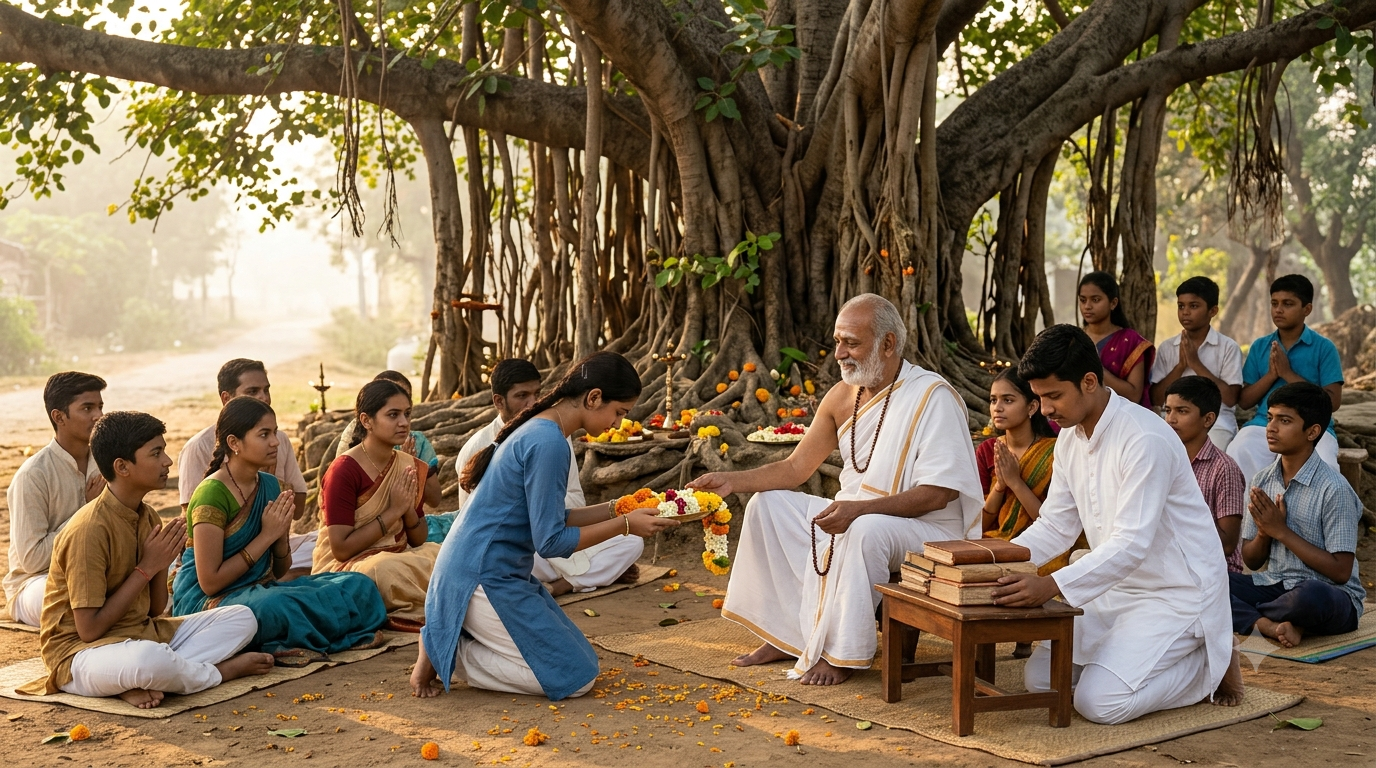
Observance can be simple: worship of the guru’s sandals or seat, remembrance of lineage, study, a gratitude offering, and renewed ethical commitments.
- Clean the study or prayer space and place a text, teacher photograph, or symbolic sandals respectfully.
- Offer flowers, fruit, lamp light, and a written expression of gratitude.
- Study a passage connected to the lineage and record questions for future guidance.
- Give dakshina within your means and only through transparent channels.
- Thank secular teachers, craftspeople, parents, and mentors who shaped your learning.
- Review safeguarding, boundaries, and accountability in any organization you support.
Food, offerings, and hospitality
Prasad varies entirely by community and may include fruit, sweets, a shared vegetarian meal, or food offered in an ashram or temple.
The ethical offering may also be time, study, service, or support for education. Gifts should never create debt, pressure, or favoritism.
Regional and community traditions
Ashrams and sampradayas
Disciples honor the lineage, hear teachings, offer guru dakshina, and begin or renew periods of study.
Buddhist and Jain contexts
The same full moon carries distinct meanings, including the Buddha’s first sermon in Buddhist tradition and reverence for teachers in Jain communities.
Schools and arts
Music, dance, yoga, language, and classical-learning communities often thank teachers and acknowledge the discipline behind mastery.
Observing in Trinidad and Tobago or the wider diaspora
In Trinidad and Tobago, Guru Purnima can honor pandits, acharyas, music teachers, Hindi and Sanskrit teachers, parents, and community elders while preserving clear boundaries.
Organizations should model respect through transparent finances, safeguarding policies, fair treatment of volunteers, and openness to questions.
A respectful home observance
- Write the names of teachers whose guidance changed your life and what each taught.
- Offer a short prayer for humility, discernment, and the ability to learn from correction.
- Read from a trusted text and take one practical study note.
- Send a respectful thank-you message without demanding the teacher’s attention.
- Support a scholarship, library, or teaching project with transparent governance.
Good practice: Do not travel, fast, donate, or disclose personal information under pressure. Children must never meet teachers privately without proper safeguarding. Report abuse to appropriate civil authorities, not only internal religious channels.
Frequently asked questions
Who is honored on Guru Purnima?
Veda Vyasa is especially remembered, along with one’s own gurus, teachers, lineage, and the principle of knowledge transmission.
Must I have a personal guru?
No. A person can honor teachers and study responsibly without claiming a formal guru relationship.
What is guru dakshina?
It is an offering of gratitude to a teacher. It may be money, service, study, or another appropriate gift and should be freely given.
Does reverence mean a guru cannot be questioned?
No. Hindu traditions value discernment, and ethical teachers do not require followers to conceal harm or abandon conscience.
Sources and further reading
- Encyclopaedia Britannica – Guru – Background on the guru concept.
- Drik Panchang – Guru Purnima – Location-sensitive date reference.
- Hindu American Foundation – Gurus – Community educational context.
- Oxford Centre for Hindu Studies – Academic lectures and Hindu studies resources.
Editorial and rights note: This educational overview is independently written from cross-checked facts and does not reproduce source text. External sources are cited for verification and further reading; citation does not imply endorsement. The hero is an illustrative AI-generated image created for HinduClarity, not a historical photograph or documentary record. This page is not a substitute for guidance from your temple, family tradition, qualified teacher, or licensed professional. Hindu calendars and practices vary by sampradaya, region, and location.
Back to the complete Hindu Festivals Calendar for 2026-2027
Continue with the Diwali guide or the Ganesh Chaturthi guide.