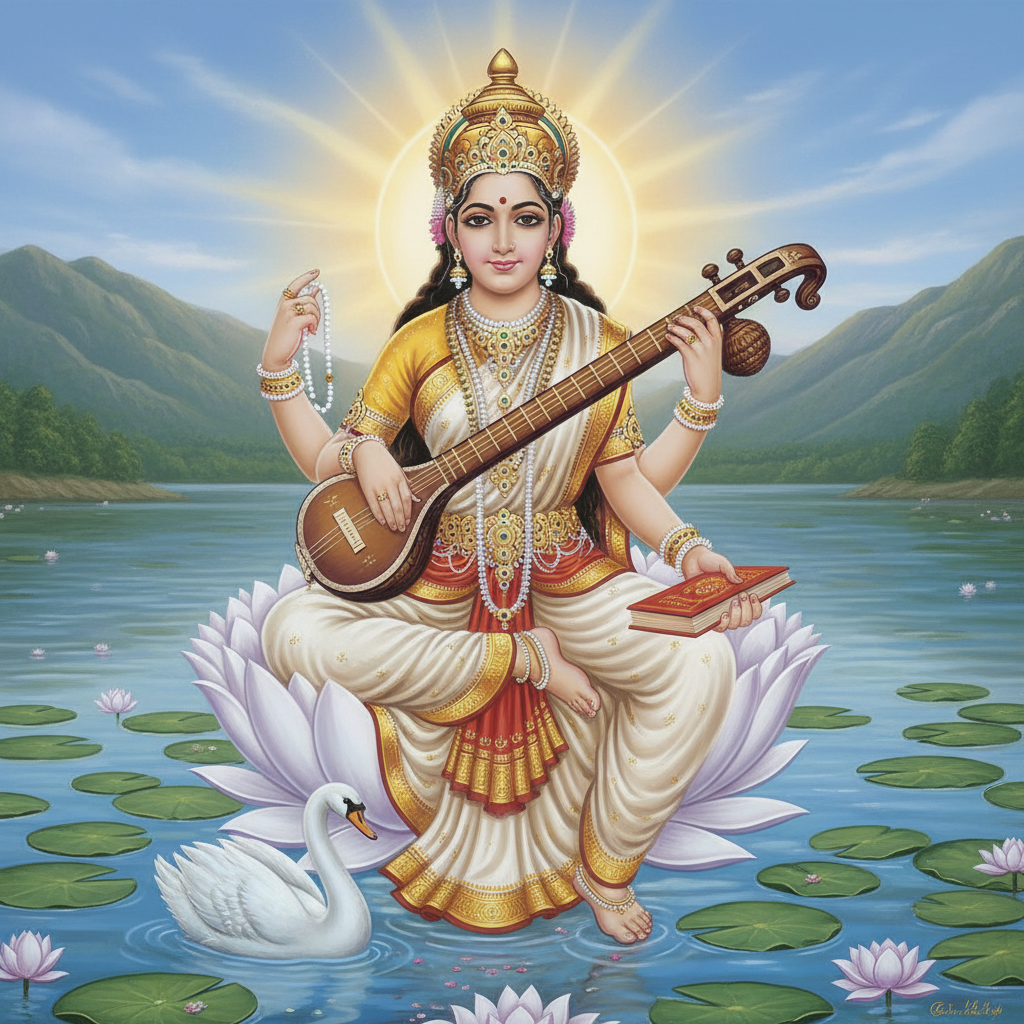
Mother Saraswati is revered as the Hindu goddess of wisdom, learning, music, language, and refined understanding. She represents the light of knowledge that removes confusion and helps the mind move toward clarity.
Who Is Mother Saraswati?
Saraswati is honored across Hindu traditions as the divine power of knowledge, speech, art, and insight. Students, teachers, musicians, writers, and seekers often worship her for clarity of mind and purity of expression.
She is commonly associated with calmness, discipline, truthfulness, and the graceful use of learning. Her worship reminds devotees that knowledge is sacred when it is joined with humility and good conduct.
Symbols and Iconography
Mother Saraswati is often shown wearing white, seated on a lotus or swan, and holding a veena. The white color suggests purity, simplicity, and truth.
The veena represents music, harmony, and the refinement of culture. Her book and mala symbolize study, contemplation, and spiritual practice. The swan is associated with discernment: the ability to choose truth over confusion.
Saraswati Puja and Vasant Panchami
Vasant Panchami is one of the best-known festivals dedicated to Saraswati. Families, schools, and temples may honor books, instruments, notebooks, and learning tools as symbols of sacred knowledge.
Devotees may offer flowers, light a lamp, recite prayers, and begin new educational or artistic efforts with reverence. The focus is not only success in study, but the wise and ethical use of knowledge.
Mantras and Devotional Practice
A common Saraswati prayer is “Om Aim Saraswatyai Namah.” The seed sound Aim is associated with learning, speech, and wisdom.
Devotional practice may include chanting, reading sacred texts, music, meditation, and dedicating study to a higher purpose.
Lessons from Mother Saraswati
Saraswati teaches that knowledge should make a person more peaceful, truthful, and compassionate. Real wisdom is not pride in information; it is clarity joined with character.
Her example encourages careful speech, lifelong learning, respect for teachers, and disciplined creativity.
Frequently Asked Questions
Note: Hindu traditions are diverse. Details can vary by region, sampradaya, scripture, temple practice, and family custom. This guide is written for respectful learning and general clarity.
Mantras
The following mantras are traditionally associated with Mother Saraswati. Pronunciation and ritual details can vary by lineage, so formal or intensive practice is best learned from a qualified teacher. The stated uses describe devotional intentions, not guaranteed medical, financial, romantic, or supernatural outcomes.
1. Saraswati Nama Mantra
Transliteration: Om Aim Saraswatyai Namah.
Meaning: Salutations to Saraswati; Aim is a traditional seed syllable associated with learning, speech, insight, and creative expression.
Traditional use: Often recited before study, writing, teaching, music, examinations, or artistic work to cultivate attention, clarity, disciplined learning, and eloquent speech.
2. Ya Kundendu Prayer
Transliteration: Ya Kundendu Tusharahara Dhavala, Ya Shubhra Vastravrita; Ya Vina-varadanda-mandita-kara, Ya Shveta Padmasana; Ya Brahmachyuta Shankara Prabhritibhir Devaih Sada Vandita; Sa Mam Patu Saraswati Bhagavati Nihshesha Jadyapaha.
Meaning: May Goddess Saraswati—radiant like jasmine, the moon, and snow; dressed in white; holding the vina; seated on a white lotus; and revered by the gods—protect me and remove dullness of mind.
Traditional use: Traditionally used as an opening prayer for education, music, scholarship, and the removal of confusion or intellectual inertia.
Practice note: Begin with a calm, respectful intention. A small, consistent number of repetitions is generally better than rushing. If you follow a family, temple, or guru tradition, use the pronunciation, count, and procedure taught in that lineage.
Sources and Further Reading
Source note: Vedic Sarasvati and later goddess traditions, veena/book/swan imagery, Brahma or Vishnu relationships, student worship, mantras, and learning claims need historical separation.
- Metropolitan Museum of Art — Sarasvati — Supports historical identification and Sarasvati iconography.
- Metropolitan Museum of Art — Vishnu with Lakshmi and Sarasvati — Supports historical depiction of Lakshmi and Sarasvati with Vishnu; not a universal genealogy or theology.