Navagraha guide
Surya Dev is the Hindu solar deity: a divine form of the Sun praised in Vedic hymns, worshipped in later Hindu traditions, and counted among the nine Navagraha. Surya represents visible light, ordered time, witness, vitality, and the daily rhythm of sunrise and sunset. In modern astronomy, however, the Sun is a star; in Jyotisha, Surya is a graha interpreted through a religious-astrological system. These descriptions answer different questions and should not be treated as interchangeable.
Important distinction: Surya and Savitr are closely related Vedic solar deities, but they are not simply two spellings of one name in every hymn. Surya often emphasizes the visible Sun and its course, while Savitr emphasizes the divine “impeller” who sets beings and activities in motion. Later interpretation may connect or identify them more strongly.
Surya Dev at a glance
| Name | Surya (“Sun”); Aditya is another important solar title |
|---|---|
| Religious identity | Vedic solar deity, later Hindu deity, and member of the Navagraha |
| Navagraha correspondence | The Sun; traditionally central among the nine grahas |
| Common associations | Light, sight, time, witness, kingship, and life-sustaining energy |
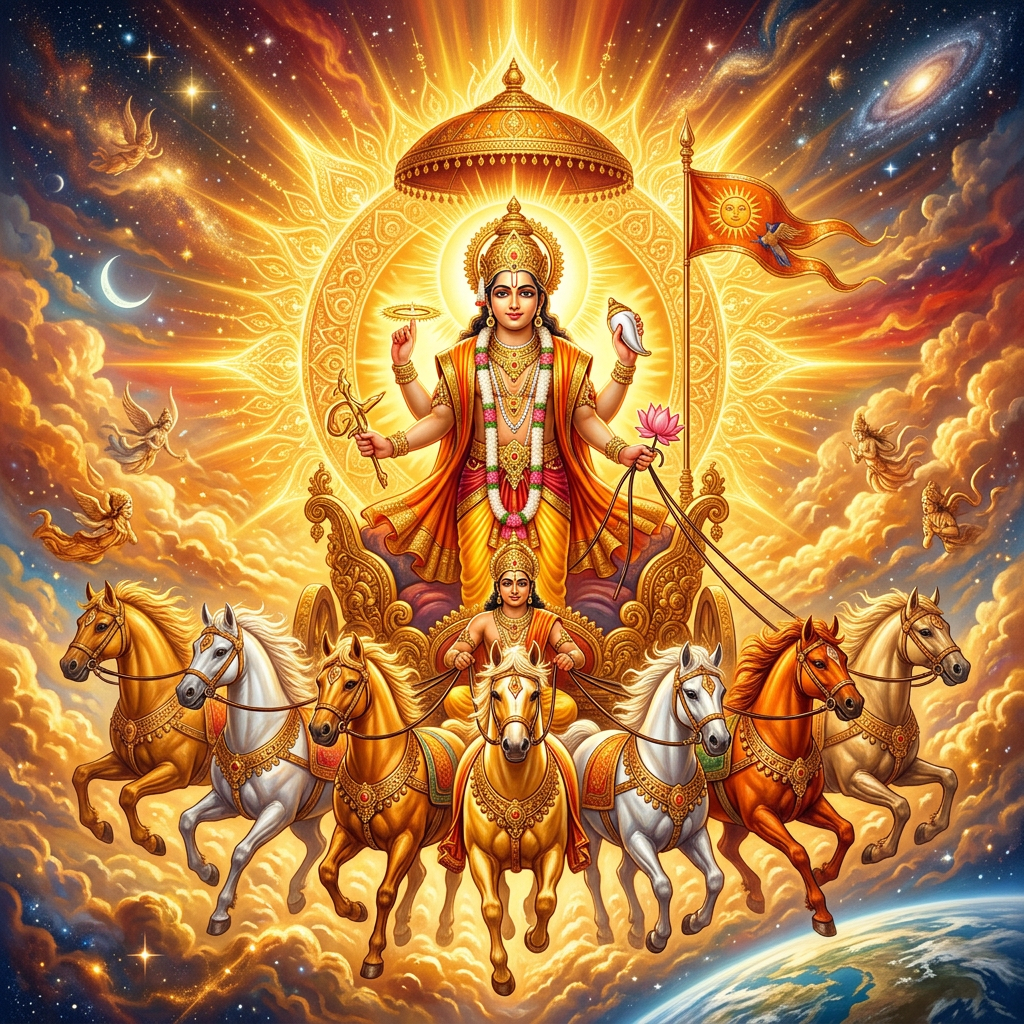
| Common iconography | A crowned deity with lotuses, sometimes in a chariot; details vary by place and period |
| Weekday | Sunday (Ravivara) in many calendars |
| Astronomy | The star at the center of our solar system |
| Parent guide | The Navagraha |
Who is Surya in Hindu tradition?
Surya is encountered in several overlapping settings. In Vedic poetry he is a radiant deity whose rising makes the world visible and marks the passage of time. In temple art and later sacred narrative, he appears in human form with a court, vehicle, and family relationships. In daily devotion, worshippers may greet the morning Sun with water, prayer, mantra, or movement. In Navagraha worship, Surya occupies a leading or central place among the nine grahas.
These layers developed across long periods and many communities. “Surya” can name the visible Sun, the deity addressed through it, or a figure in a particular narrative. A description from one Purana, temple manual, regional image, or family custom should therefore not be presented as the only Hindu understanding.
Surya and Savitr in the Vedas
Rigveda 1.50 is explicitly a hymn to Surya. It celebrates the rising deity, the rays that make him visible, his illuminating course, and the seven harit figures that draw his chariot. The hymn supplies an early textual basis for Surya’s connections with light, sight, motion, and the ordered day. It does not, by itself, establish every later Puranic genealogy or every feature of temple sculpture.
Rigveda 1.35 is addressed to Savitr. Its golden-handed deity travels in a golden chariot, establishes movement and rest, and protects along ordered paths. Scholars and translators debate how sharply individual Vedic solar deities should be separated, but the hymns themselves preserve distinct names, praises, and functions. It is safest to say that Surya and Savitr belong to an interconnected Vedic solar field while retaining contextual distinctions.
This matters for mantra attribution. A prayer may be popularly described as “a Sun mantra” while its Vedic wording addresses Savitr, Surya, or another solar form. Practitioners should preserve the name and context given by the text or lineage rather than replacing every solar name with “Surya.”
Astronomy, theology, and Jyotisha: three different lenses
- Astronomy: The Sun is a roughly 4.5-billion-year-old star made mainly of hydrogen and helium. Nuclear fusion in its core powers the light and heat that reach Earth. This is a physical description tested through observation and scientific models.
- Theology and devotion: Surya is divine presence, witness, giver of light, and a focus of reverence. Hymn, image, offering, and pilgrimage express relationships and meanings that a scientific measurement is not designed to evaluate.
- Jyotisha: Surya is a graha interpreted in horoscopes and ritual calendars. Traditional associations may include authority, selfhood, fatherhood, visibility, and status. These are school-specific interpretive categories, not scientific findings that sunlight causes personality or guarantees events.
The Sanskrit term graha should not be translated mechanically as “planet.” The Navagraha include Surya and Chandra, as well as Rahu and Ketu, which correspond to lunar nodes rather than physical planets. Traditional sacred classification and modern astronomical classification serve different purposes.
Named narratives and why their versions differ
Svarbhanu obscures Surya
Rigveda 5.40 describes Svarbhanu striking or concealing Surya with darkness and the sage Atri finding or restoring the Sun. This is an early Vedic eclipse-related witness. It does not contain the complete later story in which Rahu drinks the nectar of immortality and is beheaded. Treating the two accounts as word-for-word versions of the same episode would erase their different language and setting.
Rahu pursues the Sun and Moon
In the Mahabharata’s account of the churning of the ocean, a disguised Rahu drinks amrita. Surya and Soma expose him, and Narayana severs him after the nectar has reached his throat. The passage connects his enmity toward Sun and Moon with eclipses. Later retellings commonly pair Rahu’s head with Ketu, but this particular translated Mahabharata passage names the severed head and trunk without directly naming the trunk Ketu.
Sanjna, Chhaya, and Surya’s family
A narrative translated in the Vishnu Purana relates Surya to Sanjna and her shadow-form Chhaya, and to children including Manu, Yama, Yamuna, Shani, Tapati, the Ashvins, and Revanta. Names, sequence, parentage, and emphasis can differ in parallel Puranic, epic, and regional tellings. It is therefore better to write “in this account” than to insist on one fixed family chart. The relationship between Surya and Shani is important in later story, but it should not be turned into a deterministic claim about every person’s horoscope or family life.
Surya’s iconography
Surya is often shown as a regal, upright male deity holding fully opened lotuses. A chariot and solar attendants may appear, and popular descriptions often speak of seven horses. The charioteer Aruna and dawn figures may accompany him in some compositions. Yet number, vehicle, clothing, companions, weapons, and hand gestures are not identical across centuries or regions.
The Cleveland Museum of Art’s eighth-century Central Indian Navagraha relief offers a useful object-specific example: its Surya wears boots, holds open lotuses, and stands with a female Dawn figure before him. Several other grahas in the same relief are nearly identical. This object supports those details for that sculpture; it does not prove that every Surya image must have boots, lotuses, or the same attendants.
Surya in worship and Surya Namaskar
Surya worship ranges from simple household practice to temple liturgy. Depending on community and lineage, a devotee may face the morning light, offer clean water from a vessel, recite names or hymns, light a lamp safely, visit a Surya or Navagraha shrine, or give charity. Sunday is commonly associated with Surya, but no single offering list or schedule governs all Hindus.
Surya Namaskar, or Sun Salutation, is a family of movement sequences rather than one universally fixed ritual. The number and order of postures, breathing pattern, pace, mantras, and devotional framing vary among yoga schools. Some practitioners use it as worship; others approach it as physical culture or contemplative movement. Neither approach should be silently presented as the only authentic one.
Short invocations such as Om Suryaya Namah are used in some settings, while other traditions teach sets of names, Vedic verses, or longer liturgies. Pronunciation, eligibility rules, and repetition counts can be lineage-specific. Learn formal practice from a trusted teacher, and do not accept claims that a mantra or paid ritual guarantees health, concentration, wealth, promotion, fertility, or protection from every difficulty.
- Never stare directly at the Sun. Ordinary sunglasses are not safe solar-viewing equipment.
- Adapt or skip yoga movements that cause pain, dizziness, or unsafe strain; seek qualified guidance when health, pregnancy, disability, or injury is relevant.
- Use lamps and water offerings safely and follow temple rules and local environmental guidance.
- Devotion may be meaningful and comforting, but it is not a substitute for medical, mental-health, legal, or financial care.
Surya, Rahu, Ketu, and eclipses
Astronomically, a solar eclipse occurs when the Moon passes between Earth and the Sun and its shadow reaches Earth. Because the Moon’s orbit is tilted, eclipses require alignment near an orbital node. In Jyotisha, Rahu names the ascending node and Ketu the descending node. They are mathematically defined points, not physical bodies. Sacred narrative personifies eclipse forces; astronomy explains shadow geometry. Safe eclipse viewing always requires certified protection or an indirect viewing method.
Frequently asked questions
Is Surya the same as the physical Sun?
Surya is the divine personification and theological form of the Sun in Hindu traditions. Astronomy studies the Sun as a star. A devotee may relate the two without confusing a sacred claim with a physical measurement.
Are Surya and Savitr the same deity?
They are closely connected solar deities, and later interpretation may identify them strongly. In the Rigveda, however, hymns preserve distinct names and emphases: Surya commonly appears as the visible solar deity, while Savitr is the divine impeller who sets beings into motion or rest.
Why does Surya have seven horses?
Rigveda 1.50 describes seven harit figures drawing Surya’s chariot, and later art and explanation develop sevenfold symbolism in different ways. The common “seven horses” image is influential, but the exact visual form and symbolic interpretation are not uniform everywhere.
Does Surya Namaskar guarantee good health or success?
No. It can be a devotional or movement practice, but it cannot guarantee a medical, academic, career, or astrological outcome. Practice within your abilities and use qualified professional care when needed.
Do Rahu and Ketu physically swallow Surya?
No. In astronomy they correspond to the Moon’s orbital nodes, and a solar eclipse is an alignment of Sun, Moon, and Earth. Narratives of swallowing communicate sacred meaning through personification rather than describing a hidden physical planet.
Sources and further reading
- Rig Veda Online: 1.50, “Surya”; 1.35, “Savitar”; and 5.40—exact hymn locators for Surya, Savitr, and the Svarbhanu episode.
- The Mahabharata, Book 1, Section XIX, trans. Kisari Mohan Ganguli—Rahu, Surya, Soma, and the amrita narrative.
- H. H. Wilson, trans., The Vishnu Purana—a historical translation containing one Puranic account of Surya’s family; compare variants and newer scholarship.
- NASA Science, “Sun: Facts”—modern solar science only.
- NASA Science, “Why Do Eclipses Happen?”—modern eclipse geometry only.
- Cleveland Museum of Art, Nine Celestial Bodies (Navagraha)—object-specific evidence for an eighth-century Central Indian image of Surya within a Navagraha relief.