Hindu tradition and Jyotisha
The Navagraha are nine “seizers” or influential celestial powers honored in several Hindu ritual and Jyotiṣa traditions: Surya, Chandra, Mangala, Budha, Brihaspati, Shukra, Shani, Rahu, and Ketu. The group joins visible luminaries, planets, and the two eclipse nodes within a sacred framework. It is therefore not a nine-planet model of modern astronomy, nor does every Hindu community understand or worship the grahas in exactly the same way.

At a glance: astronomy describes physical bodies and calculated points; Jyotiṣa interprets their positions within traditional astral systems; ritual addresses the grahas as sacred presences. These are related cultural languages, not interchangeable scientific claims.
Who are the nine Navagraha?
| Graha | Common English reference | Claim-bounded description | Guide |
|---|---|---|---|
| Surya | Sun | Vedic solar deity and member of the Navagraha | Surya Dev |
| Chandra | Moon | Lunar deity, with important distinctions from Vedic Soma | Chandra Dev |
| Mangala | Mars | Graha associated with the physical planet Mars | Mangala Dev |
| Budha | Mercury | Graha associated with Mercury; distinct from the Buddha | Budha Dev |
| Brihaspati (Guru) | Jupiter | Vedic deity and later Guru/Jupiter-associated graha | Brihaspati Dev |
| Shukra | Venus | Teacher figure and Venus-associated graha | Shukra Dev |
| Shani | Saturn | Deity and graha associated with Saturn | Shani Dev |
| Rahu | Ascending lunar node | Nonphysical node and figure in eclipse narratives | Rahu |
| Ketu | Descending lunar node | Nonphysical node and figure in eclipse narratives | Ketu |
The English glosses in this table are orientation aids, not complete definitions. A graha is literally something that “seizes” or takes hold, and its religious meaning cannot be reduced to the modern category “planet.” Surya and Chandra are the Sun and Moon; Rahu and Ketu are calculated points where the Moon’s orbit crosses the ecliptic; the remaining names are correlated with the five naked-eye planets known in premodern astronomy.
What does Navagraha mean?
Nava means “nine,” while graha has a wider range than “planet.” In Sanskrit astral literature it can refer to a celestial influence or agent. Translating Navagraha simply as “nine planets” is convenient but incomplete, because the traditional list contains the Sun, Moon, and two nonphysical orbital nodes. “Nine celestial powers” or “nine grahas” preserves the category more accurately.
The group is a synthesis. Vedic hymns address deities associated with the Sun and Soma, and other early texts discuss eclipses and celestial order, but that does not mean the fully standardized nine-member Navagraha set appears unchanged throughout the Vedic corpus. The familiar row of nine belongs to later developments in ritual, temple art, mathematical astronomy, and astral interpretation. Scholars of jyotiḥśāstra also distinguish its mathematical, calendrical, omen, and horoscopic strands rather than treating them as one timeless practice.
Three lenses: astronomy, Jyotiṣa, and ritual
1. Astronomy: bodies and orbital points
Modern astronomy studies the Sun as a star, the Moon as Earth’s natural satellite, and Mercury through Saturn as planets. Rahu and Ketu are not objects in space. They correspond to the ascending and descending lunar nodes—the two points where the Moon’s tilted orbit intersects the apparent path of the Sun. Eclipses can occur when a new or full Moon is close to a node. This geometry helps explain why eclipse symbolism became central to Rahu and Ketu.
2. Jyotiṣa: a traditional interpretive system
In Jyotiṣa, grahas are read through signs, houses, aspects, strengths, periods, and other rules that depend on a particular school and chart. A natal chart is not merely a diagram of the physical solar system; it is a structured symbolic map. Interpretations differ by text, school, and practitioner, and should not be presented as experimentally established forces or as certain predictions about character, illness, marriage, finances, or fate.
3. Ritual: sacred relationship and discipline
Practices documented by particular temples, families, regions, and lineages vary, so a visitor should follow local guidance rather than assume that one online procedure is universal. Some worshippers approach the nine together; others honor a particular graha; many Hindus do not maintain a separate Navagraha practice at all. None of these differences makes one community less Hindu.
Mythology and reality: eclipse narrative and orbital nodes
A well-known eclipse narrative grows from the churning of the ocean and the distribution of amṛta, the nectar of immortality. In the Bhāgavata Purāṇa 8.9.24–26, Rahu disguises himself as a deva and drinks among them. Surya and Chandra recognize him, and Hari severs his head with the discus. Because the nectar has touched the head, Rahu remains alive and hostile toward the two luminaries. Popular retellings often identify the severed remainder with Ketu, but details and emphases differ across sources; the cited passage itself concentrates on Rahu’s immortal head. A retelling should therefore name its textual or regional frame rather than claim that every Hindu account is identical.
Astronomy answers a different question. The Moon’s orbit is tilted relative to the ecliptic, and the two crossing points are its nodes. A solar or lunar eclipse requires the relevant new or full Moon to occur near one of those nodes. The nodes have no physical head, tail, shadow body, or mass: they are calculated locations that change over time. In Jyotiṣa, Rahu is correlated with the ascending node and Ketu with the descending node; in ritual and story, both can be addressed as personal sacred powers.
Keep the levels clear: the narrative expresses sacred memory, conflict, order, and the experience of light being obscured; orbital geometry explains when physical eclipses can occur. Treating the story as literature or theology does not erase its ritual meaning, while honoring it does not require presenting personification as a scientific mechanism.
Navagraha in temple art and sacred space
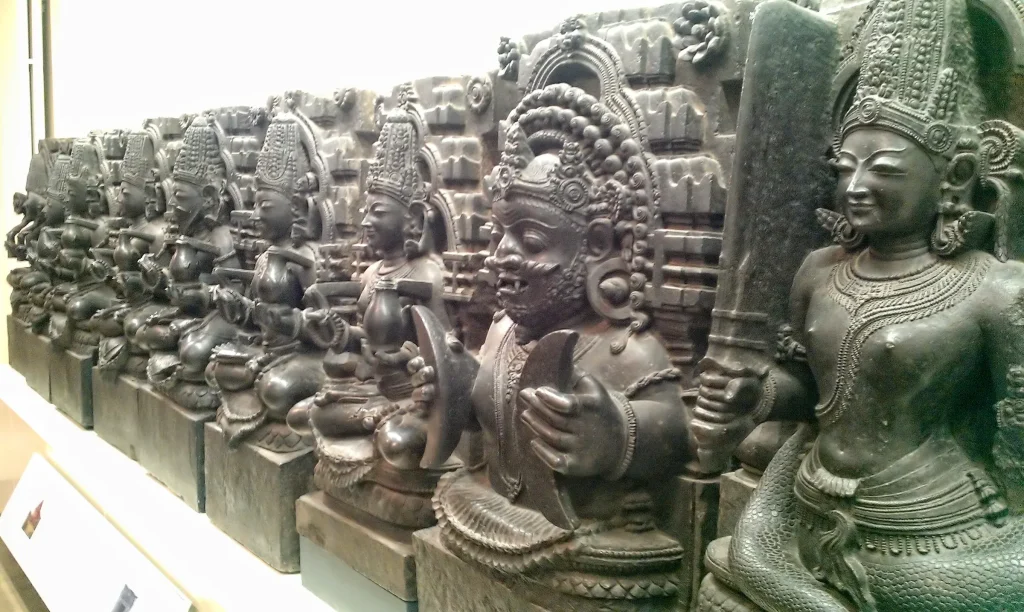
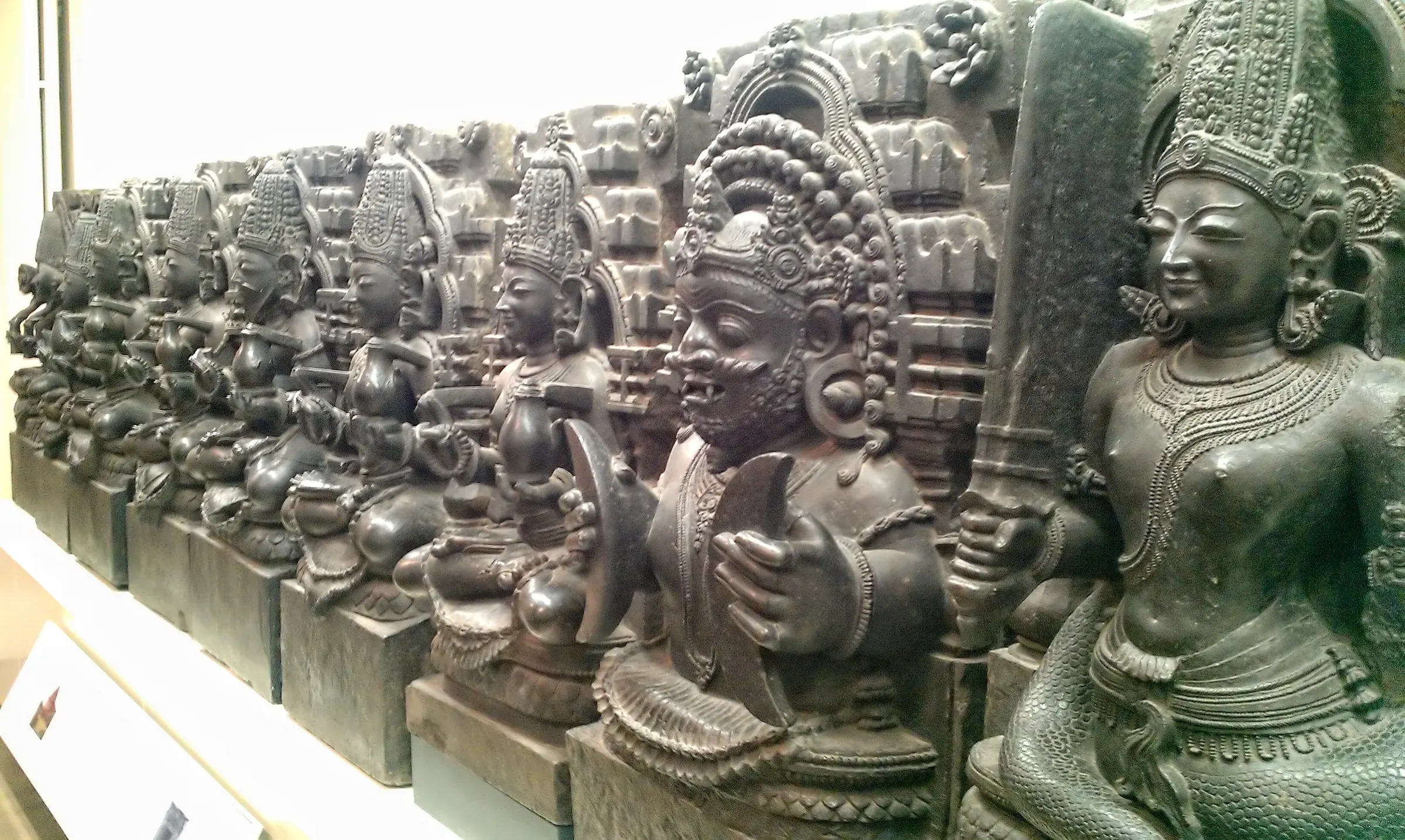
Surviving sculptures show that the nine were represented as an ordered ensemble in medieval India. A Central Indian sandstone panel at the Cleveland Museum of Art, dated to the 700s, places the celestial figures in a row and identifies Surya, Moon, Mercury, Venus, Mars, Jupiter, Saturn, Rahu, and a serpent-tailed Ketu. The museum notes that such panels could appear near temple entrances. That object is valuable historical evidence, but it is not a universal blueprint for every temple.
Why lists, order, and emphasis can vary
Nine is the familiar standard for the Navagraha ensemble, but the way those nine are named, ordered, and visually ranked depends on the evidence being described. A sculptural row follows the practical demands of its object, while a prayer or technical table can use a different sequence for its own textual purpose. Any specific temple arrangement or ritual order should be attributed to that temple or tradition rather than universalized.
Emphasis also changes with context. Historical sculpture, sacred narrative, mathematical astronomy, almanac calculation, and horoscope interpretation do not organize information for the same purpose. Rahu and Ketu can be personified in narrative art while also being calculated as node positions in astral literature. Sacred personification and calculation coexist without requiring that the nodes be physical planets.
Readers should therefore ask four questions whenever they encounter a Navagraha claim: Which text or temple is being described? What region and period does the evidence belong to? Is the statement astronomical, ritual, iconographic, or astrological? Does the author present a belief as belief, or incorrectly promise a measurable result? Those questions protect both religious nuance and factual clarity.
How the Navagraha relate to time
The grahas are woven into several ways of organizing time. Lunar calendars use the Moon’s changing relation to the Sun to define tithis, while nakṣatras divide the Moon’s path against the stellar background. Rahu and Ketu identify the two lunar nodes used in eclipse-related geometry. Calendrical calculation, horoscope interpretation, sacred narrative, and ritual can overlap, but they are not identical systems.
- Historical sculpture: museum records document particular Navagraha ensembles, periods, and regional styles.
- Calendar work: astral literature contains mathematical and calendrical material that should be distinguished from devotional claims.
- Eclipse geometry: the lunar nodes identify where the Moon’s orbit crosses the ecliptic.
- Horoscopic practice: practitioners interpret charts through tradition-specific texts and rules rather than one universal keyword list.
Mantra, transliteration, and meaning
Navagraha liturgies contain many tradition-specific formulas. The following is one short, Surya-focused Vedic example for education—not a universal mantra to the entire group and not a promised remedy. It is Ṛgveda 1.50.10, within a hymn addressed to Sūrya.
Sanskrit:
उद्वयं तमसस्परि ज्योतिष्पश्यन्त उत्तरम् ।
देवं देवत्रा सूर्यमगन्म ज्योतिरुत्तमम् ॥१०॥
Scholarly transliteration (IAST):
ud vayaṃ tamasas pari jyotiṣ paśyanta uttaram |
devaṃ devatrā sūryam aganma jyotir uttamam ||
Simple phonetic guide:
ood vuh-YUM tuh-muh-sus puh-REE, JYO-tish PUSH-yun-tuh OOT-tuh-rum;
DAY-vum DAY-vuh-traa SOOR-yum uh-GUN-muh JYO-teer OOT-tuh-mum.
- Meaning: “We have come beyond darkness, beholding the higher light; we have reached Sūrya, god among the gods, the highest light.” This is a close, readable rendering; translations can differ in how they express the verse’s movement from darkness toward light.
- Intent for reflection: the verse can support contemplation of light, clarity, gratitude, and awakened attention. It is not evidence that recitation mechanically changes a horoscope or guarantees a material result.
- Practice caution: Vedic recitation includes accent and oral conventions that a simplified English guide cannot preserve. Use the phonetic line only to recognize the words; learn formal recitation from a qualified teacher or temple tradition. Never look directly at the Sun, and do not substitute mantra practice for medical or other professional care.
A respectful way to approach Navagraha worship
For a first visit, follow the temple’s posted route and the guidance of its priests or volunteers. Observe before assuming that a clockwise circuit, a fixed number of rounds, a color, oil, grain, or mantra is required. Customs that are normal in one temple can be absent in another. If you wish to make an offering, ask what the temple accepts; food allergies, fire rules, and local restrictions matter.
Educationally, it is safer to describe a practice than to promise a result. Devotees may understand prayer as repentance, steadiness, gratitude, surrender, or a request for grace. An article cannot guarantee “removal” of planetary effects, protection from accidents, a marriage outcome, recovery from illness, or financial success. Gemstones and ritual services also carry costs; seek transparent guidance and do not replace medical, legal, or financial advice with astrological claims.
Common misunderstandings
- “The Navagraha are the solar system.” No. The sacred list uses a different classification and omits Earth, Uranus, and Neptune while including the luminaries and nodes.
- “Rahu and Ketu are hidden planets.” In astronomical terms they are orbital intersection points, though ritual and narrative represent them personally.
- “Every difficult event proves a graha caused it.” This is not a scientific conclusion. Jyotiṣa readings are tradition-specific interpretations.
- “All Hindus must worship the nine.” Practice differs across regions, sects, temples, and households.
- “Vedic references prove the later group was already fixed.” Early solar, lunar, and eclipse references must be distinguished from the later nine-member ensemble.
Explore the Navagraha guides
Luminaries and visible planets
For deeper study, keep a three-column notebook: what a named text says, what a particular community does, and what astronomy measures. This simple method prevents a poetic image from becoming a physics claim, or one temple custom from being presented as a rule for all Hindus.
Frequently asked questions
Are the Navagraha gods or planets?
They are grahas—sacred celestial agents in Hindu ritual and astral traditions. Several correspond to physical bodies, while Rahu and Ketu correspond to orbital nodes. Calling all nine “planets” is an approximate translation, not a modern scientific classification.
Why are Rahu and Ketu included?
The nodes mark where the Moon’s orbit crosses the ecliptic, so they are central to eclipse calculation. Hindu narratives personify eclipse events through Rahu and Ketu, connecting astronomical observation, story, and ritual symbolism.
Is Navagraha worship compulsory?
No single practice is compulsory for all Hindus. Some temples and households emphasize the grahas; others center different deities or forms of worship. Follow the customs of the community you are visiting.
Can Navagraha puja change a horoscope?
Practitioners may understand puja as a devotional response to a chart, but promised outcomes are matters of belief, not scientific guarantees. Ritual should not be sold as certain protection, healing, wealth, or control over another person.
What is the best order for visiting Navagraha shrines?
There is no reliable universal order for every temple. Follow signs, observe local worshippers respectfully, or ask temple staff. Do not import one temple’s circumambulation rule into another without checking.
Sources and further reading
- Vedic Heritage Portal, Ṛgveda Śākala Saṃhitā, Maṇḍala 1, Sūkta 50, verse 10—primary Sanskrit text and recitation source for the educational mantra above.
- Bhāgavata Purāṇa 8.9.24–26—primary-text passage for the Rahu, Surya, Chandra, and nectar narrative, presented with a tradition-specific translation.
- Cleveland Museum of Art, Nine Celestial Bodies (Navagraha)—an 8th-century Central Indian sculptural ensemble and curatorial description.
- Metropolitan Museum of Art, Iconographic Drawings of the Secrets of the Nine Luminaries—collection metadata for a dated visual tradition.
- David Pingree, Jyotiḥśāstra: Astral and Mathematical Literature—scholarly orientation to Indian astral and mathematical textual traditions.
- NASA Science, “Eclipses”—modern astronomical explanation of eclipse geometry.
- NASA Science, “Solar System”—modern scientific classification of the Sun, planets, moons, and smaller bodies.