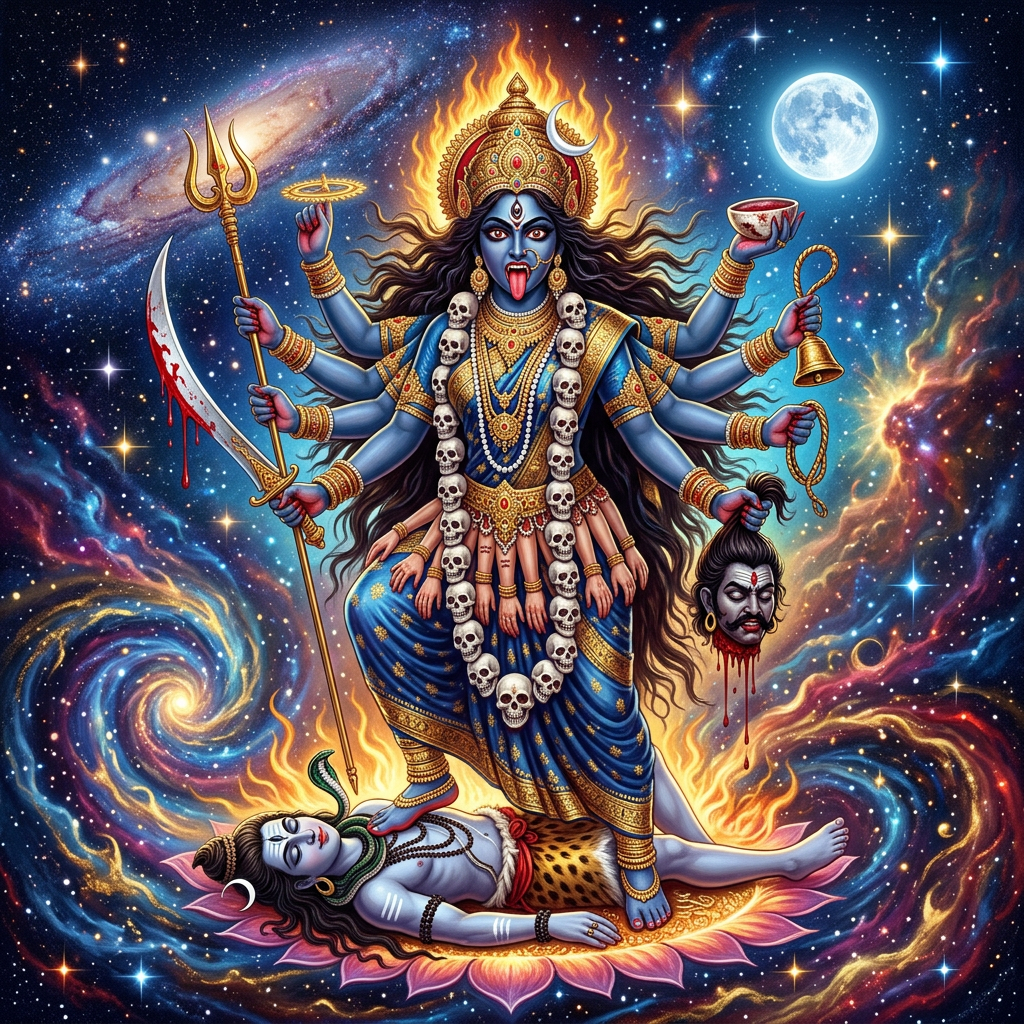
Maha Kali is a powerful Hindu goddess and form of the Divine Mother associated with time, transformation, fierce protection, and liberation from fear and ego. Her appearance can be startling, but devotees do not understand her fierceness as cruelty. It expresses divine power directed against ignorance, injustice, and spiritual bondage.
Kali traditions are diverse. In many Shakta traditions she is worshipped as supreme reality; elsewhere she is approached as a form of Devi closely related to Durga or Parvati. The names Kali and Mahakali are not used identically in every scripture, temple, or family tradition.
Who Is Maha Kali?
Kali is often connected with kala, a Sanskrit word that can mean time, death, or blackness. Maha means great. Mahakali therefore suggests the Goddess as the immeasurable power before which every limited form and moment passes. Her darkness is frequently interpreted not as evil, but as the boundless reality into which all colors and distinctions are absorbed.
Kali in the Devi Mahatmya
One influential scriptural account appears in the Devi Mahatmya, within the Markandeya Purana. During Devi’s battle with the asuras Shumbha and Nishumbha, Kali emerges from the Goddess’s brow. She defeats Chanda and Munda and is praised as Chamunda. During the battle with Raktabija, whose spilled blood produces more warriors, Kali consumes the blood before it reaches the ground and helps Devi stop his multiplying force.
These are sacred battle narratives, not instructions for literal violence. Devotional interpretations often understand the demons as outward threats to dharma and inward patterns such as arrogance, uncontrolled desire, and harmful habits that repeatedly return. Later Shakta and Tantric texts develop additional visions of Kali as consciousness, time, and liberating wisdom.
Iconography and Meaning
- Dark complexion: often interpreted as limitless reality, time, or the mystery beyond ordinary form.
- Sword and severed head: can symbolize cutting through ignorance and the false belief that the ego is absolute.
- Garland of heads or skulls: may represent mortality, conquered limitations, or the sounds and letters from which speech arises.
- Extended tongue: has several explanations, including battle imagery and a popular devotional story in which Kali realizes she has stepped upon Shiva.
- Standing upon Shiva: is commonly read as the relationship between Shakti, dynamic power, and Shiva, still consciousness. Explanations vary.
No single symbolic reading exhausts Kali’s image. Temple icons and meditation forms differ in posture, number of arms, objects, expression, and theological emphasis. Fierce imagery should be explained respectfully rather than sensationalized as “dark magic.”
Kali and the Ten Mahavidyas
Kali is commonly named first among the Dasha Mahavidyas, the Ten Great Wisdom Goddesses of Shakta Tantric traditions. Kali worship is broader than this framework, however, and not every devotee or temple organizes her theology through the Mahavidyas. Specialized Tantric practices may require initiation and should not be improvised from online instructions.
Worship and Regional Traditions
Kali Puja is especially prominent in Bengal, Assam, Odisha, and neighboring communities, often on the new-moon night that coincides with Diwali in many calendars. Devotees may offer lamps, flowers, food, hymns, and prayer. Dakshina Kali is beloved in Bengali devotion, while Mahakali, Bhadrakali, and regional goddess traditions have their own histories and ritual forms.
In Trinidad and Tobago and the wider Caribbean, observance may reflect family, mandir, and diaspora traditions. A simple home practice can include bathing or washing, preparing a clean space, offering flowers, fruit, water, or a safely supervised diya, and praying for courage, truthful self-examination, and compassionate action. A simple salutation is Om Kalikayai Namah.
Devotion is not a guarantee of protection, healing, wealth, punishment of enemies, or supernatural results. Health, safety, legal, or mental-health concerns still require qualified practical help. Avoid animal harm, coercive rites, fear-based claims, and practices outside your training or lineage.
Frequently Asked Questions
Is Kali evil?
No. Within Hindu worship she is a protective and liberating form of the Divine Mother. Her fearsome imagery confronts mortality and ignorance; it is not a sign of moral evil.
Are Kali and Durga the same?
They are deeply related forms of Devi, and some texts portray Kali as emerging from Durga or another Goddess form. Traditions may emphasize their unity, their distinct forms, or both.
Is Mahakali one specific form everywhere?
No. The name can emphasize Kali’s supreme or cosmic dimension, identify a scriptural meditation form, or name a regional temple deity. Context matters.
Sources and Further Reading
Source note: Devi Mahatmya narratives, tongue/garland/weapons symbolism, relation to Shiva, Mahavidya framing, mantra practice, and promised outcomes require tradition-specific sources.
- Metropolitan Museum of Art — Kali — Supports historical identification and iconographic description of Kali.
- Markandeya Purana Sanskrit e-text — GRETIL, University of Gottingen — Supports text-level checking of the Devi Mahatmya narratives, including Durga, Kali, Chanda-Munda, Raktabija, and Mahishasura.
Continue exploring: Visit the Hindu Devis guide, read about Mother Durga, or explore the Sharad Navratri guide.