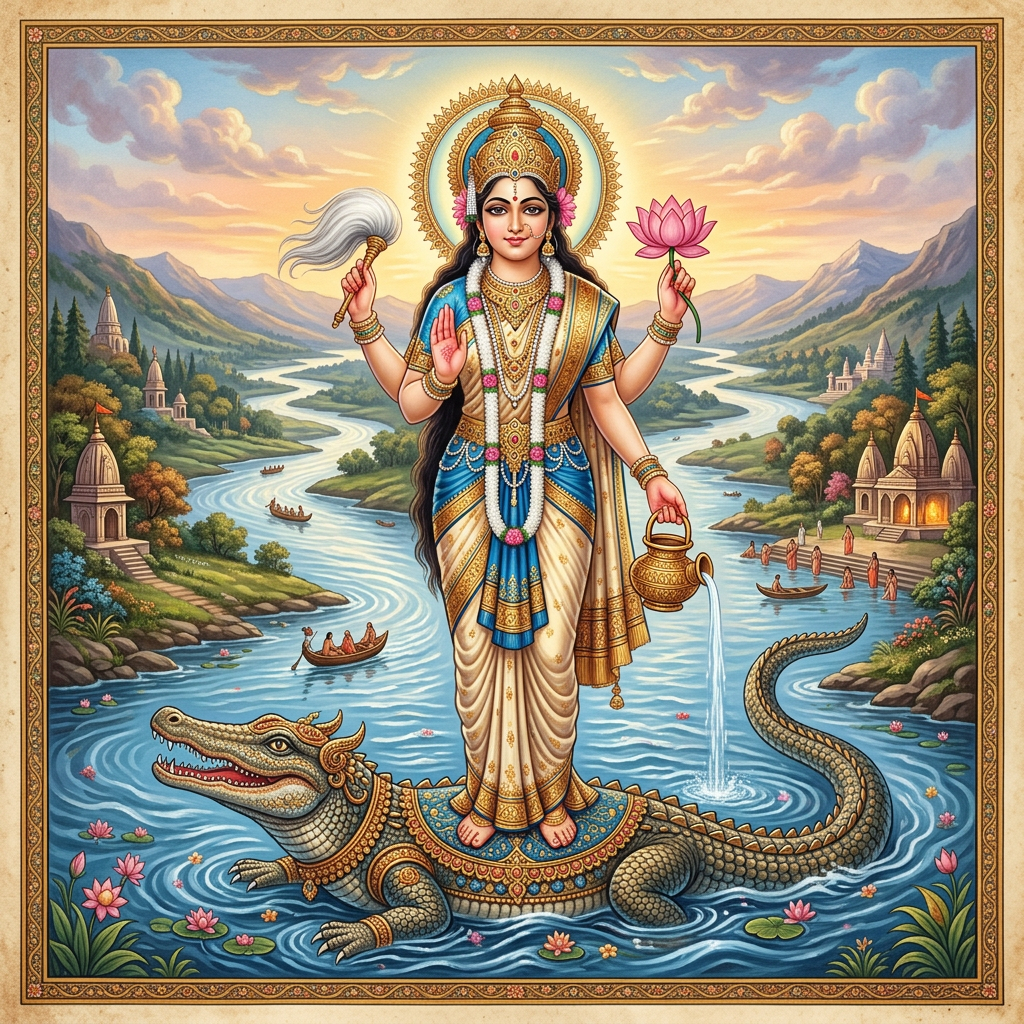
Ganga Devi is the divine personification of the Ganga (Ganges), one of Hinduism’s most sacred rivers. Devotees affectionately call her Ganga Ma, or Mother Ganga, honoring both the life-sustaining river and the compassionate divine presence associated with it. Her flowing waters connect Himalayan pilgrimage places, ancient cities, family rites, and everyday acts of prayer.
Who Is Ganga Devi?
Hindu texts and traditions describe Ganga as having a celestial as well as an earthly course. The title Tripathaga, “she who travels three paths,” expresses the idea that her waters move through heaven, earth, and the realm below. Such descriptions are theological and poetic: they present the river as a link among worlds and as a source of purification, blessing, and remembrance.
Bathing in the Ganga, offering her water, or remembering her in prayer is traditionally associated with purification from wrongdoing and progress toward liberation. These are devotional beliefs rather than scientific claims. Reverence for sacred water does not mean that untreated river water is medically safe to drink or bathe in; visitors should follow current local health and safety guidance.
Bhagiratha and the Descent of the Ganga
The best-known story of Ganga’s descent, called Gangavatarana, is told in the Ramayana and retold in the Mahabharata and Puranas. King Bhagiratha undertakes severe austerities so that Ganga may descend and restore his ancestors. Because the force of the heavenly river could overwhelm the earth, Shiva receives her in his matted hair and releases her in measured streams. Ganga then follows Bhagiratha to complete his ancestral duty.
The narrative explains several sacred relationships: Ganga’s association with Shiva, the river’s name Bhagirathi in the Himalayas, and the importance of perseverance and care for one’s ancestors. Devotional teachers also read the story inwardly, seeing Shiva’s steady presence as the wisdom needed to channel immense spiritual power. That interpretation is meaningful, but it should be distinguished from the text’s narrative events.
Iconography and Symbols
- Water vessel: suggests the river’s nourishing flow and the sacred use of water in worship.
- Lotus: commonly represents beauty, purity, and spiritual awakening.
- Makara: her traditional aquatic vahana, often rendered as a composite water creature rather than an ordinary crocodile.
- White garments or radiant complexion: frequently communicate clarity and auspiciousness, although artistic details vary.
Ganga may appear alone, beside Shiva, or as a river goddess at a temple doorway. There is no single mandatory number of arms or objects in every image; regional sculpture, painting, and temple conventions differ.
Worship, Pilgrimage, and Regional Practice
Major places associated with Ganga include Gangotri, Haridwar, Prayagraj, Varanasi, and Gangasagar. Worship may include a simple greeting to the river, the offering of flowers or a lamp, recitation of hymns, and evening arati. Ganga Dussehra commemorates her descent in many North Indian communities. Customs concerning bathing, ancestral rites, and carrying Ganga water vary by family, region, and lineage.
A respectful personal observance can be simple: wash your hands, keep a clean space, offer fresh water in a small vessel, and pray with gratitude. If visiting the river, follow local temple guidance, avoid leaving plastic, cloth, food packaging, or non-biodegradable offerings, and never enter dangerous currents. Caring for the river and the communities that depend on it is a practical expression of reverence.
Ganga in Family and Temple Life
Ganga water is kept in many homes and temples for puja and important life-cycle rites. Small amounts may be used in purification, vows, weddings, and remembrance of the deceased. Families far from India may honor Ganga symbolically through clean water and prayer, while some communities invoke her presence in local rivers. Procedures differ, so sensitive rites should follow family or priestly guidance rather than a generalized online checklist.
Mantra and practice
A sacred salutation to Ganga Devi
This short name-salutation appears in Ganga devotional liturgy and is presented here for respectful study and prayer.
ॐ गङ्गायै नमः ।
oṃ gaṅgāyai namaḥ
- Pronunciation
- Approximately “Om Gung-gaa-yai Na-mah.” English spelling cannot fully represent Sanskrit sounds, and regional pronunciation varies.
- Meaning
- “Oṃ; salutation to Gaṅgā.” The word gaṅgāyai means “to Gaṅgā.”
- Tradition and context
- The salutation is attested in Ganga worship and name-recitation traditions. Spellings with गंगा and गङ्गा represent the same name here; this page uses the more explicit Sanskrit form.
- Practice
- It may be offered as a brief expression of reverence. Formal rites, inherited repetition practices, and ancestral observances should follow family, temple, or teacher guidance. Recitation does not make untreated water safe or replace responsible care for rivers.
Source: Sanskrit Documents, Gaṅgā Pūjā, which repeatedly gives the salutation त्रिपथगामिन्यै गङ्गायै नमः. The archive is a volunteer textual repository rather than a critical edition or universal ritual authority.
For wider context, see HinduClarity’s guide to approaching a simple puja at home.
Frequently Asked Questions
Is Ganga Devi the same as the River Ganges?
Ganga Devi is the sacred river understood in personal, divine form. “Ganges” is the common English name for the river, while “Ganga” is widely used in Indian languages and devotional contexts.
Why is Ganga shown in Shiva’s hair?
This recalls the descent story in which Shiva receives Ganga’s tremendous force in his matted locks, allowing her to reach the earth without devastation.
Can anyone offer a prayer to Ganga?
A sincere prayer of gratitude is broadly accessible. Formal rites, especially ancestral ceremonies, may follow detailed regional or family procedures and can be learned from a knowledgeable priest or elder.
Related Devi Guides
Explore the HinduClarity Devi guide collection, and read about Mother Durga and Mother Lakshmi.
Sources and Further Reading
Source note: Ganga descent variants, Shiva/Bhagiratha narrative, makara iconography, purification theology, ritual practice, geography, and environmental claims need separate evidence.
- Metropolitan Museum of Art — The Descent of the Ganges (Gangavatarana) — Supports historical artistic reception of the Ganga descent narrative.
- Smithsonian Associates — The Ganges: River and Goddess — Supports broad geographic and religious-cultural context for the Ganges as both river and goddess; detailed theology and ritual claims still need primary or practice-specific evidence.
- The Ramayana of Valmiki, Part 3, trans. Ralph T. H. Griffith — Supports named Ramayana narrative checking; wording and book context must be cited rather than blended with later retellings.