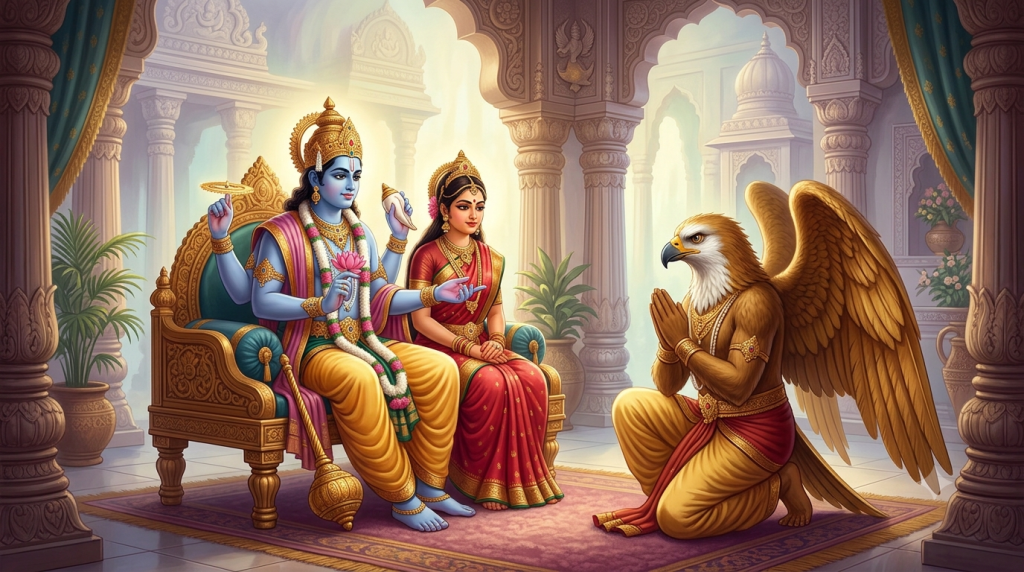
The Garuda Purana (Garuḍa Purāṇa) is a major Sanskrit Purāṇa presented principally as teachings of Lord Viṣṇu conveyed to Garuḍa and passed through sages. Although it is widely associated with funerals, death, and the soul’s journey, those subjects belong mainly to a smaller and highly variable later section. Most surviving versions are encyclopedic guides to life: devotion, ethics, cosmology, temple worship, sacred geography, governance, charity, health traditions, yoga, and self-knowledge.
Essential correction: The Garuda Purana is not merely a “book of death” or a catalogue of hells. In commonly studied recensions, roughly nine-tenths of the text belongs to the life-oriented Pūrva-khaṇḍa. The shorter Preta-khaṇḍa or Uttara-khaṇḍa discusses death, funerary duties, karma, rebirth, and afterlife journeys, but its contents and chapter count vary greatly among manuscripts.
What Is the Garuda Purana?
The Garuda Purana is conventionally counted among the eighteen Mahāpurāṇas. It is associated with Vaiṣṇava tradition because Viṣṇu is its supreme theological focus and Garuḍa—Viṣṇu’s eagle-like divine vehicle and devoted companion—is the principal recipient and transmitter of instruction. The text nevertheless discusses and honors many deities and practices, including forms of Śiva, Devī, Sūrya, Gaṇeśa, and pañcāyatana worship.
Like other Purāṇas, it is not a single-author book produced at one known date. It is a layered body of Sanskrit literature transmitted, rearranged, and expanded over centuries. Traditional attribution connects it with Vyāsa, while its own narrative transmission runs from Viṣṇu to Garuḍa and onward through sages. A historical study of manuscripts must be kept distinct from this sacred account of transmission.
Date, Growth, and Recensions
The age of the Garuda Purana cannot be reduced to a single date. Scholarly estimates for its earlier layers range broadly within the first millennium CE, while much of the extant compilation is commonly placed around the late first or early second millennium. Later additions continued after that. These estimates concern textual layers and surviving evidence, not the age of every religious idea preserved in the work.
Manuscripts differ markedly. The titles Sauparṇa Purāṇa, Tārkṣya Purāṇa, and Vainateya Purāṇa have also been associated with the work or related traditions. Common printed recensions contain two principal divisions:
- Pūrva-khaṇḍa (“Earlier Section”): commonly about 229 chapters, though some versions contain approximately 240–243. It is the much larger, encyclopedic section.
- Uttara-khaṇḍa or Preta-khaṇḍa/Preta-kalpa: commonly between 34 and 49 chapters, depending on the recension. It focuses on death, funerary observance, ancestral rites, karma, rebirth, and afterlife descriptions.
- Brahma-khaṇḍa: a 29-chapter section found in the Venkateśvara printed edition. Its distinctive theology and absence from many witnesses indicate a later and recension-specific addition; it should not be treated as universal.
Traditional accounts sometimes give 19,000 verses, while modern counts of surviving manuscripts are far lower and inconsistent. It is therefore misleading to promote one verse total as though every Garuda Purana manuscript contains exactly the same work.
The Pūrva-khaṇḍa: A Guide to Life
The Pūrva-khaṇḍa gathers a remarkable range of subjects. Its organization may appear miscellaneous to a modern reader, but its underlying purpose is comprehensive: to connect sacred knowledge with the religious, ethical, civic, artistic, and bodily dimensions of life.
| Subject | What the text discusses |
|---|---|
| Cosmology and theology | Viṣṇu, Lakṣmī, creation, dissolution, time cycles, worlds, the body as a microcosm, and relationships among divine forms. |
| Worship and sacred geography | Pūjā, festivals, vows, mantras, images, pilgrimage places, and forms of Viṣṇu worship alongside other Hindu deities. |
| Temple and image design | Site plans, proportional systems, sanctum and superstructure, temple types, and iconographic measurements. |
| Ethics and daily conduct | Self-restraint, nonviolence, generosity, learning, hospitality, truth, family and social responsibilities, and prudent conduct. |
| Governance and statecraft | Justice, selection of ministers, protection, taxation, prosperity, diplomacy, and the obligations of a ruler. |
| Gems and material knowledge | Types, quality, flaws, traditional tests, cleaning, mythic associations, and cautions about expert evaluation. |
| Health traditions | Diseases, symptoms, diet, herbs, formulations, preventive conduct, and veterinary material within the historical framework of Ayurveda. |
| Grammar, metrics, astronomy, and calendar | Language, literary forms, time reckoning, lunar and planetary material, and calendrical observance. |
| Yoga and liberation | Posture as preparation, concentration, meditation, the movement from form to formless contemplation, self-knowledge, and mokṣa. |
Viṣṇu and Lakṣmī in Creation
In its Vaiṣṇava cosmology, Viṣṇu represents the unchanging supreme reality, while Lakṣmī is inseparable creative power. Some passages draw on Sāṃkhya language: spirit and material nature are distinguishable yet interdependent in manifestation. The masculine and feminine are not independent rival principles; together they express the one sacred ground from which the universe unfolds.
The Body as a Sacred Microcosm
The Garuda Purana relates the human body to the greater cosmos. What exists outwardly is mirrored inwardly, and divine presence is located within embodied life. This correspondence helps explain why the text can move from temple architecture to bodily discipline, from cosmology to yoga, and from ritual action to self-knowledge without treating them as unrelated subjects.
Temple Architecture and Sacred Images
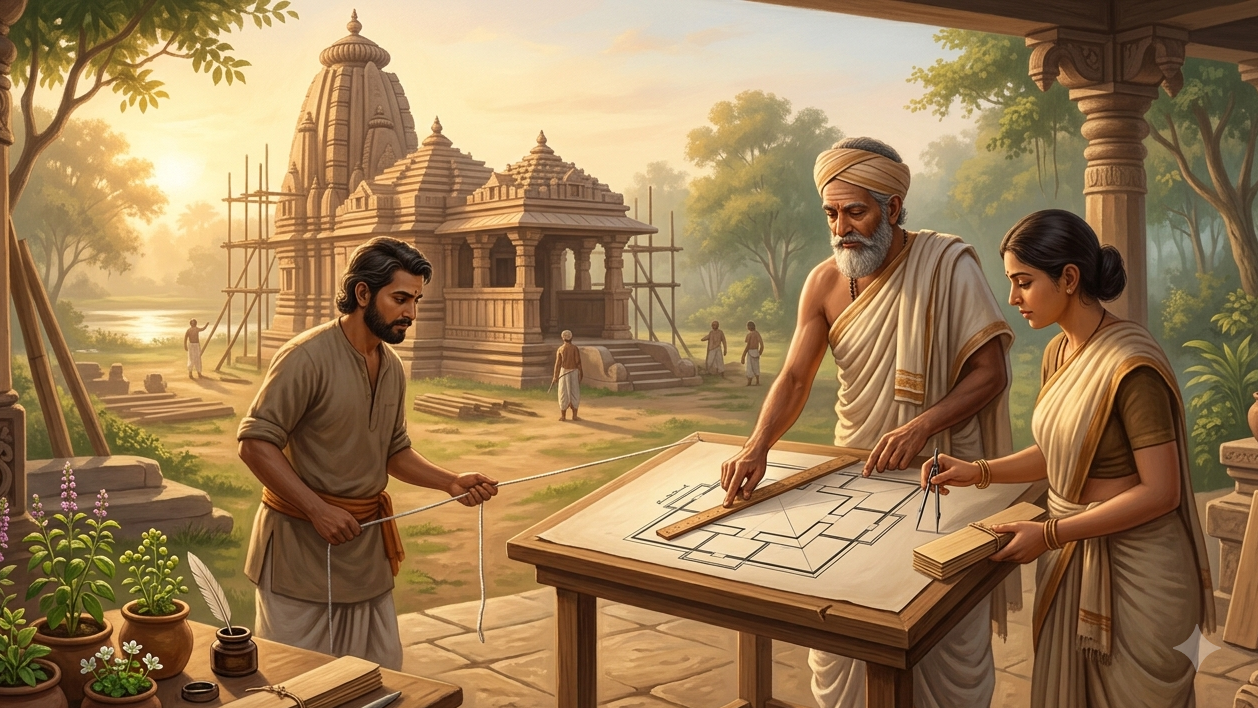
The architectural chapters describe square grids, the sanctum, walls, entrances, superstructures, halls, and proportional relationships. They also enumerate temple forms and prescribe measurements for images and architectural elements. These passages belong to a wider Sanskrit tradition of vāstu and śilpa knowledge. They are valuable evidence for religious aesthetics and design principles, but they are not a universal modern building code.
Ethics, Charity, and Right Conduct
Ethical teaching emphasizes dāna (generosity), self-control, nonviolence in thought, speech, and action, learning, truthfulness, hospitality, and care in choosing companions. Charity is praised when offered at an appropriate time and place, to a worthy recipient, with compassionate intention rather than display. The text also preserves historically situated rules tied to social class and stage of life; responsible reading distinguishes enduring ethical themes from norms formed in a particular society.
Good Government
Sections on polity advise rulers to govern through truth and justice, choose capable and ethical ministers, protect the realm, and avoid taxation that destroys the source of prosperity. The recurring comparison is careful collection—like a bee taking nectar without ruining the flower. These teachings place political authority under dharma rather than treating power as self-justifying.
Medicine and Historical Knowledge
A large group of chapters is often called the Dhanvantari Saṃhitā. It addresses disease classification, symptoms, diet, plants, formulations, preventive practices, and veterinary care. Scholars have noted parallels with classical Ayurvedic works. This material is historically important, but ancient medical prescriptions should not replace qualified diagnosis, emergency care, or evidence-based treatment today. Plant names and formulations can also be difficult to identify safely across languages and regions.
Yoga and the Brahma Gītā
The concluding chapters of the Pūrva-khaṇḍa are sometimes called the Brahma Gītā. They discuss yogic discipline, meditation, and liberation, with Dattātreya appearing as a teacher of eight-limbed yoga in some transmitted material. Postures are means rather than the final goal. Practice advances from concentration on Viṣṇu with form to subtle contemplation of the formless reality within, under guidance and with self-knowledge as the liberating aim.
The Preta-khaṇḍa: Death, Karma, and Ancestral Rites
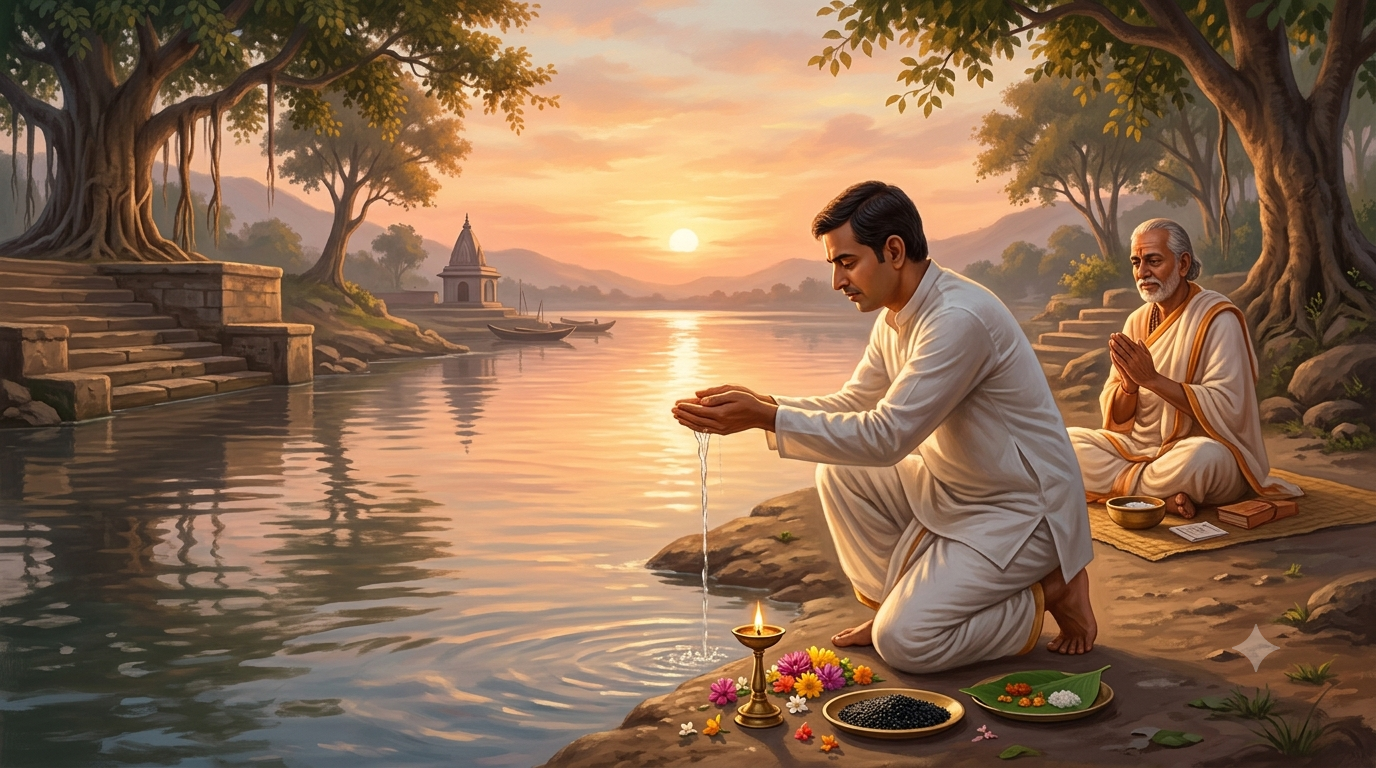
The shorter Preta-khaṇḍa addresses the duties of survivors, preparation of the body, cremation or other rites in specified circumstances, offerings, mourning periods, śrāddha, the status of the departed, judgment under Yama, karmic consequences, rebirth, and the hope of liberation. It speaks to grief through a traditional ritual and moral universe in which actions have consequences and the living continue duties of remembrance toward ancestors.
Descriptions of messengers of Yama, difficult roads, hell realms, and punishments should be read soberly. They serve as moral and ritual teaching within a karmic cosmology; they are not an invitation to sensational entertainment. Different Preta-khaṇḍa manuscripts vary enormously, and Hindu funerary practice does not follow one uniform Garuda Purana manual everywhere. Family custom, regional practice, community tradition, and priestly guidance often determine what is actually performed.
What Happens After Death?
The text presents death as transition rather than annihilation. The subtle being is described as moving under the force of karma, while rites and offerings by descendants support remembrance and the traditional relationship between the living and departed. Yama functions as a guardian of moral order, not merely a frightening figure. Heaven and hell are generally not eternal destinations in the Abrahamic sense; they are conditioned states within saṃsāra, followed by further embodiment unless liberation is attained.
Funeral Reading and the Garuḍa-purāṇa-sāroddhāra
A short work called the Garuḍa-purāṇa-sāroddhāra, composed or compiled by Navanidhirāma and translated into English in the early twentieth century, has often been mistaken for the complete Garuda Purana. It is a later digest/commentarial work drawing on afterlife material and other sources. Readers should not use it as proof that the entire Mahāpurāṇa is only about death.
Mantras
Oṃ Namo Nārāyaṇāya — ॐ नमो नारायणाय
Meaning: “Oṃ, reverence to Nārāyaṇa.” Traditional use: Vaiṣṇava remembrance, devotional japa, surrender to Viṣṇu, and steadying the mind. Formal initiation and pronunciation may follow lineage practice.
Oṃ Namo Bhagavate Vāsudevāya — ॐ नमो भगवते वासुदेवाय
Meaning: “Oṃ, reverence to the Blessed Lord Vāsudeva.” Traditional use: devotion to Viṣṇu/Kṛṣṇa, contemplation of divine presence, and prayer for spiritual clarity and liberation.
Garuḍa Gāyatrī
Oṃ Tatpuruṣāya Vidmahe Suvarṇapakṣāya Dhīmahi Tanno Garuḍaḥ Prachodayāt.
Traditional use: contemplation of Garuḍa and prayer for courage, protection, discernment, and freedom from harmful influences. Wording varies across liturgical traditions; practitioners should follow their family or lineage usage.
How to Read the Garuda Purana Responsibly
- Name the recension. Chapter numbers and even whole sections differ among editions.
- Do not reduce it to death. Begin with the Pūrva-khaṇḍa’s extensive teachings on life, devotion, ethics, knowledge, and yoga.
- Distinguish the complete Purana from the Sāroddhāra. The popular English “Essence” is a later digest, not the entire Mahāpurāṇa.
- Read historical prescriptions in context. Ancient medical, social, legal, and political passages are not automatic modern instructions.
- Avoid fear-based claims. Neither ritual services nor recitation should be marketed as guaranteed escape from every karmic consequence.
- Respect local practice. Funeral and ancestral traditions legitimately vary by region, community, family, and lineage.
Common Questions
Is it unlucky to keep or read the Garuda Purana at home?
No universal scriptural rule makes the text inherently unlucky. Some communities reserve portions for funerary contexts, while others study its theology, ethics, worship, yoga, and sacred knowledge. Family and lineage customs should be respected without turning a local convention into a claim about all Hindus.
Is the Garuda Purana only read after someone dies?
No. Recitation connected with mourning is a living tradition, but most of the text addresses life. Its ethical, devotional, architectural, medical-historical, governmental, and yogic material is not confined to funerals.
Does it teach eternal hell?
Its hell realms function within karma and rebirth. They are generally temporary consequences within saṃsāra, not one irreversible eternal destination. Manuscripts differ in their lists and descriptions.
Can its medical remedies replace a doctor?
No. They are historically important records of premodern knowledge. Modern illness requires appropriate professional diagnosis and treatment; unknown herbs and formulations can be unsafe.
Continue exploring: Visit the Hindu Puranas guide for the conventional eighteen Mahapuranas and related illustrated guides.
Sources and Further Reading
Source note: The guide has no external links while making detailed claims about the text's encyclopedic Pūrva-khaṇḍa, variable funerary/afterlife sections, recensions, ritual, medicine, yoga, and manuscript instability.
- J. L. Shastri and G. P. Bhatt (eds./trans.), The Garuḍa Purāṇa, three volumes (Motilal Banarsidass) — Supports direct checking of the dialogue frame, encyclopedic life-oriented material, worship and sacred geography, ethics, statecraft, medicine, yoga, funerary rites, karma, rebirth, and afterlife descriptions in this named printed edition.
- Garuḍa Purāṇa Sanskrit e-text (GRETIL, University of Göttingen) — Supports Sanskrit-text checks for structure and subject matter in the represented recension, including the work's Vaiṣṇava frame and its religious, ritual, cosmological, and after-death materials.
- Ludo Rocher, The Purāṇas (1986) — Supports the guide's warnings about the Garuda Purana's layered composition, variant divisions and chapter counts, late or recension-specific material, traditional verse totals, and the danger of reducing the whole work to its death literature.
Editorial statement: This is a recension-aware educational overview, not a complete translation, ritual manual, medical guide, or substitute for instruction from a qualified religious teacher. Sanskrit narratives and teachings are paraphrased rather than copied from modern translations.
Explore More Purana Guides
Continue your study of the eighteen Mahapuranas with these related guides on HinduClarity.
- Hindu Puranas: Guide to the 18 Mahapuranas — the complete overview and index.
- Vishnu Purana
- Bhagavata Purana
- Agni Purana
- Markandeya Purana
- Matsya Purana