Navagraha guide
Chandra Dev is the divine personification of the Moon in Hindu traditions and the lunar graha in Jyotiṣa. Chandra is associated with cool radiance, changing lunar phases, calendrical time, nourishment, and—in many astrological traditions—the mind and emotional responsiveness. These meanings belong to religious, poetic, and Jyotiṣa frameworks; the physical Moon is Earth’s natural satellite and does not scientifically determine personality or life events.
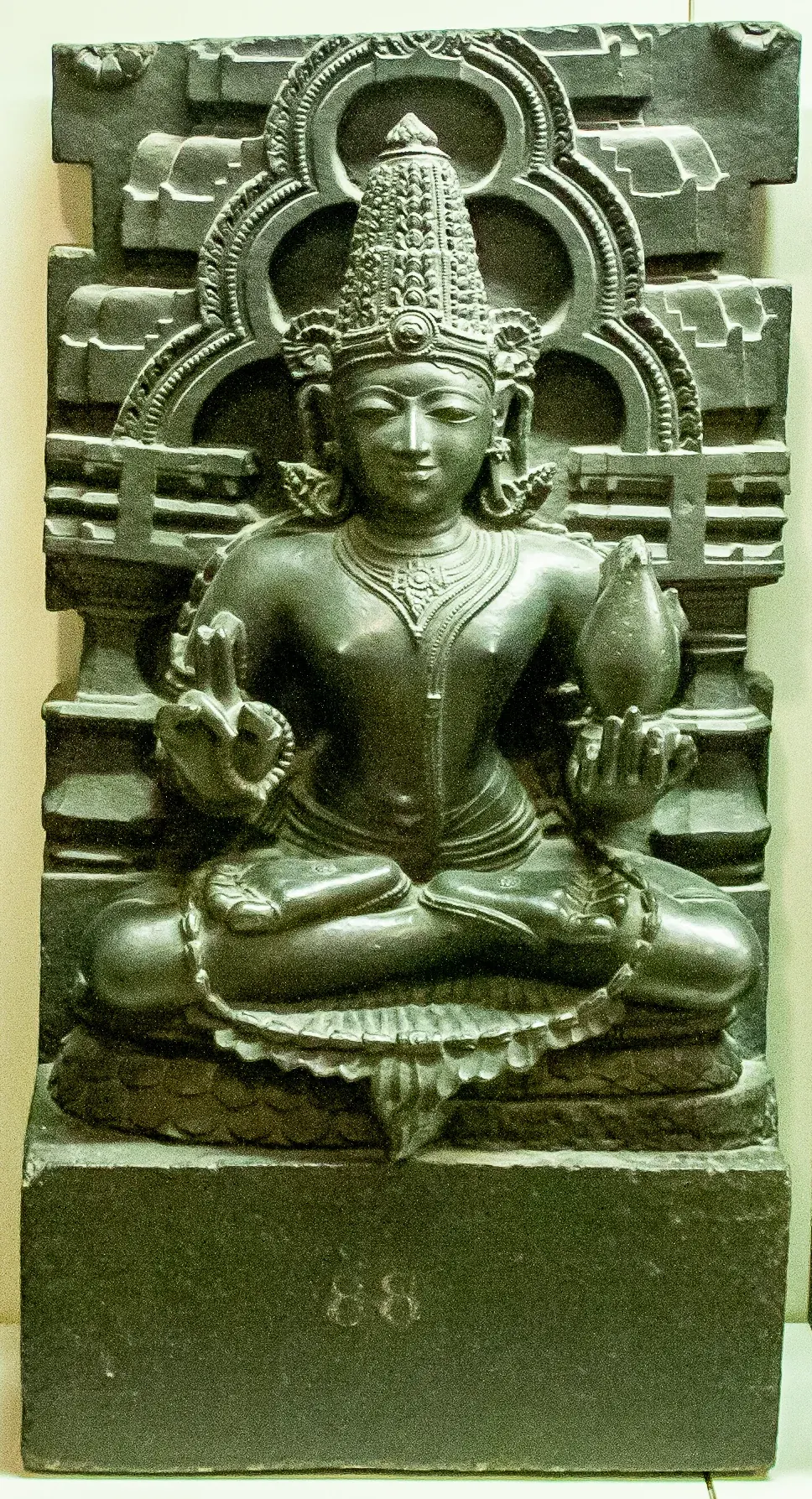
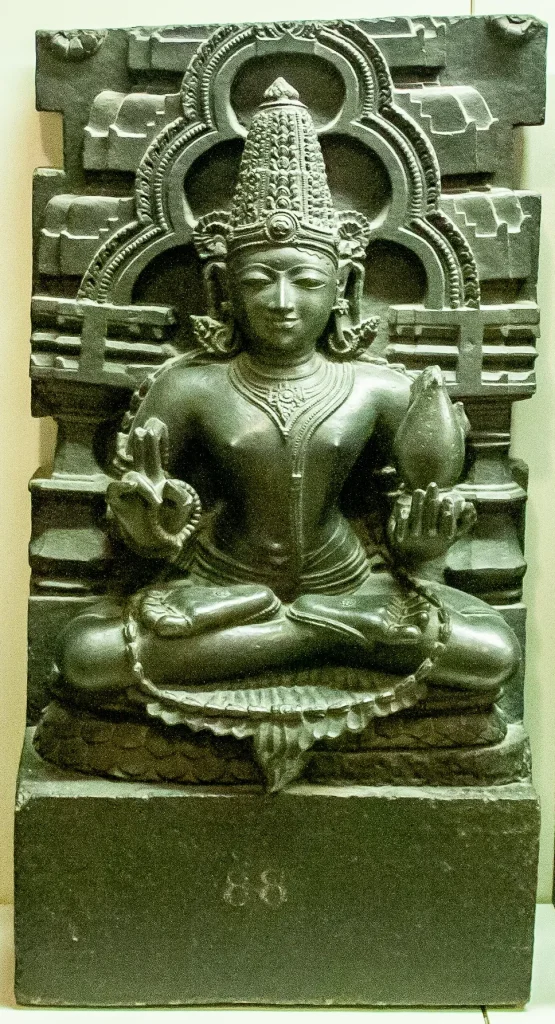
_-_relief_from_the_British_Museum.jpg)
Essential distinction: Vedic Soma, the sacred offering and deity praised in early hymns, has lunar connections that became increasingly explicit in later traditions. “Soma” and “Chandra” often overlap, but they should not be treated as perfectly identical in every text, period, or ritual context.
Chandra Dev at a glance
| Name | Chandra (“shining” or “bright”); Soma is a major related name |
|---|---|
| Navagraha correspondence | The Moon |
| Weekday | Monday (Somavāra) |
| Common associations | Cool light, lunar time, nourishment, mind, responsiveness |
| Iconography | A radiant male deity, often with a crescent or lunar disc and a chariot; details vary |
| Astronomy | Earth’s only natural satellite |
| Parent guide | The Navagraha |
Who is Chandra in Hindu tradition?
Chandra is both a deity encountered in story and worship and one member of the nine Navagraha. His changing light provides a natural language for waxing and waning, growth and decline, recurrence, memory, fertility, and the measurement of time. Poets compare the Moon’s cool beauty with a face, a jewel, or soothing light, while ritual calendars use lunar motion with considerable technical precision.
No single biography covers every source. The Viṣṇu Purāṇa, available here through H. H. Wilson’s historical translation, is one textual witness for later lunar genealogies; other Purāṇas and recensions preserve different details. These accounts should be read as named sacred narratives connected with lunar time, not blended into one uncontested biography or treated as scientific mechanisms for the phases.
Chandra and Soma: connected, not always interchangeable
In the Rigveda, Soma is prominently the pressed ritual substance, the deity addressed through it, and a source of inspired, vital power. Lunar identification is not the only meaning operating in those hymns. Later literature more firmly associates Soma with the Moon, plants, sap, nourishment, and the cycle of replenishment. Chandra, “the shining one,” becomes a common name for the lunar deity.
This layered history matters. Saying “the Vedas worship Chandra exactly as a later Navagraha” compresses distinct textual worlds. A more accurate formulation is that early Vedic traditions contain solar, lunar, Soma, calendrical, and eclipse materials that later Hindu traditions interpreted and reorganized in new ways. Continuity and development can both be true.
Lunar time: tithi, paksha, and nakshatra
Chandra is inseparable from the structure of many Hindu calendars. A tithi is a lunar day defined by the changing angular relationship between the Moon and Sun; it is not simply a midnight-to-midnight civil date. The bright half of a lunar month is shukla paksha, when the visible illuminated portion generally grows, and the dark half is krishna paksha, when it generally diminishes.
- Amavasya: the new-moon tithi and a significant ritual point in many calendars.
- Purnima: the full-moon tithi, associated with numerous observances across different regions and traditions.
- Nakshatra: one of the traditional divisions along the Moon’s path; different lists and technical conventions require specialist context.
- Month naming: regional calendars may be amanta or purnimanta, so month boundaries are not uniform across India and the diaspora.
Because local almanacs use location and lineage-specific rules, exact observance timing should be checked with an appropriate panchanga or temple calendar. A generic article should not turn one location’s lunar date into a worldwide rule.
What Chandra looks like
There is no single mandatory image of Chandra. The Metropolitan Museum of Art catalogs a late fourteenth- or early fifteenth-century Tibetan Mandala of Chandra, while the Cleveland Museum’s Central Indian Navagraha relief identifies Chandra within a nine-figure ensemble. These specific objects document different settings and periods; neither provides a universal checklist for Chandra’s complexion, hands, vehicle, or attributes.
In a Navagraha ensemble, Chandra may be less elaborate than in an independent image. The Cleveland Museum of Art’s 8th-century panel identifies the Moon among a row of nine celestial bodies, where several planetary figures look similar. Iconography must therefore be read object by object: a museum date, place, material, and curatorial identification support that particular artwork, not every later popular color chart.
The Moon in modern astronomy
The Moon is a rocky natural satellite orbiting Earth. Its phases arise because we see different portions of its sunlit half as the Moon changes position relative to Earth and the Sun. The Moon does not generate its own visible light; it reflects sunlight. A full cycle of phases takes about 29.5 days, while its orbit relative to the stars is shorter. These different cycles help explain why lunar calendars require careful calculation.
The same disciplined separation applies to eclipses. A lunar eclipse occurs when Earth’s shadow falls on the Moon; a solar eclipse occurs when the Moon passes between Earth and the Sun for observers in the relevant path. In Navagraha narratives, Rahu and Ketu personify eclipse forces. Astronomy explains the geometry, while narrative and ritual express religious meaning.
Chandra in Jyotiṣa
Jyotiṣa schools interpret Chandra through different textual rules and chart contexts. Those readings belong to a traditional interpretive discipline and should not be converted into a one-word personality label, a clinical diagnosis, or a claim that the physical Moon scientifically determines a person’s mind or life events.
These are traditional interpretive associations, not scientific findings that the Moon causes a person’s temperament, mental-health condition, fertility, or relationship outcome. A responsible guide does not diagnose a “weak Moon,” guarantee emotional healing through a remedy, or discourage professional care. Astrology can be studied as a religious and cultural system without overstating its evidence.
Chandra worship and Monday observance
Monday is associated with Soma or Chandra in many traditions, while Monday worship may focus on Shiva in other communities. Practices differ by family, temple, region, and lineage, so follow locally taught procedures rather than a universal online list. Fasting is not required of every Hindu and may be medically unsuitable for some people.
- Ask a temple what offerings are accepted before bringing milk, rice, flowers, or other materials.
- Do not stare at the Sun while looking for a daytime Moon; protect your eyes and follow eclipse-viewing safety guidance.
- If fasting affects diabetes, pregnancy, medication, an eating disorder, or another health condition, seek qualified medical advice and choose a non-food form of observance.
- Treat mantras and ritual counts as lineage-specific. Learn pronunciation and procedure from a trusted teacher rather than an unsourced promise page.
Devotees may pray for steadiness, clarity, family well-being, or peace. Such intentions are meaningful within worship, but no ritual can be guaranteed to cure anxiety, restore a relationship, secure conception, or control another person. The ethical center is devotion and responsible action, not fear-based purchasing.
Frequently asked questions
Is Chandra male or female?
Chandra is usually personified as a male deity in Sanskrit and temple traditions. Grammatical gender and divine personhood should not be confused with the Moon’s gender in every language or culture, which can differ.
Are Chandra and Soma the same deity?
They frequently overlap in later Hindu usage, and Monday is called Somavāra. In early Vedic hymns, however, Soma has important ritual and divine meanings beyond a simple synonym for the physical Moon. Context determines the best translation.
Why does the Moon wax and wane?
Astronomically, phases result from the changing portion of the Moon’s sunlit half visible from Earth. Purāṇic stories give sacred and moral meanings to the cycle; they should not be presented as competing physical calculations.
What should I offer Chandra?
There is no universal offering list. Water, pale flowers, food, lamps, prayer, and charity appear in different practices, but a temple’s rules and a family lineage take priority. Avoid waste and do not pour materials into waterways.
Does worshipping Chandra improve mental health?
Prayer may be personally comforting, but it is not a guaranteed treatment. Jyotiṣa’s association between Chandra and the mind is traditional symbolism, not a clinical diagnosis. Seek a qualified mental-health professional when support is needed.
Sources and further reading
- NASA Science, “Moon Facts”—physical characteristics, orbit, and modern lunar science.
- NASA Science, “Moon Phases”—astronomical explanation of the lunar cycle.
- Metropolitan Museum of Art, Mandala of Chandra, God of the Moon—collection record for a late medieval Tibetan artwork.
- Cleveland Museum of Art, Nine Celestial Bodies (Navagraha)—dated ensemble including the Moon.
- Ralph T. H. Griffith, trans., Hymns from the Rigveda—a historical English translation; use alongside current scholarship and note its date.
- H. H. Wilson, trans., The Vishnu Purana—a historical translation of a later primary text; narrative details are text-specific.