Navagraha guide
Rahu is the mythic and Jyotiṣa name associated with the Moon’s ascending, or north, orbital node. It is not a physical planet, moon, or hidden object. In astronomy, the node is the point where the Moon crosses the ecliptic from south to north. In Hindu narrative and sacred art, Rahu is personified—often as a severed head—and linked with eclipses. These are related but distinct ways of understanding the same cultural figure: geometry describes how an eclipse occurs; narrative gives that event religious and symbolic form.

Rahu at a glance
- Astronomical referent: the ascending lunar node, a calculated intersection rather than a material body.
- Navagraha role: one of the nine grahas in Jyotiṣa and many ritual or artistic groupings.
- Narrative form: the immortal severed head in a well-known churning-of-the-ocean account.
- Eclipse connection: eclipses can happen only when the Sun and Moon align near the lunar-node axis.
- Practice: forms of prayer and offering vary by temple, household, region, and lineage; worship is not a guaranteed method for changing an outcome.
What is Rahu?
The word Rahu can point to three connected ideas. First, it names a figure in Hindu eclipse narratives. Second, it names a member of the Navagraha, the nine grahas used in Jyotiṣa and represented in many temples. Third, in astronomical language it corresponds to the ascending node of the Moon’s orbit. Confusion begins when these three meanings are collapsed into one literal claim.
Calling Rahu a “shadow planet” is common English shorthand in astrological writing, but it should not be mistaken for a scientific classification. Rahu has no rocky or gaseous globe, mass, atmosphere, or reflected surface that a spacecraft could visit. It is a mathematical point defined by two orbital planes. The Sun and Moon are also counted among the nine grahas, so “graha” does not map neatly onto the modern astronomical category “planet.”
The lunar nodes and eclipse geometry
Imagine two broad circles projected onto the sky. One is the ecliptic, the apparent annual path of the Sun and the plane of Earth’s orbit. The other is the Moon’s orbit around Earth. The Moon’s orbit is tilted by about five degrees to the ecliptic, so the circles intersect at two opposite points. The Moon crosses from south of the ecliptic to north at the ascending node, associated with Rahu. It crosses back from north to south at the descending node, associated with Ketu.
This tilt explains why there is not an eclipse every month. A solar eclipse requires a new moon near one of the nodes, where the Moon can pass between Earth and the Sun. A lunar eclipse requires a full moon near a node, where Earth can stand between Sun and Moon. NASA describes the periods when these alignments are possible as eclipse seasons. The nodes identify the crossing geometry; they do not physically swallow or cast the shadow.
| Framework | What Rahu means | What it does not mean |
|---|---|---|
| Astronomy | The Moon’s ascending crossing of the ecliptic | A planet or object occupying that point |
| Mythic narrative | The severed, immortal head that pursues Sun and Moon | A modern physical explanation of shadows |
| Jyotiṣa | A graha interpreted within a chart and tradition | A scientifically measured force proving a fixed destiny |
| Sacred art and worship | A personified member of Navagraha ensembles | One universally standardized image or ritual |
Rahu in the churning-of-the-ocean account
A widely retold account places Rahu in the distribution of amṛta, the nectar of immortality, after the churning of the ocean. In K. M. Ganguli’s English translation of the Mahabharata, Book 1, Section XIX, a Danava named Rahu takes the guise of a deva and begins to drink. Surya and Soma recognize him and alert the others. Narayana cuts him with the discus after the nectar has reached his throat. The head rises into the sky, while the headless trunk falls; the passage explains eclipses through Rahu’s continuing hostility toward Sun and Moon.
Two cautions improve the telling. First, this passage calls the drinker Rahu and describes both head and trunk, but it does not name the trunk Ketu. The familiar Rahu-head/Ketu-tail pairing reflects later synthesis and development rather than every version using identical names. Second, an older Ṛgveda hymn, 5.40, speaks of Svarbhanu covering Surya with darkness and of Atri finding or restoring the Sun. It should not be silently rewritten as the full later nectar story. Texts of different periods and genres preserve related eclipse imagery without offering one uniform biography.
Historian of science Rajesh Kochhar argues that Rahu and Ketu’s roles as planetary deities developed alongside mathematical accounts of eclipses in the first millennium CE. That historical proposal helps explain why precise node astronomy, older eclipse beings, later narrative, and temple personification can coexist. It is a scholarly interpretation of development—not a reason to dismiss religious meaning or to present mythology as a failed science lesson.
How Rahu is shown in art
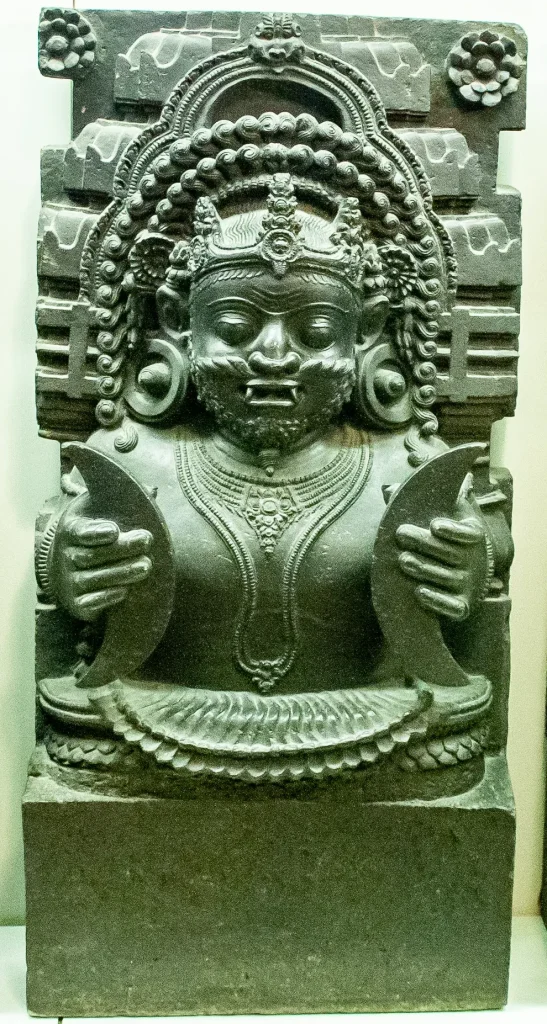
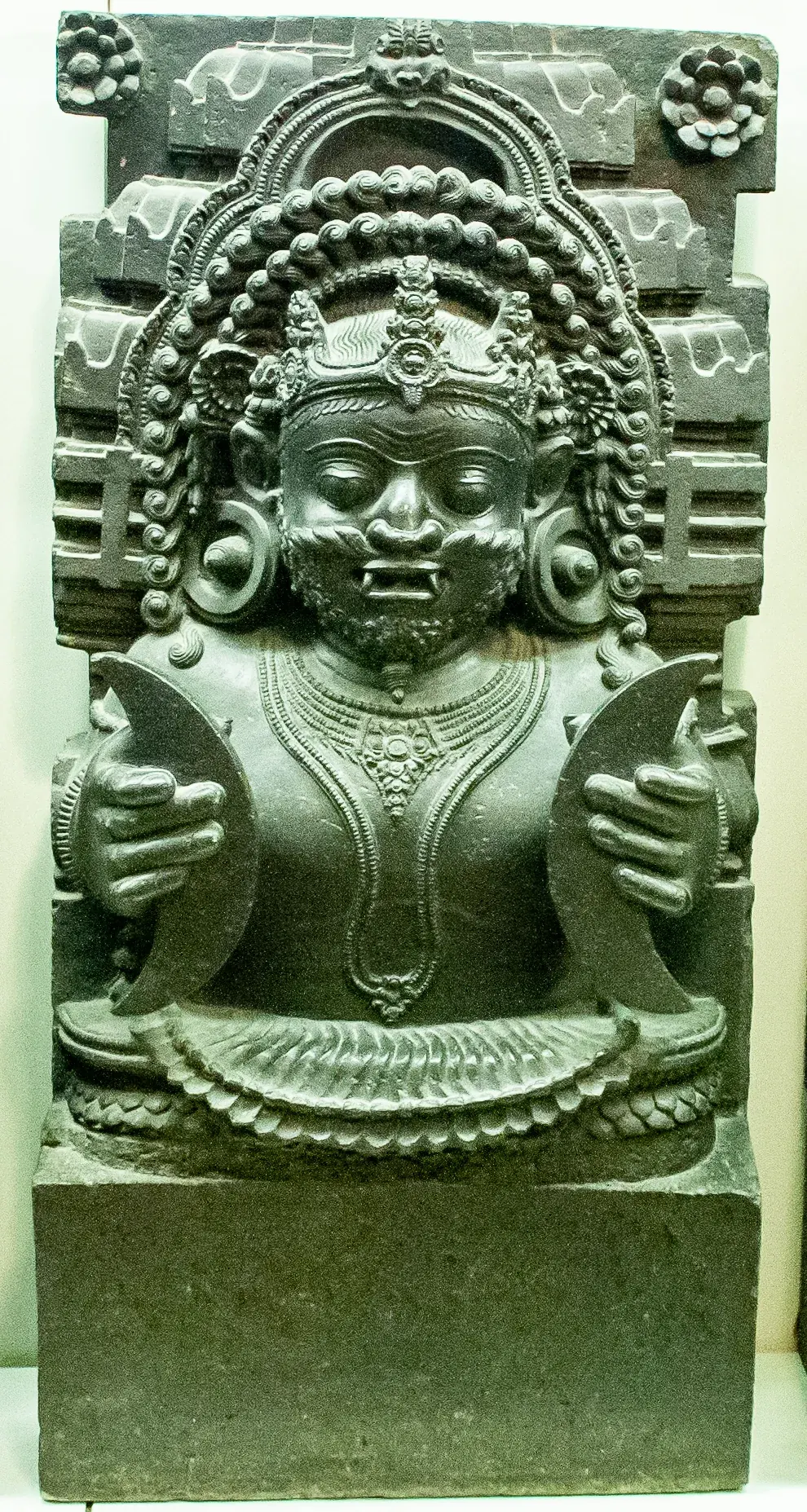
Rahu is frequently recognizable as a large head or as an upper body without ordinary legs. A fierce face, prominent mouth or teeth, crown, halo, multiple arms, weapons, gesture of offering, or animal mount may appear depending on place and date. Getty’s iconography authority summarizes Rahu as a Hindu mythic character often represented as the severed head of an asura and associated with Ketu and eclipses. That is a useful identification aid, not a complete rulebook.
Navagraha sculpture also changes across regions and centuries. Rahu may sit in a row with seven visible luminaries and Ketu, occupy a directional position in a temple scheme, or appear in a manuscript or modern print. Number of arms, objects held, complexion, posture, and mount are not uniform. When identifying an artwork, use its museum record, inscription, findspot, and the full ensemble rather than assuming every fierce disembodied figure is Rahu.
Rahu in Jyotiṣa—without fatalism
Jyotiṣa schools interpret Rahu and Ketu as an axis through their own textual rules and complete-chart contexts. Modern keyword lists differ and should not be mistaken for a single scriptural definition, a deterministic forecast, or a scientific diagnosis of personality.
A chart reading should not be framed as proof that misfortune, illness, addiction, relationship failure, or spiritual danger is inevitable. Terms such as dosha are used differently across lineages, and automated charts can hide those assumptions. Readers may treat Jyotiṣa as a religious, cultural, or advisory tradition while still making medical, legal, financial, and mental-health decisions with qualified professionals and ordinary evidence.
Worship and respectful practice
Rahu is honored within some collective Navagraha settings and dedicated shrines. Procedures vary by temple, family, region, and lineage. A visitor should follow the guidance of that community rather than treating a web checklist of days, colors, foods, offerings, or mantras as universally binding.
Devotional practice can provide reflection, continuity, or a way to approach uncertainty, but no ethical source can promise that a specific offering will erase karma, cure disease, secure a visa, defeat an enemy, prevent an eclipse, or guarantee wealth. Avoid fear-based sellers who claim that only an urgent paid remedy can protect you. If fasting is part of your own tradition, adapt it for health, age, pregnancy, medication, and work needs with appropriate professional advice.
Frequently asked questions
Is Rahu a real planet?
No. Rahu corresponds astronomically to the ascending lunar node, an intersection point calculated from the Moon’s orbit and the ecliptic. “Planet” or “shadow planet” is conventional astrological language, not a modern astronomical classification.
Does Rahu cause eclipses?
In narrative, Rahu swallows or attacks the Sun and Moon. In physical astronomy, eclipses result from Sun-Earth-Moon alignment near either lunar node. Rahu can name one of the required crossing points, but it is not a body casting a shadow.
Are Rahu and Ketu two halves of one being?
That is a prominent later interpretation: Rahu is the head and Ketu the trunk or tail. The Mahabharata passage cited above describes Rahu’s separated head and trunk but does not call the trunk Ketu, so the exact identification should be attributed to later tradition rather than imposed on every textual witness.
Is Rahu always harmful in a birth chart?
No responsible general guide can make that claim. Jyotiṣa interpretations depend on the entire chart and the practitioner’s method. They are not deterministic medical or life predictions, and different schools may judge the same placement differently.
Must everyone perform a Rahu remedy?
No. Hindu practice is diverse, and many people do not perform dedicated Rahu worship. Those who do should follow a trusted community or teacher without expecting guaranteed outcomes or responding to manufactured fear.
Sources and further reading
- NASA Science, “Why Do Eclipses Happen?”—Moon-orbit tilt, alignment, shadows, and eclipse seasons.
- Kisari Mohan Ganguli (trans.), The Mahabharata, Volume I, Book 1, Section XIX—Rahu, the nectar, severing, and eclipse narrative.
- Ṛgveda 5.40, English translation—Svarbhanu, Surya’s darkness, and Atri; an earlier textual witness distinct from the later nectar account.
- Rajesh Kochhar, “Rahu and Ketu in Mythological and Astronomological Contexts,” Indian Journal of History of Science 45.2 (2010): 287–297—historical development of eclipse imagery, nodes, and planetary-deity roles.
- Getty Research Institute, CONA Iconography Record: Rahu—museum-authority summary and association with Ketu.