Navagraha guide
Ketu is the mythic and Jyotiṣa name associated with the Moon’s descending, or south, orbital node. It is not a physical planet or an unseen object. Astronomically, this node is where the Moon crosses the ecliptic from north to south. In later Hindu narrative and art, Ketu is often understood as the headless trunk or tail paired with Rahu. In Jyotiṣa, Ketu is interpreted as a graha. These astronomical, narrative, artistic, and astrological meanings are connected, but they should not be treated as identical kinds of claim.

Ketu at a glance
- Astronomical referent: the descending lunar node, a calculated intersection in orbital geometry.
- Navagraha role: one of the nine grahas represented in Jyotiṣa, ritual, and sacred art.
- Narrative identity: commonly the headless body or tail paired with Rahu in later accounts.
- Artistic forms: human upper body with a serpent or tapering lower body, a headless form, or other regional variants.
- Practice: worship varies; it may be meaningful without guaranteeing protection, health, wealth, or a changed horoscope.
What is Ketu?
Ketu belongs to the Navagraha, but “graha” is a traditional category rather than another word for a modern planet. The group includes the Sun and Moon as well as Rahu and Ketu. Ketu therefore does not need to be a physical world to have a role in Jyotiṣa or religious life. Astronomers can calculate the same orbital point without treating it as a person, while worshippers and artists may address or depict Ketu as a sacred figure.
“South node” and “descending node” are equivalent here. The terms describe the direction of the Moon’s crossing relative to the ecliptic, not a location in Earth’s southern hemisphere and not an object below the ground. Ketu and Rahu remain opposite ends of one node axis.
The descending node in eclipse geometry
The ecliptic is the apparent path followed by the Sun across the sky and corresponds to the plane of Earth’s orbit. The Moon’s orbital plane is inclined by about five degrees. Where the two planes intersect, they create two opposite nodes. At Rahu, the Moon crosses from south of the ecliptic to north. At Ketu, it crosses from north to south.
Most new and full moons pass too far above or below the necessary alignment for an eclipse. A solar eclipse becomes possible when a new moon is close to either node, allowing the Moon’s shadow to fall on Earth. A lunar eclipse becomes possible when a full moon is close to either node, allowing the Moon to pass through Earth’s shadow. NASA calls the windows in which the geometry lines up “eclipse seasons.” Both nodes can host eclipse alignments; Ketu is not a special object emitting darkness.
| Question | Ketu | Rahu |
|---|---|---|
| Which lunar node? | Descending (north-to-south crossing) | Ascending (south-to-north crossing) |
| Physical planet? | No | No |
| Common later body image | Headless trunk, tail, or serpent-bodied figure | Severed head or upper body |
| Can an eclipse occur nearby? | Yes, with the required new- or full-moon alignment | Yes, with the required new- or full-moon alignment |
| Jyotiṣa relationship | Interpreted together as an opposing axis, with methods varying by school | |
From Rahu’s severing to the Rahu–Ketu pair
The best-known story begins during the distribution of amṛta after the churning of the ocean. In K. M. Ganguli’s translation of the Mahabharata, Book 1, Section XIX, a Danava named Rahu disguises himself and drinks among the devas. Surya and Soma expose him. Narayana’s discus separates his head after the nectar has reached his throat. The immortal head rises, the trunk falls, and the story connects Rahu’s continuing pursuit of Sun and Moon with eclipses.
A common later retelling identifies the head as Rahu and the headless trunk or tail as Ketu. Yet the cited Mahabharata passage itself does not use the name Ketu for the trunk. This is an important source caveat: the familiar two-part biography is meaningful and widespread, but it should be described as a later identification rather than quoted as if every early witness stated it.
The names also have histories beyond this single story. Ṛgveda 5.40 describes Svarbhanu obscuring Surya and Atri recovering the Sun, without narrating the nectar episode or a Rahu–Ketu body split. Historian of science Rajesh Kochhar notes that ketu had a range of earlier uses, including luminous signs and comet-like phenomena, before Ketu became established as the descending node and a paired planetary deity. His account is a scholarly reconstruction of historical development; Hindu textual and regional traditions need not reduce the figure to one linear origin story.
Ketu’s iconography and why it varies
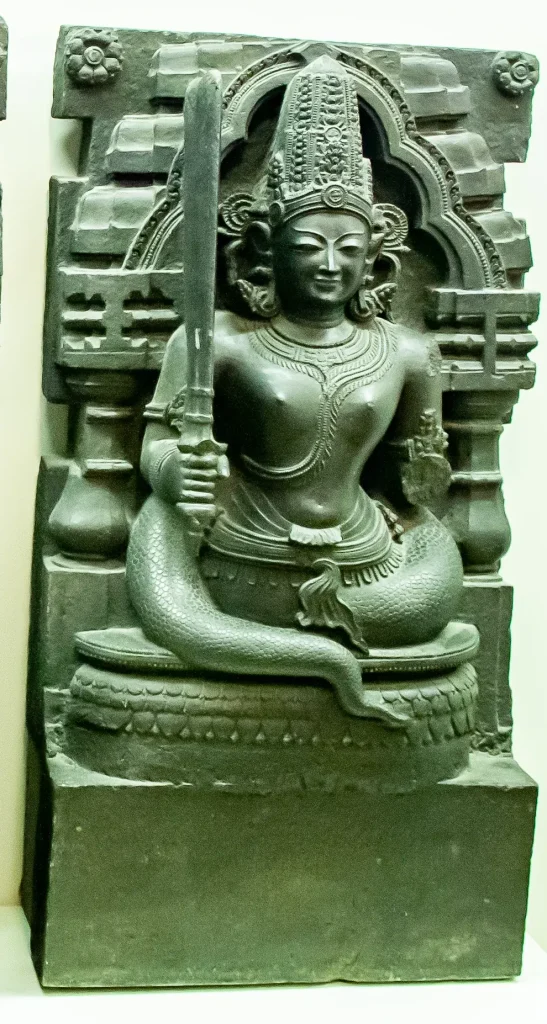
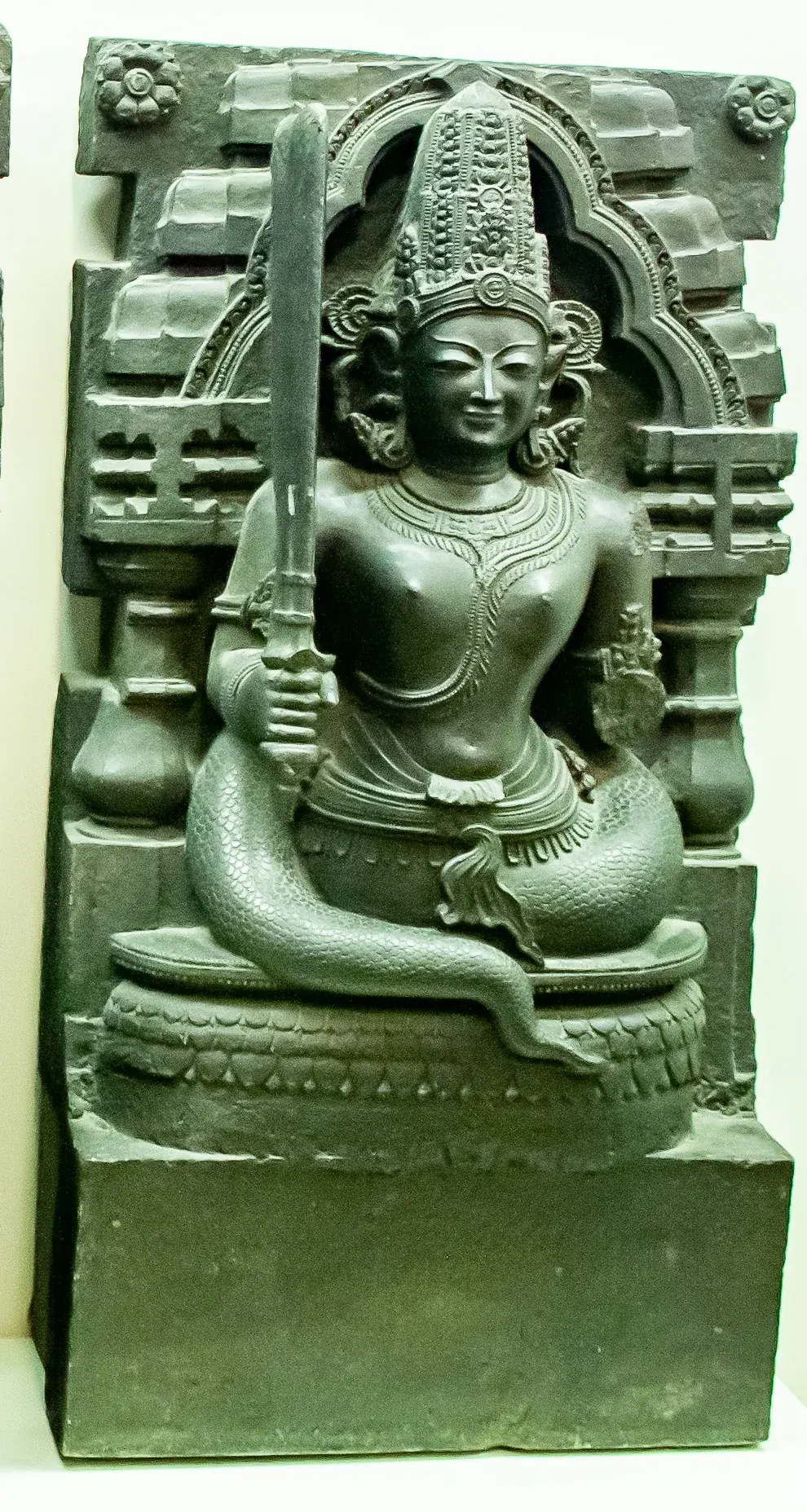
Ketu’s visual identity often communicates incompleteness or a tail-like body. Some images show a human torso ending in a serpent coil or tapering tail; some emphasize a headless body; some give Ketu a crowned head, multiple arms, weapons, banners, or gestures. A vulture or other mount appears in certain iconographic traditions, but no single arrangement should be presented as universal.
Museum collections make the variation visible. The Buffalo AKG Art Museum holds Ketu, The Tail of Rahu from a twentieth-century Navagrahas—The Planets series, a title that records one modern artistic interpretation of the paired body. Getty’s cultural-object authority separately catalogs Rahu and Ketu as associated Hindu mythic characters. Such records establish how particular works or cataloging traditions identify the figures; they do not prove that every temple image follows the same form.
Context is therefore essential. In a Navagraha row, neighboring figures, inscriptions, directional placement, hand-held objects, date, and region help identify Ketu. The older semantic range of ketu and the later node-personification also help explain why comet, banner, flame, serpent, and tail imagery can overlap without yielding one simple checklist.
Ketu in Jyotiṣa—interpretation, not destiny
Jyotiṣa schools interpret Ketu through their own textual rules and complete-chart contexts. Modern keyword lists differ and should not be mistaken for universal translations, deterministic forecasts, or laboratory findings.
Ketu should not be used to tell someone that illness, bereavement, infertility, divorce, mental distress, or spiritual failure is certain. A birth chart is not a medical test, legal judgment, or scientific risk model. Even within Jyotiṣa, a node is interpreted in context rather than through one placement alone. Readers can respect astrological practice while refusing fatalism, stigma, and fear-driven sales claims.
Worship and respectful practice
Ketu is included in some Navagraha settings and dedicated shrines. Details differ among temples, communities, households, and teachers. A visitor should follow local guidance rather than treating one source’s color, weekday, number, grain, offering, or mantra as a universal online “remedy” list.
Devotion may be undertaken for reverence, steadiness, repentance, or reflection during uncertainty. It should not be sold as a guaranteed cure, protection contract, debt solution, examination result, immigration outcome, or way to control another person. Be wary of anyone who diagnoses an urgent “Ketu problem” and insists that only an expensive service can remove it. Health conditions, crisis, and major financial or legal choices call for qualified professional help.
Frequently asked questions
Is Ketu a planet?
No. In astronomy, Ketu corresponds to the descending lunar node, a calculated crossing point. It is called a graha within Jyotiṣa, but that traditional category is not the same as the modern scientific category “planet.”
Is Ketu the south node?
Yes. “South node” and “descending node” refer to the point where the Moon crosses the ecliptic from north to south. Rahu is the opposite, ascending node.
Is Ketu literally Rahu’s body?
Many later narratives and images treat Ketu as Rahu’s separated trunk or tail. The Mahabharata passage cited here describes Rahu’s head and trunk but names only Rahu, so the explicit Ketu identification belongs to later development and should be labeled accordingly.
Does Ketu always mean loss?
No. “Loss” is an oversimplified keyword. Jyotiṣa schools interpret Ketu through the whole chart, and many also use language of insight, release, skill, or spiritual inquiry. None of these interpretations makes a specific life event inevitable.
Can worship of Ketu guarantee protection?
No ritual outcome can be guaranteed. Worship can be a sincere religious practice, but it should not replace medical care, practical safety, or professional advice, and it should not be marketed through fear.
Sources and further reading
- NASA Science, “Why Do Eclipses Happen?”—Moon-orbit tilt, alignment, shadows, and eclipse seasons.
- Kisari Mohan Ganguli (trans.), The Mahabharata, Volume I, Book 1, Section XIX—Rahu’s drink, severing, head and trunk, and the eclipse account.
- Ṛgveda 5.40, English translation—the earlier Svarbhanu eclipse account, which does not contain the later Rahu–Ketu split.
- Rajesh Kochhar, “Rahu and Ketu in Mythological and Astronomological Contexts,” Indian Journal of History of Science 45.2 (2010): 287–297—historical discussion of Ketu’s semantic range, node identification, and personification.
- Buffalo AKG Art Museum, Ketu, The Tail of Rahu from the series Navagrahas—The Planets—a cataloged modern artwork illustrating one Ketu interpretation.
- Getty Research Institute, CONA Iconography Record: Ketu—museum-authority identification and relationship to Rahu.