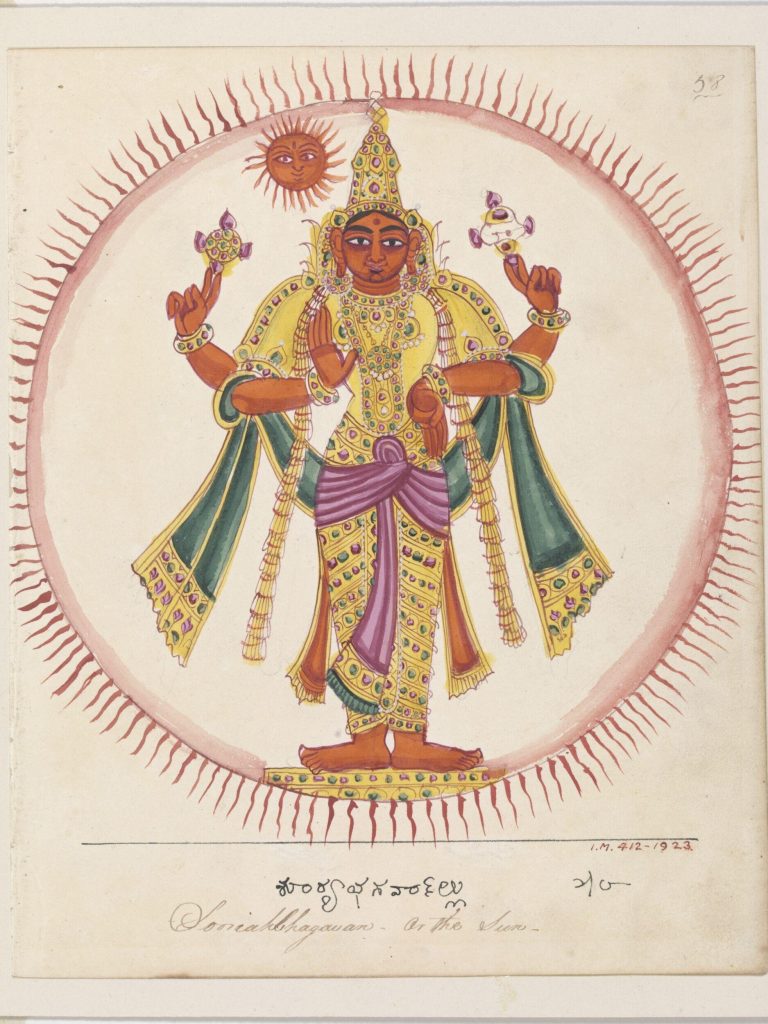
The Gayatri Mantra is a revered Vedic prayer that asks for the divine radiance of Savitr to inspire or guide our understanding. Its core verse is Rigveda 3.62.10, traditionally attributed to the seer Vishvamitra and composed in the gāyatrī meter. It is not primarily a request for money, victory, or a guaranteed result. It is a compact contemplation of sacred light and awakened discernment.
The mantra exists in more than one recitation form. The Rigvedic verse begins tat savitur vareṇyam. Many daily-practice traditions prepend Om and the three vyāhṛtis—bhūr, bhuvaḥ, svaḥ. Pronunciation, eligibility rules, visualization, and repetition counts vary by lineage, region, and household.
Gayatri Mantra in Sanskrit and transliteration
Common expanded recitation
ॐ भूर्भुवः स्वः ।
तत्सवितुर्वरेण्यं
भर्गो देवस्य धीमहि ।
धियो यो नः प्रचोदयात् ॥
IAST transliteration:
Oṃ bhūr bhuvaḥ svaḥ
tat savitur vareṇyaṃ
bhargo devasya dhīmahi
dhiyo yo naḥ pracodayāt
Core Rigvedic verse
The underlying verse in Rigveda 3.62.10 is:
tat savitur vareṇyaṃ
bhargo devasya dhīmahi
dhiyo yo naḥ pracodayāt
The Government of India’s Vedic Heritage Portal places this verse in Rigveda, Mandala 3, Sukta 62, and provides the recited Vedic text in its textual setting.[1] Calling the expanded form “the Gayatri Mantra” is normal contemporary usage, but distinguishing the core verse from its liturgical preface helps readers understand both history and practice.
A careful English translation
A clear, non-exclusive translation is:
We meditate upon the excellent radiance of the divine Savitr. May he inspire our understandings.
Translations differ because several Sanskrit words carry more than one shade of meaning. “Radiance,” “splendor,” or “effulgence” may render bhargas; dhī can refer to understanding, insight, vision, or inspired thought; and pracodayāt suggests impelling, directing, or inspiring. The plural forms dhīmahi (“we meditate/contemplate”) and naḥ … dhiyaḥ (“our understandings/thoughts”) give the verse a communal voice, even when one person recites it.
Word-by-word meaning
- tat — that
- savituḥ — of Savitr, the divine impeller or vivifier
- vareṇyam — excellent, choice-worthy, worthy of seeking or reverence
- bhargaḥ — radiance, splendor, illuminating power
- devasya — of the deity, of the divine one
- dhīmahi — we meditate upon, contemplate, or hold in inspired thought
- dhiyaḥ — understandings, insights, thoughts, or faculties of discernment
- yaḥ — who, which
- naḥ — our
- pracodayāt — may inspire, impel, or direct
Sanskrit sandhi changes how some words appear in the continuous verse. Thus the dictionary form savituḥ appears as savitur before the next word, and bhargaḥ appears as bhargo. A word-for-word gloss is helpful, but the mantra’s syntax and Vedic vocabulary do not reduce neatly to a single English slogan.
Who is Savitr?
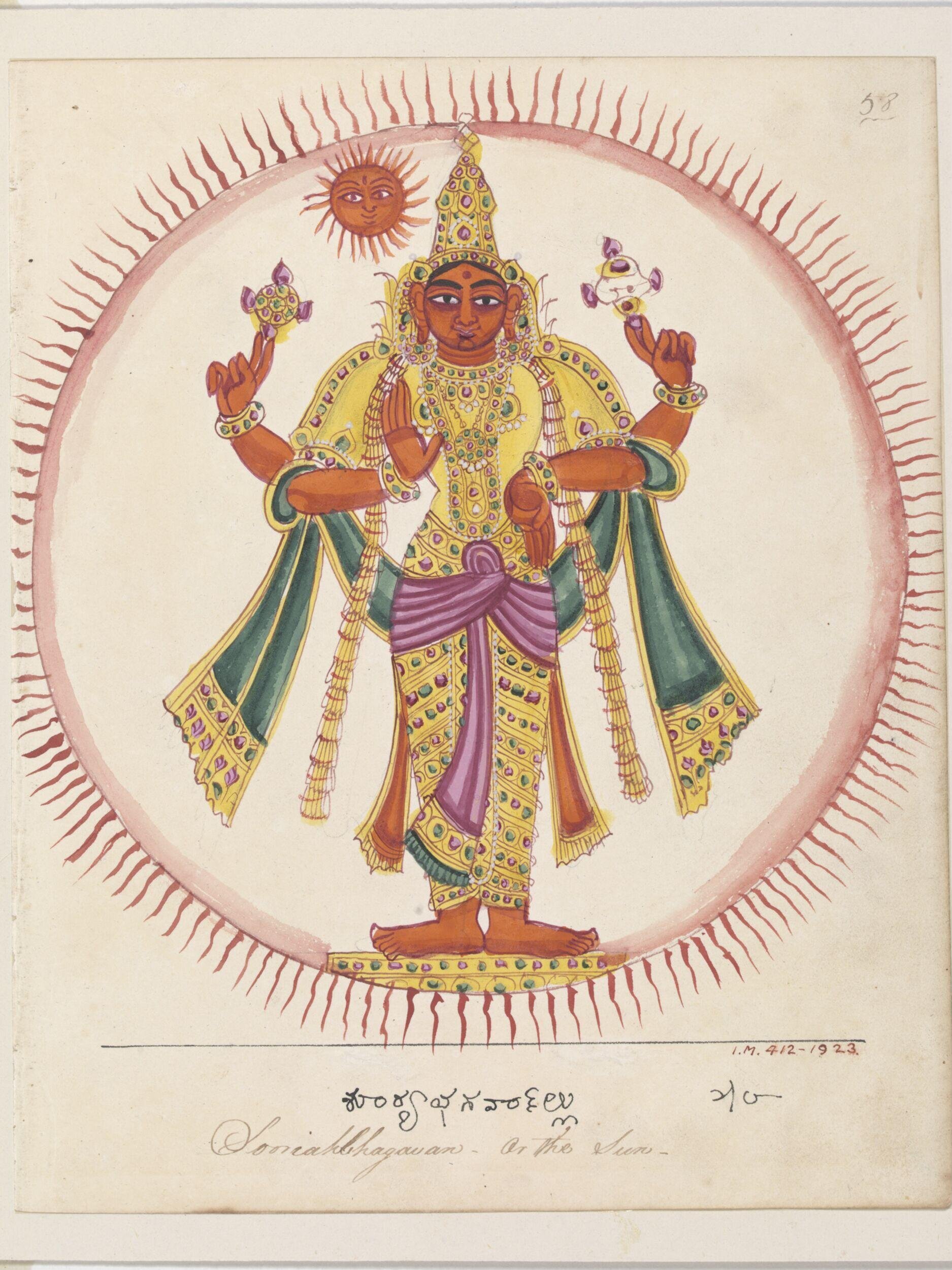
Savitṛ (commonly written Savitr or Savitar) is a Vedic deity associated with impelling, vivifying, and setting beings into motion. He has a close relationship with the sun, but translating the name simply as “the sun” loses some of the verse’s theological force. The Vedic Heritage Portal preserves the verse in its Rigvedic hymn context, where the address to Savitr is explicit.[1]
Later Hindu interpretations often understand the mantra’s divine light more broadly—as Brahman, the Supreme, the inner light of consciousness, or the grace of a chosen deity. Some devotional iconography personifies Gayatri as a goddess. These are important living traditions, but they should not be projected backward as though Rigveda 3.62.10 originally described every later form. Textual origin and later theological reception can both be honored without collapsing one into the other.
Why is it called the Gayatri Mantra?
Gāyatrī first names a Vedic meter, generally structured as three units of eight syllables. Rigveda 3.62.10 is the most celebrated verse in that meter and became known simply as “the Gayatri.” Gayatri also came to be personified as a goddess and identified in later tradition with the sacred verse itself. These connected senses—the Vedic meter, the mantra, and the personified goddess—belong to related but distinct historical layers.
Readers sometimes count the expanded preface as part of the meter and become confused. Om and bhūr bhuvaḥ svaḥ are not part of the three-line metrical verse. Vedic recitation can also preserve accents and phonetic details that ordinary Roman transliteration omits.
What do Om, bhur, bhuvah, and svah mean?
In the common expanded form, Om is the sacred syllable. Bhūr, bhuvaḥ, svaḥ are three vyāhṛtis, sacred utterances commonly associated with earth, the intermediate region, and heaven. English summaries sometimes render them as “physical, mental, and spiritual realms” or as stages of consciousness. Those can be contemplative interpretations, but the basic Vedic cosmological sense should not be erased.
Some rites use additional vyāhṛtis. The familiar three-word preface is therefore widespread, not the only form found in the broader textual and ritual tradition.
Traditional settings for recitation
The Gayatri has long been central to upanayana initiation and sandhyāvandana, the daily observance performed at transitional times, especially dawn and dusk. Historical texts often frame formal Vedic recitation through gender and varna-based eligibility. Modern Hindu practice is not uniform: some teachers preserve inherited restrictions, while reform movements, contemporary teachers, women’s lineages, and household communities teach the mantra more broadly.
A careful educational page should neither pretend that the historical restrictions never existed nor declare one community’s current rule binding on every Hindu. If you belong to a lineage, follow its guidance. If you are learning independently, approach the mantra with cleanliness, attention, and respect rather than using it as a promise-driven “hack.”
How to recite the Gayatri Mantra respectfully
- Choose a quiet time. Dawn and dusk are traditional, but regular attentive practice may be more realistic than an elaborate schedule.
- Sit steadily and breathe normally. No forceful breath retention is required for a basic recitation.
- Learn one pronunciation system. Hear the mantra from a competent teacher or reliable Vedic recitation source. Avoid mixing every online version.
- Recite at an unhurried pace. Keep long vowels long: dhīmahi begins with a long ī, and pracodayāt ends with a long ā followed by t.
- Attend to meaning. Contemplate illumination and discernment rather than racing through a count.
- Close quietly. Allow a short pause or prayer according to your tradition.
Some practitioners recite three, nine, 27, or 108 times, often with a mālā. No number guarantees intelligence, examination success, healing, or spiritual realization. Repetition can support a disciplined practice, but promised outcomes should be treated with caution.
Pronunciation notes and common variants
- Oṃ: often sounded smoothly as “om,” with a resonant ending; traditions differ in duration.
- bhuvaḥ: the final ḥ is visarga. Its realized sound may vary with recitation style and the following sound.
- vareṇyam: ṇ is a retroflex nasal; the final ṃ marks anusvara.
- dhīmahi: do not shorten the first vowel if aiming at Sanskrit pronunciation.
- pracodayāt: the “c” is like “ch” in “church,” not “k.”
North and South Indian teaching styles, Vedic śākhās, temple traditions, and modern devotional recordings may differ in pitch, accent, tempo, and sandhi. A recording that differs from yours is not automatically “wrong.” Vedic accent is a specialized oral discipline; learners should not infer it from unmarked Roman text.
What the mantra is—and is not
The Gayatri Mantra is a prayer and meditation on divine illumination. It can be understood devotionally, ritually, or philosophically. It is not a guaranteed cure, an instant method for raising IQ, or a substitute for study, therapy, or medical care. Personal testimonies about calm or clarity describe experiences, not universal clinical outcomes.
It is also not accurately reduced to “a prayer to the visible sun.” Sunrise is a powerful traditional setting, and Savitr is solar, yet the verse asks the deity’s radiance to inspire human understanding. Its spiritual reception has always been richer than solar observation alone.
Frequently asked questions
Can anyone chant the Gayatri Mantra?
Current Hindu answers vary. Some lineages limit formal recitation to those who have received instruction or initiation; many modern teachers offer it more widely. Respect the rules of the setting you enter and avoid declaring one position universal.
Is Gayatri a goddess or a mantra?
Both usages exist. Gayatri is the name of a Vedic meter, the famous mantra composed in that meter, and a later personified goddess associated with the mantra.
Is the Gayatri Mantra dedicated to the sun god Surya?
The Rigvedic verse addresses Savitr, a closely solar Vedic deity with an emphasis on impelling and vivifying power. Savitr and Surya overlap in solar symbolism but are not simply interchangeable in every Vedic context.
Must it be chanted 108 times?
No. One hundred and eight is a sacred and widely used repetition count, not a universal minimum. Quality, regularity, lineage, and attention matter more than making guaranteed claims about a number.
What is the best English translation?
No single translation captures every nuance. Prefer a version that preserves Savitr, divine radiance, collective meditation, and the prayer that our understandings be inspired.
Related HinduClarity Guides
Sources
- Government of India, Vedic Heritage Portal, Rigveda Shakala Samhita, Mandala 3, Sukta 62 — primary textual and recitation context for verse 3.62.10.
- Frits Staal, “Patterns of Mantra Use in a Vedic Ritual” — peer-reviewed study of how mantras function within Vedic ritual sequences.
- Rigveda 3.62, translated by Ralph T. H. Griffith — public-domain translation of the hymn in context; consult current scholarship for philological nuance.
- Internet Encyclopedia of Philosophy, “Upaniṣads” — broader context for later Hindu reflection on knowledge, Self, and ultimate reality.