Hindu festival guide
Krishna Janmashtami
A comprehensive guide to the birth of Krishna, midnight worship, fasting, Bhagavata traditions, regional celebrations, and date differences.
Krishna Janmashtami dates for 2026 and 2027
| Year | Observed date | Planning note |
|---|---|---|
| 2026 | Thursday, September 3 in many Smarta calendars; Friday, September 4 in some Vaishnava and ISKCON communities | Ashtami tithi, Rohini nakshatra, and lineage rules can produce different civil dates. |
| 2027 | Wednesday, August 25 | Ashtami tithi, Rohini nakshatra, and lineage rules can produce different civil dates. |
Calendar note: Janmashtami timing is one of the clearest examples of legitimate calendar variation. Follow your temple or sampradaya rather than declaring another community’s date wrong.
What Krishna Janmashtami means
Krishna Janmashtami celebrates the birth of Krishna, revered as an avatar of Vishnu, the speaker of the Bhagavad Gita, beloved child of Gokula, cowherd of Vrindavan, friend, teacher, and lord.
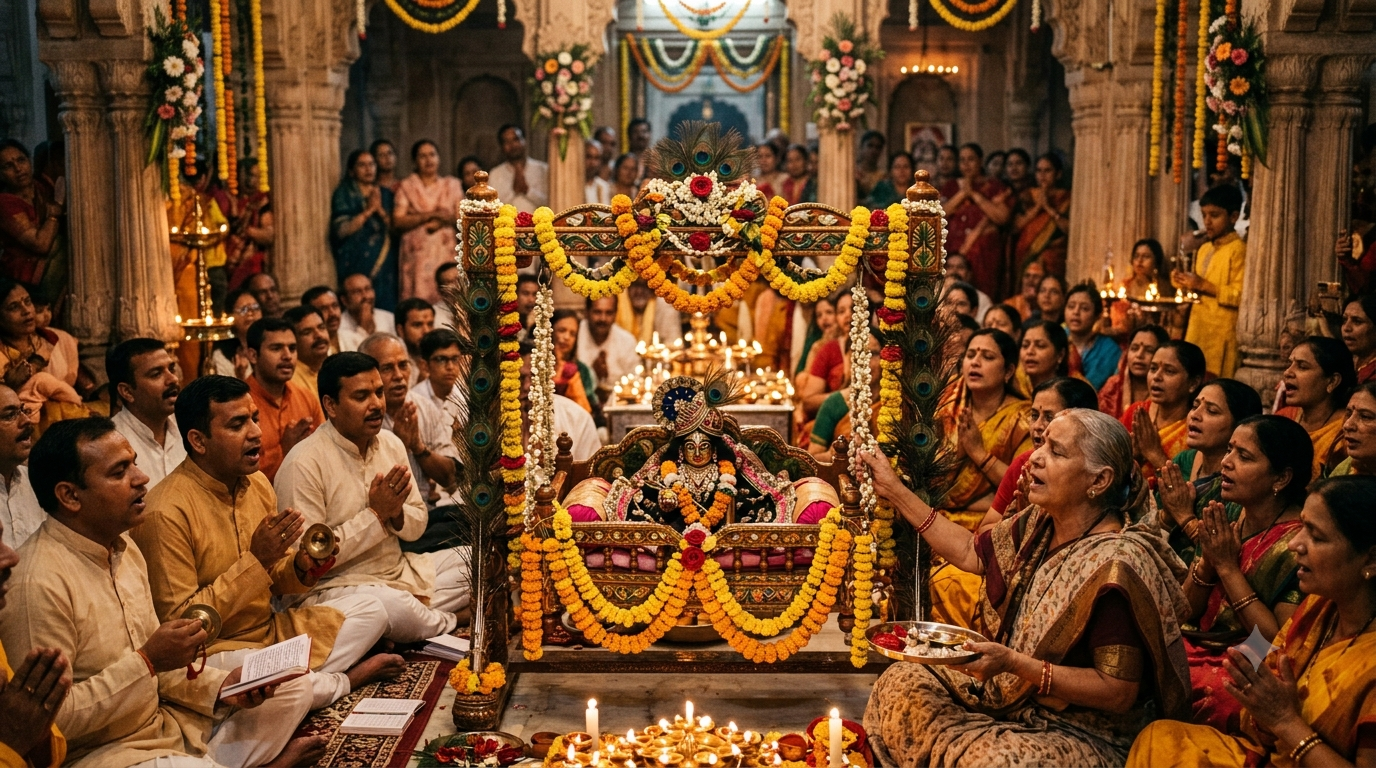
Devotees fast according to ability, sing bhajans, read the Bhagavata Purana or Bhagavad Gita, decorate a cradle, enact stories, and worship at midnight, the traditional hour of Krishna’s birth.
The festival carries different emphases across Vaishnava lineages. Child Krishna devotion, Radha-Krishna bhakti, temple liturgy, philosophy, drama, and community service may all appear.
Divine presence
Krishna’s birth in confinement symbolizes hope and the arrival of freedom within dangerous circumstances.
Lila
Childhood play reveals joy and intimacy in devotion, while remaining part of a disciplined theological tradition.
Dharma and wisdom
The later Krishna of the Mahabharata and Bhagavad Gita teaches action, devotion, knowledge, and discernment.
Sacred story and historical setting
The Bhagavata and Vishnu Purana traditions tell that Krishna is born to Devaki and Vasudeva in Mathura while the tyrant Kamsa imprisons them. Vasudeva carries the infant across the Yamuna to Gokula, where Krishna is raised by Yashoda and Nanda.
Kamsa’s fear of prophecy drives violence, while Krishna’s survival and later defeat of Kamsa restore hope. The narrative should be told with care around children, emphasizing courage, protection, and the defeat of unjust power.
Popular childhood stories and modern cartoons should not replace the study of named texts. Avoid sexualizing rasa-lila imagery or using Krishna’s play to excuse dishonesty, theft, or violations of consent.
How the festival is observed
The observance often builds through evening kirtan and reading, reaches a midnight puja, and concludes with arati and the breaking of the fast.
- Clean and decorate the shrine with flowers, leaves, lamps, and a small cradle if customary.
- Offer fruit, butter, milk sweets, tulsi leaves where permitted, and simple vegetarian foods.
- Read a named section of the Bhagavata Purana or Bhagavad Gita with translation.
- Sing kirtan while protecting neighbors, children, and hearing health from excessive sound.
- At midnight, perform arati, cradle worship, and prayer according to temple or family custom.
- Break the fast safely and distribute prasad without waste.
Food, offerings, and hospitality
Makhan mishri, panjiri, fruit, milk sweets, kheer, seedai, appam, and region-specific fasting foods are common. Vaishnava offering rules differ by lineage.
Use tulsi respectfully and only when allowed. Food offered at midnight must remain refrigerated or otherwise safe during a long program.
Regional and community traditions
Mathura and Vrindavan
Temple worship, jhanki tableaux, kirtan, pilgrimage, and midnight celebrations connect the festival with Krishna’s sacred geography.
Maharashtra: Dahi Handi
Teams form human pyramids to reach a suspended pot, a public custom that requires strict training, height limits, insurance, and emergency planning.
South India and Vaishnava temples
Kolam footprints, seedai, scriptural recitation, processions, and lineage-specific worship shape the day.
Observing in Trinidad and Tobago or the wider diaspora
Temples in Trinidad and Tobago may follow different Smarta or Vaishnava dates. Families should confirm the chosen mandir’s schedule and explain that a one-day difference is calendrical, not a doctrinal failure.
Music, dance, children’s tableaux, and Gita study can connect youth with the festival when scripts are respectful and do not turn sacred characters into comedy props.
A respectful home observance
- Decorate a small shrine and place safe symbolic baby footprints leading toward it.
- Read Krishna’s birth narrative and a short Gita passage.
- Offer fruit or a simple milk preparation and sing one or two bhajans attentively.
- Perform midnight worship only if household health and sleep needs permit; an earlier observance is acceptable.
- Support children, refugees, prisoners’ families, or another cause connected with safety and hope.
Good practice: Do not attempt unsupervised Dahi Handi pyramids. Fasting, late-night driving, open flame, dairy storage, and crowd density require planning. Never give honey or unsuitable foods to infants during ceremonial play.
Frequently asked questions
Why do Janmashtami dates differ?
Calendar rules weigh Ashtami tithi, midnight, Rohini nakshatra, and lineage conventions differently. Smarta and Vaishnava communities may therefore observe on adjacent days.
Must worship happen at midnight?
Midnight is traditional, but an earlier family puja is appropriate for children, older adults, workers, or anyone whose health requires rest.
Why is butter offered?
Butter recalls Krishna’s Gokula childhood and the affectionate stories of Yashoda’s household.
Is Dahi Handi a required religious ritual?
No. It is a regional public custom, especially associated with Maharashtra, and can be omitted entirely.
Sources and further reading
- Encyclopaedia Britannica – Krishna – Background on Krishna and major traditions.
- Drik Panchang – Janmashtami – Location-sensitive date and fasting timing.
- ISKCON – Janmashtami – Gaudiya Vaishnava observance and educational context.
- Bhagavata Purana translations – GRETIL – Textual research resource; select editions carefully.
Editorial and rights note: This educational overview is independently written from cross-checked facts and does not reproduce source text. External sources are cited for verification and further reading; citation does not imply endorsement. The hero is an illustrative AI-generated image created for HinduClarity, not a historical photograph or documentary record. This page is not a substitute for guidance from your temple, family tradition, qualified teacher, or licensed professional. Hindu calendars and practices vary by sampradaya, region, and location.
Back to the complete Hindu Festivals Calendar for 2026-2027
Continue with the Diwali guide or the Ganesh Chaturthi guide.