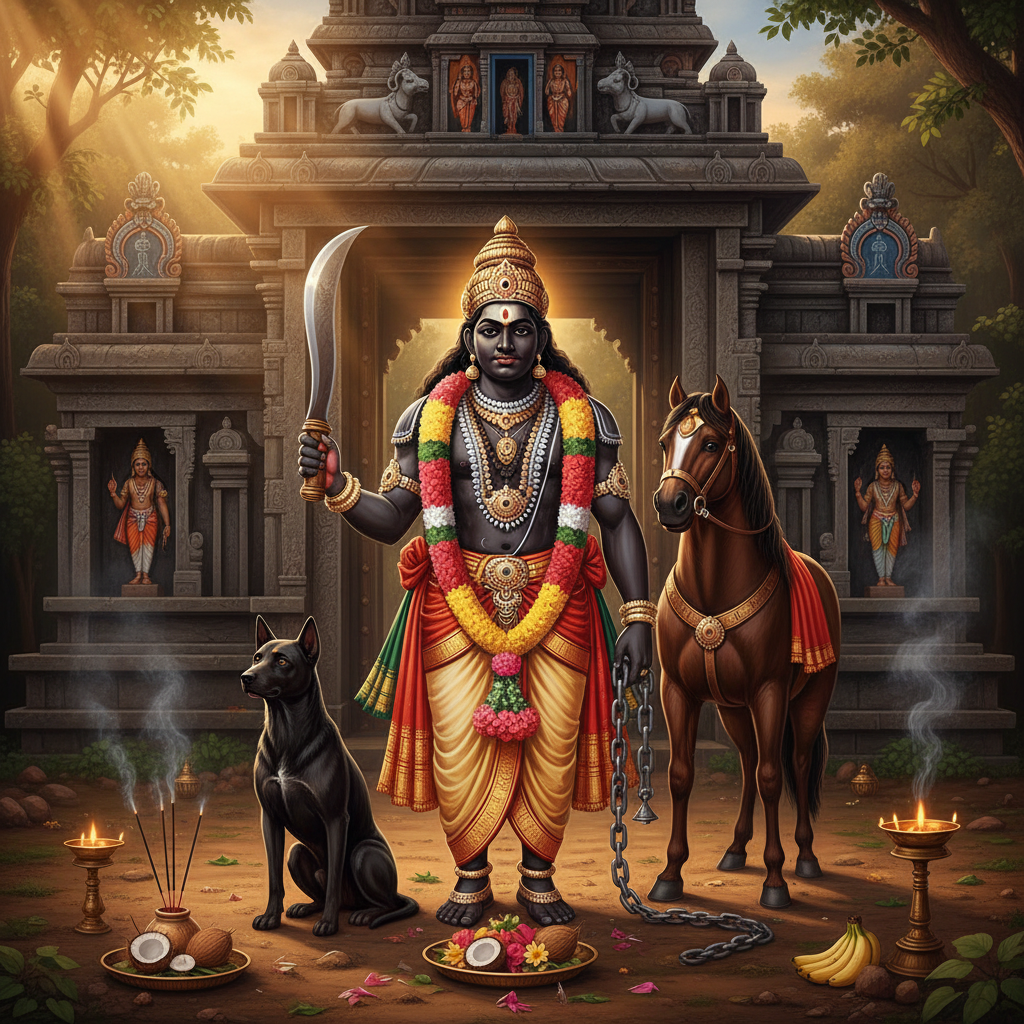
Sangili Karuppu—also called Sangili Karuppan and related in many communities to Karuppasamy—is a guardian deity within Tamil folk and village traditions. In Trinidad and Tobago, names may be heard as Sangani, Sangani Baba, Sangili Karuppu, or Karuppu Sami. These pronunciations and inherited identifications deserve respect, but they should not be forced into one universal genealogy.
Tradition note: Guardian-deity worship is highly local. A name, story, offering, or ritual used in one village, estate community, temple, or family may differ in another. Follow the guidance of the elders and officiants responsible for the specific tradition rather than treating an internet summary as ritual authority.
Who Is Sangili Karuppu?
Karuppu deities are widely revered as kaval deivam, protective guardians of a village, boundary, family, or shrine. Sangili Karuppu is often understood as a particular form within this broader religious world. Sangili means chain in Tamil, while karuppu means black or dark. The name may be connected with iconography, local narratives, and the deity’s formidable protective character.
It is more accurate to call him a Tamil guardian deity than to declare him an “avatar” in a way every community accepts. Some temples associate Karuppasamy with Ayyanar, Madurai Veeran, Muneeswaran, Draupadi Amman, Mariamman, or other deities. Relationships depend on local sacred geography and oral tradition.
Justice, Boundaries, and Community Memory
Sangili Karuppu is often approached as a vigilant protector and witness to truth. Devotees may pray for courage, the safety of family and land, fair resolution of conflict, or strength to keep a vow. Such devotion does not place anyone above civil law and should never be used to threaten an opponent.
Guardian worship also preserves community memory. Shrines may stand at an entrance, beneath a tree, or near the edge of settled land. The location says something important: sacred responsibility extends to thresholds, fields, roads, and relationships, not only to the inner sanctum of a large temple.
Iconography and Sacred Objects
- Aruval: a curved agricultural blade or sword, representing decisive protection and the cutting away of wrongdoing. It is a sacred emblem, not permission to carry or use a weapon.
- Sangili or chain: a distinctive attribute in some forms, interpreted as restraint, authority, or the binding of disorder.
- Whip, staff, or spear: vigilance and the enforcement of boundaries; objects vary by shrine.
- Horse: speed and the guardian’s readiness to patrol, especially in traditions linked with Ayyanar.
- Large eyes and moustache: alertness, mature authority, and an unmistakable village-guardian presence.
Dark colour in the name or image is sacred and powerful; it should never be interpreted through colour prejudice. Symbolic explanations differ and may be secondary to a community’s own origin story.
From Tamil Nadu to Trinidad and Tobago
Indentured migrants carried diverse village and family traditions from South India into the Caribbean. Over generations, names, songs, ritual roles, and relationships could be preserved, adapted, or combined. A Trinidadian form of “Sangani Baba” may therefore carry authentic local meaning even when its spelling does not match a modern Tamil catalogue.
Responsible teaching records who uses a name, where the practice is found, and what elders say, instead of inventing a Sanskrit source to make a folk tradition appear respectable. Oral history, temple practice, and community testimony are important sources, while still requiring careful attribution.
How to Show Respect
- Ask the responsible temple or family elder before making offerings or photographing a shrine.
- Keep the area clean and observe local rules about shoes, dress, food, and ritual boundaries.
- For simple home devotion, offer water, flowers, fruit, and a safely supervised light if this fits your family practice.
- Do not improvise animal sacrifice, alcohol offerings, spirit work, weapons, or trance practices. These matters are community-specific, legally and ethically sensitive, and require legitimate ritual authority.
- Express protection through practical dharma: keep promises, support neighbours, report violence, and use mediation or lawful help for disputes.
Claims about black magic, hidden enemies, or guaranteed revenge can intensify fear and conflict. Prayer may provide courage and belonging, but health, safety, abuse, crime, and legal problems need qualified professional assistance. No ethical officiant should use threats or demand escalating payments for a guaranteed supernatural result.
Frequently Asked Questions
Are Sangani and Sangili Karuppu definitely the same?
Not in every context. “Sangani” may be a local pronunciation or a distinct inherited name. The relevant family or temple tradition is the best authority.
Is Karuppasamy a form of Shiva?
Some communities connect him with Shiva or other major deities; others emphasize his independent guardian identity. Both should be described as particular traditions.
Sources and Further Reading
Source note: Sangani/Sangili Karuppu identity, local stories, justice/protection functions, Trinidad practice, offerings, and oral histories require community-specific evidence.
- Temple Guardians and Folk Hinduism in Tamil South India — The Rijksmuseum Bulletin — Supports contextual treatment of Tamil guardian-deity traditions and the need to distinguish local practice from pan-Hindu generalization.
- Henry Whitehead, The Village Gods of South India — Documents South Indian village-deity traditions; useful only with an explicit dated/colonial-era critical caveat.
Continue exploring: Visit HinduClarity’s Devas and divine beings guide. For a related but distinct fierce guardian form, read about Lord Shiva and Shaiva traditions.