Navagraha guide
Brihaspati Dev is a Vedic deity of sacred formulation and priestly wisdom who later becomes widely known as the guru of the devas and the graha associated with Jupiter. These identities are historically related, but they should not be collapsed. The Brihaspati praised in Vedic hymns, the teacher in epic and Purāṇic narratives, Jupiter as a physical planet, and Guru in Jyotiṣa belong to distinct yet overlapping religious, literary, and interpretive settings.
_-_one_of_the_Indian_planets_-_relief_from_the_British_Museum.jpg)
Brihaspati Dev at a glance
| Names | Brihaspati or Bṛhaspati; also called Guru or Deva-guru in later tradition |
|---|---|
| Early Vedic profile | A powerful divine figure associated with sacred utterance, prayer, priesthood, and the breaking open of obstruction |
| Later narrative role | Priestly counsellor or guru of the devas |
| Celestial correspondence | Jupiter |
| Common Jyotiṣa associations | Teaching, counsel, dharma, judgment, expansive understanding, and established knowledge |
| Weekday | Thursday (Guruvāra or Brihaspativara) |
| Common iconographic features | Yellow or golden garments; book, rosary, staff, or water pot; two or four arms; vehicle and hand attributes vary |
Who is Brihaspati?
Brihaspati is often introduced simply as “the Hindu god Jupiter.” That answer is too narrow. His name and character are already important in Vedic religion, where hymns praise Bṛhaspati and the closely related Brahmaṇaspati in language of prayer, inspired speech, priestly power, and victorious sound. Later texts more clearly portray Brihaspati as the priest and teacher of the devas. Still later temple and Jyotiṣa traditions identify him with the Jupiter graha.
The popular title Deva-guru, “guru of the devas,” is therefore meaningful, but it describes a later, more personalized role rather than exhausting his Vedic identity. “Guru” is also the common name of the Jupiter graha in Indian astrological usage. Readers should not assume that every passage about a human guru, every reference to Jupiter, and every Vedic mention of sacred speech refers to exactly the same concept.
Brihaspati in the Vedas
Arthur A. Macdonell’s scholarly survey Vedic Mythology discusses Brihaspati as a substantial Vedic deity and notes the difficulty of sharply separating the names Bṛhaspati and Brahmaṇaspati in the Ṛgveda. Hymn 2.23 praises him as pre-eminent among those associated with sacred formulation and as a powerful leader of prayer. Hymns including 2.24, 4.50, 6.73, and 10.68 develop a vigorous image: Brihaspati’s voice or roar breaks resistance, opens what is enclosed, finds light, and releases cattle or waters.
These hymns use dense poetic language. The cows, cave, darkness, water, dawn, and Vala complex have generated different interpretations, including ritual, mythic, and natural readings. It is safer to say what the hymns depict than to offer one symbolic key as settled fact. Brihaspati’s Vedic importance lies not in a modern slogan about “good luck,” but in the efficacy of rightly formed sacred speech, the authority of priestly insight, and the power to bring concealed order or abundance into the open.
From Vedic priestly power to guru of the devas
Epic narrative makes Brihaspati’s priestly office more explicit. In the Mahabharata’s Kacha episode, the devas appoint the son of Angiras, called Vrihaspati in the nineteenth-century Ganguli translation, as their sacrificial priest. Their opponents appoint Uśanas or Shukra. Brihaspati’s son Kacha then becomes Shukra’s student in order to learn the knowledge by which Shukra revives those killed in battle.
This narrative is valuable because it shows Brihaspati and Shukra as rival priestly-teacher figures before reducing either one to a planet. It also places learning inside a difficult ethical story about loyalty, discipleship, secret knowledge, conflict, and power. Later devotional summaries often call Brihaspati the guru of the gods and Shukra the guru of the asuras; the epic passage supports that contrast in a particular narrative context, not as a license to describe one side as simply good and the other as absolutely evil.
Brihaspati, Jupiter, and Jyotiṣa are not identical categories
Brihaspati as deity and teacher
In worship and sacred narrative, Brihaspati is a devata approached through prayer, temple imagery, inherited practice, and stories of counsel. His identity carries theological and ethical significance that cannot be reduced to the material planet.
Jupiter in astronomy
Jupiter is the largest planet in our solar system, a gas giant with a powerful magnetic environment, many moons, and a much longer orbit around the Sun than Earth’s. NASA’s observations describe mass, atmosphere, storms, rings, and satellites. Astronomy does not measure Jupiter as a divine teacher or as a distributor of life outcomes.
Guru in Jyotiṣa
Jyotiṣa schools interpret Bṛhaspati or Guru through their own textual rules and complete-chart contexts, not through one graha in isolation. These traditional readings are not empirical proof that the physical planet Jupiter causes wisdom, fertility, wealth, marriage, or professional status.
What Brihaspati represents
- Sacred speech: words shaped with care, knowledge, and ritual purpose.
- Teaching: preserving knowledge while guiding its responsible use.
- Counsel: helping a person or community see beyond immediate impulse.
- Discernment: joining broad understanding to ethical judgment.
- Continuity: transmitting learning across generations.
- Humility before knowledge: recognizing that authority carries obligations.
It is tempting to make Brihaspati a symbol of automatic expansion or fortune. The older priestly profile suggests a more demanding ideal: knowledge must be spoken truthfully, situated properly, and used for more than personal advantage. A teacher’s role is not merely to possess information, but to uphold trust.
Iconography and variation
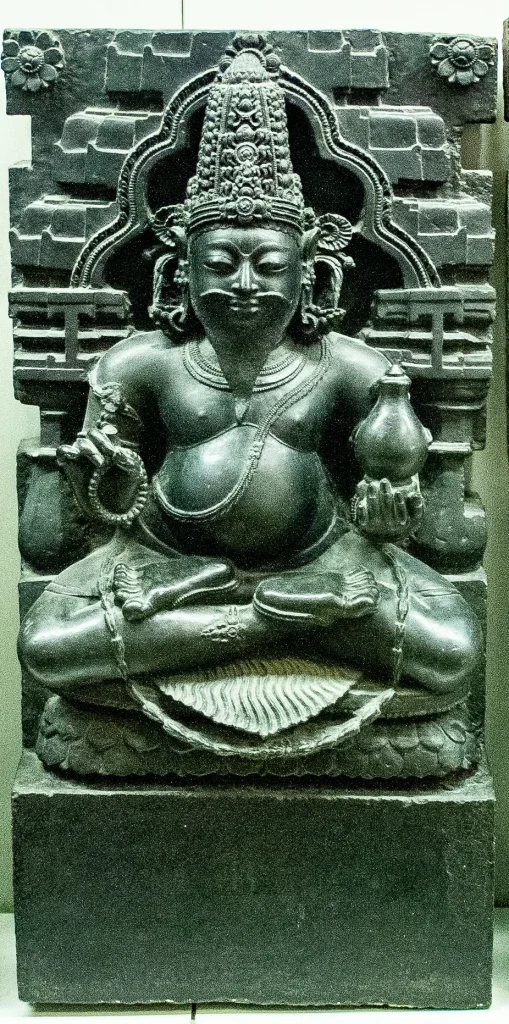
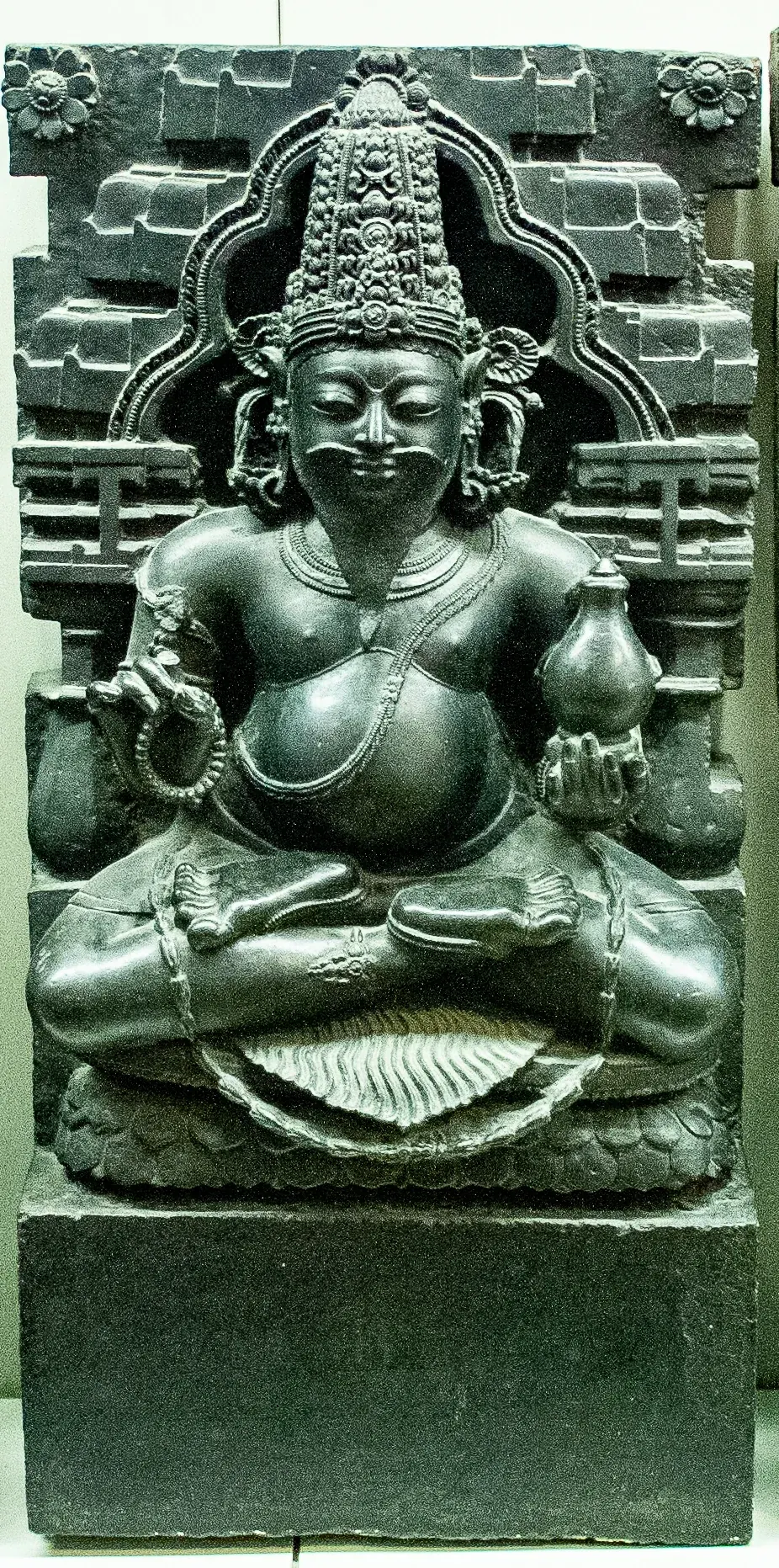
Navagraha images of Brihaspati vary across regions and periods. H. Krishna Sastri’s historical account of South Indian iconography describes Brihaspati as born of Angiras and records either two or four arms. In the two-armed form, he carries a book and rosary. Other images may include a staff, water pot, lotus, or gestures of teaching and blessing. Yellow or gold is common in modern visual traditions, but not every historic sculpture preserves colour.
A book and rosary readily communicate learning, recitation, and disciplined attention. They should not be treated as a code with one universal meaning. The vehicle is also inconsistent across manuals and images: a chariot, elephant, or other form may appear, while some Navagraha ensembles show the figure seated or standing without an emphasized mount. Identify the tradition or object before declaring one image “correct.”
How Brihaspati Dev is worshipped
Bṛhaspati may be honored within some Navagraha settings or through locally taught practice. Household and temple customs vary, so follow a trusted family, temple, or lineage rather than treating a color, food, offering, or ritual sequence as compulsory for all Hindus.
- Prepare a clean, quiet place and begin with a respectful intention.
- Offer water, flowers, fruit, or a lamp according to household custom and fire safety.
- Recite a prayer learned from family, temple, or a qualified teacher rather than relying on decontextualized “instant result” instructions.
- Reflect on a specific responsibility involving teaching, advice, study, or truthfulness.
- Conclude with gratitude to teachers and an appropriate act of service, study, or generosity.
Prayer may deepen gratitude and discipline, but it cannot guarantee a university place, legal result, pregnancy, marriage, promotion, wealth, or recovery from illness. Practical action and qualified professional care remain necessary. Gemstone prescriptions, fasts, and complex remedial rites should be approached carefully, with lineage-specific guidance and without financial or health promises.
Brihaspati within the Navagraha
In a Navagraha ensemble, Brihaspati stands among mutually related celestial powers rather than above a chart as a single controller. The historical South Indian survey records graha images placed around Surya and facing him, though actual temple arrangements vary. This group context connects Brihaspati with Surya, Chandra, Mangala, Budha, Shukra, Shani, Rahu, and Ketu.
Frequently asked questions
Is Brihaspati the same as Jupiter?
Brihaspati is the deity and graha traditionally corresponding to Jupiter. Jupiter is also a physical planet studied by astronomy. The sacred, astrological, and scientific categories are related by correspondence but are not identical.
Why is Brihaspati called Guru?
Later Hindu traditions widely present Brihaspati as priest, counsellor, and guru of the devas. Guru is also a standard name for the Jupiter graha in Jyotiṣa.
Is Brihaspati a Vedic deity?
Yes. Bṛhaspati and the closely related Brahmaṇaspati receive praise in the Ṛgveda. Their Vedic identity centres on sacred formulation, voice, priestly power, and mythic acts such as breaking open Vala; it should not be reduced to the later planetary role.
What is the relationship between Brihaspati and Shukra?
In the Mahabharata’s Kacha narrative, Brihaspati serves the devas while Uśanas or Shukra serves their opponents. The text portrays rival priestly lineages and a complicated teacher-disciple story, not a simple cartoon of good versus evil.
Does Brihaspati worship guarantee marriage, children, or wealth?
No. Such guarantees are neither responsible religious guidance nor evidence-based claims. Worship can express devotion and discipline, while personal goals still require consent, effort, care, and appropriate professional support.
Sources and further reading
- Arthur A. Macdonell — Vedic Mythology, especially the section on Bṛhaspati, for a philological survey of his Vedic hymns, sacred-speech role, and relationship to Brahmaṇaspati.
- Mahabharata, Adi Parva, Section 76, translated by Kisari Mohan Ganguli, for Brihaspati and Uśanas/Shukra as priests of opposing sides and the beginning of Kacha’s discipleship.
- H. Krishna Sastri — South-Indian Images of Gods and Goddesses, Chapter 7, for historical Navagraha placement and variant iconographic descriptions.
- NASA Science — Jupiter, for the physical planet’s measured astronomical characteristics.