Navagraha guide
Budha Dev is the Hindu graha associated with Mercury. In later Hindu narrative and Jyotiṣa traditions, Budha is linked with intelligence, speech, analysis, learning, and exchange. Budha is a sacred figure within the Navagraha, while Mercury is also the name of a physical planet studied by astronomy. These are different ways of understanding the same visible celestial body, and Budha should not be confused with the Buddha of Buddhism.
_-_relief_from_the_British_Museum.jpg)
Budha Dev at a glance
| Name | Budha (बुध), commonly written Budha Dev |
|---|---|
| Religious identity | One of the Navagraha, the nine celestial powers honoured in Hindu traditions |
| Celestial correspondence | Mercury |
| Common traditional associations | Discernment, language, study, calculation, adaptability, and commerce |
| Weekday | Wednesday (Budhavāra) in customary Indian weekday naming |
| Common iconographic features | Yellow or yellow-green colouring; two or four arms; book, sword, shield, club, rosary, or blessing gesture; vehicle varies |
| Important distinction | Budha is not Buddha, the “Awakened One” of Buddhism |
Who is Budha Dev?
Budha belongs to the Navagraha, a group that brings the Sun, Moon, five planets visible to the unaided eye, and the two lunar nodes into a religious and astrological framework. The Sanskrit word graha can mean a “seizer” or an influential celestial power; it does not simply mean “planet” in the modern scientific sense. Within worship, Budha is therefore approached as a devata, not as a ball of rock.
Many modern summaries call Budha “the god of Mercury.” That is convenient, but incomplete. It can hide three distinct layers: Budha as a figure in Hindu narrative, Mercury as an astronomical world, and Budha-graha as interpreted in Jyotiṣa. Keeping those layers visible makes the tradition clearer rather than less sacred.
Budha, Mercury, and Jyotiṣa: three related meanings
1. Budha as a sacred figure
As a deity, Budha appears in narrative genealogies and Navagraha worship. A well-known account in the Vishnu Purana identifies him as the son of Soma (the Moon) and Tara. That text also connects Budha with Ila and names Pururavas as their son. This genealogy helps place Budha at the beginning of the Lunar Dynasty in Purāṇic royal tradition. Other retellings may expand or alter details, so the Vishnu Purana account should be named rather than treated as the only possible version.
2. Mercury as a physical planet
In astronomy, Mercury is the smallest planet in our solar system and the closest planet to the Sun. It has a rocky, heavily cratered surface and completes an orbit much faster than Earth. These measured features belong to planetary science. They neither prove nor disprove devotional meaning; they answer a different kind of question.
3. Budha in Jyotiṣa
Jyotiṣa schools interpret Budha through their own textual rules and complete-chart contexts. It is misleading to turn Budha into a one-word personality label or to claim that the physical planet Mercury empirically causes intelligence, business success, or communication problems. Jyotiṣa is a traditional interpretive discipline, not an established mechanism of physical causation.
Why Budha is not Buddha
Budha and Buddha are different Sanskrit-derived words and different religious identities. Budha, with one “d,” is the Navagraha deity associated with Mercury. Buddha, with the doubled consonant in standard English spelling, is a title meaning “Awakened One” and most often refers to Siddhartha Gautama, the historical teacher at the centre of Buddhism.
The words are related to ideas of knowing or awakening, which helps explain the spelling confusion, but similarity is not identity. A search for “Budha mantra,” “Budha graha,” or “Budha Dev” concerns Mercury traditions; a search for “the Buddha” concerns Buddhist history and teaching.
The story of Soma, Tara, and Budha
In the Vishnu Purana’s account of the Lunar Dynasty, Tara is associated with Brihaspati, while Soma desires and takes her. A conflict follows. After Tara is returned, a radiant child is born, and uncertainty about his father becomes part of the story. When questioned, Tara identifies Soma as the father; Soma embraces the child and names him Budha. The same textual sequence later recalls Budha’s relationship with Ila and their son Pururavas.
This is not merely a modern astrological tale invented to connect the Moon and Mercury. It is embedded in a Purāṇic genealogy. At the same time, readers should not use the story as a universal moral template or force every later chart interpretation out of it. Purāṇic narrative, dynastic genealogy, temple worship, and horoscope reading overlap, but they are not interchangeable genres.
What does Budha represent?
- Discernment: examining details before reaching a conclusion.
- Speech and language: expressing an idea clearly and listening carefully.
- Learning: curiosity, study, classification, and the ability to revise an understanding.
- Calculation: working with numbers, measures, accounts, and patterns.
- Exchange: communication and commerce as forms of connection.
- Adaptability: responding intelligently without abandoning ethical judgment.
These are traditional and reflective associations, not promises that worship will raise grades, cure a learning difficulty, repair a business, or guarantee eloquence. A useful devotional reading is ethical: intelligence is valuable when joined with honesty, restraint, and responsibility.
That ethical emphasis matters in ordinary communication. Quickness without care can become manipulation; adaptability without principle can become opportunism. Reflection on Budha can instead encourage accurate quotation, transparent accounts, patient explanation, and the willingness to correct an error. These practices do not require a person to accept astrology as science. They are ways devotees and interested readers can engage the traditional themes of speech and discernment without making supernatural claims.
Iconography and why images vary
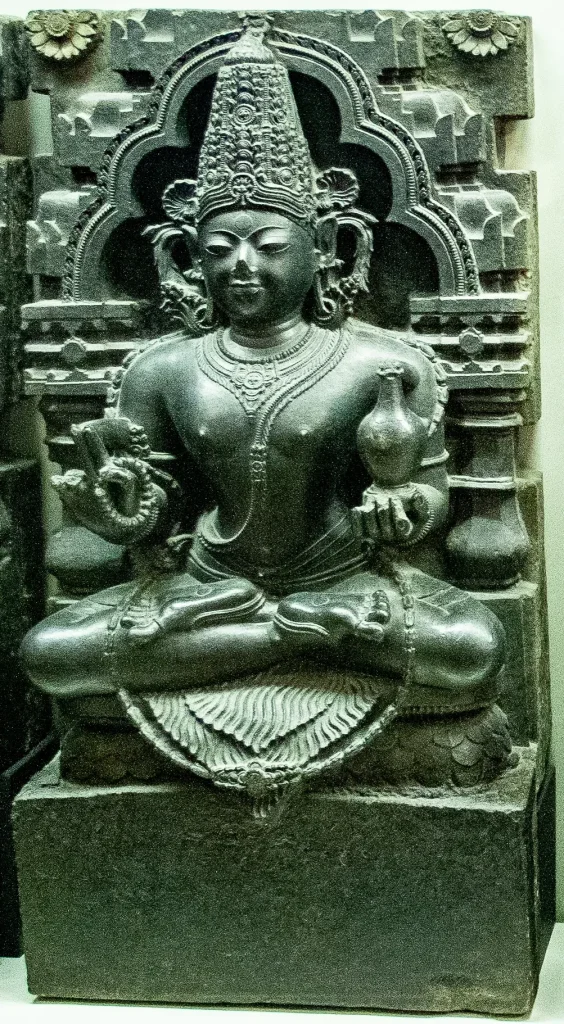
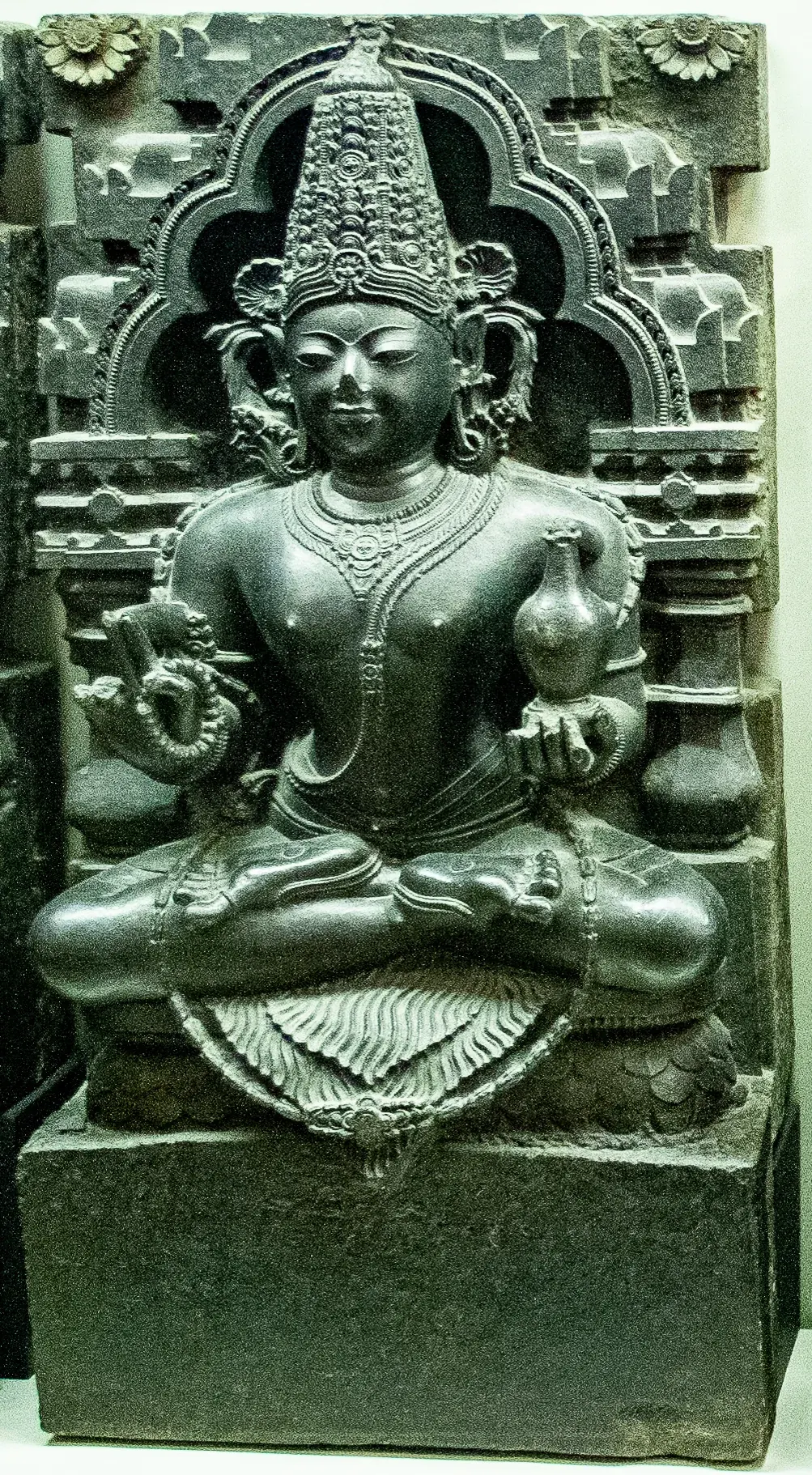
Budha’s appearance is not identical in every temple, manuscript, or modern devotional print. H. Krishna Sastri’s early twentieth-century survey of South Indian images records one prescription in which Budha has a yellow body, four arms, and a lion vehicle, holding a shield, club, sword, and varada or boon-giving gesture. Other traditions and contemporary images may show two arms, a book, rosary, lotus, water pot, bow, or a different vehicle.
A book can visually suggest learning, while weapons can signal alertness, protection, or decisive intelligence. Such interpretations are helpful when presented as readings, not universal decoded meanings. Colour also varies: yellow, green, and yellow-green are all common in modern Navagraha charts. The image in a particular temple follows its own iconographic and ritual context.
How Budha Dev is worshipped
Budha is honored within some Navagraha settings, while household and temple observances vary by region and lineage. Follow the procedures taught by the community or temple you are visiting rather than treating one arrangement or home ritual as mandatory for every Hindu.
- Clean the worship space and approach with a calm, respectful intention.
- Light a lamp if it is safe to do so, or offer flowers, water, or fruit according to household custom.
- Offer a familiar prayer learned from family, temple, or a qualified teacher. Pronunciation and practice guidance are best received in their living context.
- Spend time in quiet recitation, study, or reflection on truthful speech and responsible decisions.
- Complete the practice with gratitude and an ethical action, such as patient teaching, careful listening, or honest record-keeping.
Devotion can support attention, humility, and a sense of continuity with tradition. It should not replace tutoring, professional advice, medical care, financial planning, or direct communication. Gemstones, complex remedial rites, and prescribed mantra counts should not be presented as guaranteed solutions; anyone pursuing them should seek accountable, tradition-specific guidance.
Budha within the Navagraha
Budha is best understood in relationship, not isolation. The Navagraha are worshipped as a group, and Jyotiṣa reads a chart as an interconnected whole. Budha’s Purāṇic parentage links him narratively with Chandra Dev; the broader shrine connects him with Surya Dev, Mangala Dev, Brihaspati, Shukra, Shani Dev, Rahu, and Ketu.
Frequently asked questions
Is Budha Dev the same as Buddha?
No. Budha Dev is the Navagraha deity associated with Mercury. The Buddha is the “Awakened One,” usually Siddhartha Gautama, whose teaching stands at the centre of Buddhism.
Who are Budha’s parents?
The Vishnu Purana identifies Soma or Chandra as Budha’s father and Tara as his mother. Narrative details should be attributed to the text because retellings can vary.
What planet is Budha associated with?
Budha corresponds to Mercury. The sacred identity and traditional Jyotiṣa meanings are not the same thing as astronomy’s physical description of Mercury.
Why is Wednesday linked with Budha?
Indian weekday tradition calls Wednesday Budhavāra, the day associated with Budha. Language and regional usage produce variant spellings.
Does worshipping Budha guarantee academic or business success?
No. Worship can be a meaningful discipline of prayer and reflection, but it does not guarantee marks, profits, fluent speech, or any other outcome. Practical effort and appropriate professional help remain important.
Sources and further reading
- GRETIL, University of Göttingen — Vishnu Purana Sanskrit e-text, especially 4.6.25–34 for Budha’s parentage and 4.1.11–16 for Budha, Ila, and Pururavas.
- H. Krishna Sastri — South-Indian Images of Gods and Goddesses, Chapter 7, a historical survey of Navagraha placement and iconographic prescriptions.
- NASA Science — Mercury, for the physical planet’s measured astronomical characteristics.
- Stanford Encyclopedia of Philosophy — Buddha, for the historical and philosophical identity of the Buddha, distinct from Budha Dev.