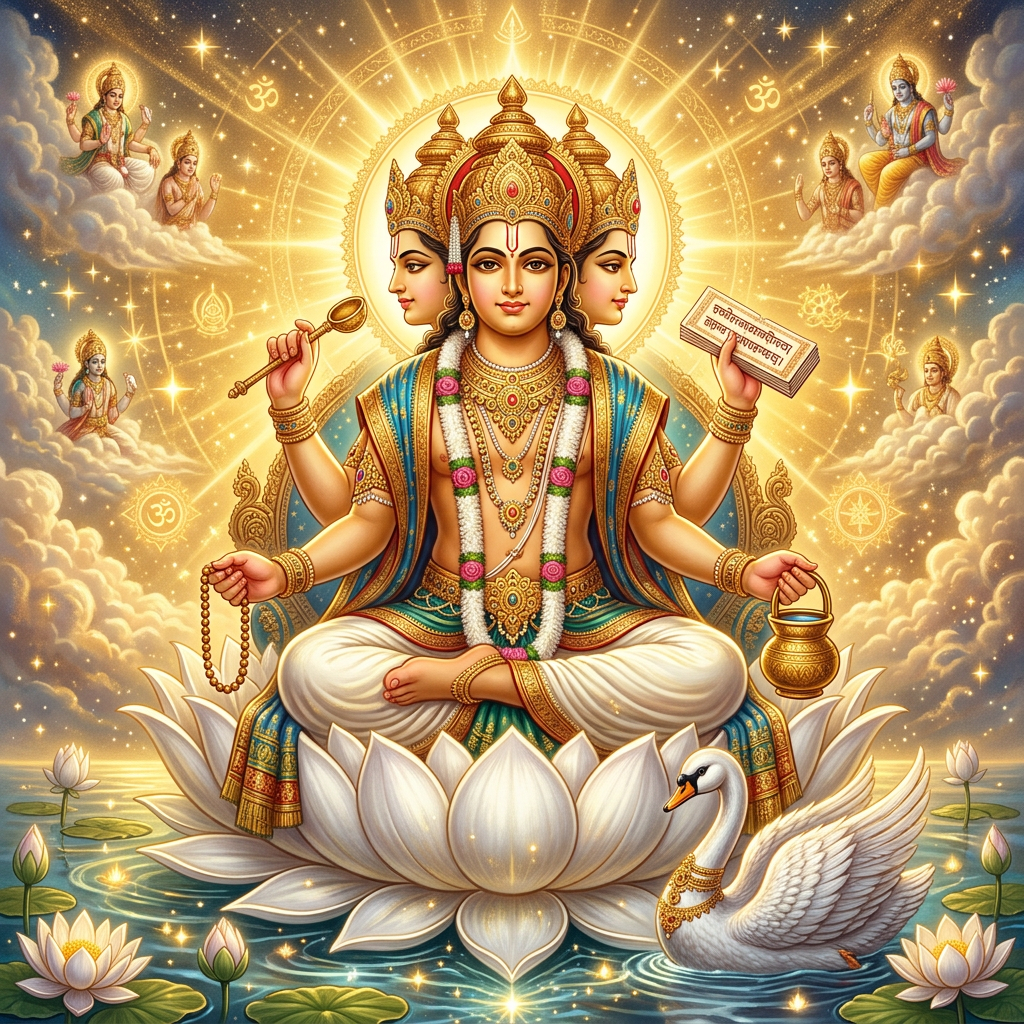
Lord Brahma is the deity of creation in the familiar Hindu Trimurti of Brahma, Vishnu, and Shiva. Hindu traditions do not all explain the cosmos in exactly the same way, but Brahma is widely honoured as the divine intelligence that gives form, order, names, and living beings to a new cosmic age.
Who Is Lord Brahma?
Purāṇic stories often describe Brahma arising on a lotus from the navel of Lord Vishnu as Vishnu rests upon Ananta in the cosmic waters. Other texts speak of Hiranyagarbha, the golden germ or cosmic embryo. These are sacred images of origin, not competing scientific accounts. In many Vaishnava explanations, Brahma is an empowered secondary creator who arranges an already manifested cosmos; other traditions emphasize him as one function of the one supreme reality.
Brahma should not be confused with Brahman, the ultimate reality discussed in the Upanishads. Brahma is a personal deity with stories and iconography; Brahman is a philosophical term that may refer to limitless reality beyond all forms, though schools interpret the relationship differently.
Four Faces and Sacred Symbols
- Four faces: commonly associated with the four Vedas and the four directions, suggesting knowledge extending throughout creation.
- Vedas or manuscript: sacred learning and the principles by which an ordered world is understood.
- Akshamala: a rosary that evokes prayer, measured time, and recurring cosmic cycles.
- Kamandalu: the water vessel of an ascetic, linked with purity and the life-bearing potential of water.
- Hamsa: his swan or goose vehicle, traditionally associated with discernment—the ability to distinguish the lasting from the temporary.
Images vary. Brahma may carry a sacrificial ladle, sit upon a lotus, or appear beside Goddess Saraswati. Symbolic explanations are devotional interpretations rather than fixed captions required by every scripture or temple lineage.
Brahma, Saraswati, and Creation Stories
Saraswati, goddess of knowledge, speech, music, and learning, is commonly identified as Brahma’s consort. Together they express a meaningful principle: creative activity requires knowledge and articulation. Purāṇas also describe mind-born sons such as Marichi and other sages who participate in populating or ordering the worlds. Lists and family relationships differ between texts, so no single genealogy should be presented as universal.
A well-known Shaiva narrative tells of Brahma and Vishnu searching for the limits of Shiva’s endless pillar of light. Neither reaches its end. The story teaches humility before the immeasurable Divine and is told with variations in texts including the Linga Purana and Shiva Purana.
Why Are Brahma Temples Uncommon?
Brahma has fewer dedicated temples than Vishnu, Shiva, Devi, or Ganesha, but this does not mean he is absent from Hindu worship. He appears in temple imagery, rituals, sacred recitations, and narratives throughout India. Several stories explain the relative rarity of his temples, often involving a curse or a failed test of truthfulness. These explanations vary by Purāṇa and region and should be understood as theological storytelling, not as one universally accepted historical event.
The Brahma temple at Pushkar in Rajasthan is especially famous, while other shrines and local traditions exist. In Trinidad and Tobago, Brahma may be remembered during household prayer, yajna, scripture reading, or discussion of the Trimurti even where no separate murti or temple is dedicated to him.
A Simple, Respectful Way to Honour Brahma
Begin with a clean space and a calm mind. Light a diya safely, offer fresh water, fruit, or flowers, and pray for wisdom to create responsibly. A simple salutation is Om Brahmane Namah, “Reverence to Brahma.” Transliteration and pronunciation vary; follow the form taught by your family, mandir, or guru when you have one.
Brahma worship is not a guarantee of academic, artistic, or business success. Its deeper practice is to combine imagination with truthfulness, learning, patience, and responsibility. Creative work should benefit rather than exploit others. Fire, incense, and lamps should be supervised, especially around children and flowing fabrics.
Frequently Asked Questions
Is Brahma the same as Brahman?
No. Brahma is the creator deity; Brahman is the ultimate reality described in Hindu philosophy, although traditions explain their relationship in different ways.
Is Saraswati always described as Brahma’s consort?
She is commonly associated with him, but Hindu texts preserve different accounts of divine relationships and origins. Qualified language respects that diversity.
Sources and Further Reading
Source note: Creation narratives, four-face symbolism, Brahma–Brahman distinction, temple-rarity explanations, and curse stories need claim-level attribution.
- Metropolitan Museum of Art — Brahma (10th-century Cambodia) — Identifies Brahma and documents historical four-faced Brahma iconography; useful for carefully bounded visual claims.
- Bhaktivedanta VedaBase — Srimad-Bhagavatam 3.8.15 — Supports a Vaishnava Purana account of lotus-born Brahma while making the translation and sectarian framing explicit.
Continue exploring: Visit HinduClarity’s Devas guide and read about Lord Shiva.