Hindu festival guide
Onam
A culturally grounded guide to Kerala’s great harvest festival, the return of Mahabali, pookalam, Onasadya, boat races, and responsible celebration.
Onam dates for 2026 and 2027
| Year | Observed date | Planning note |
|---|---|---|
| 2026 | Wednesday, August 26 for Thiruvonam | Onam spans several days; Atham begins the lead-up before Thiruvonam. |
| 2027 | Sunday, September 12 for Thiruvonam | Onam spans several days; Atham begins the lead-up before Thiruvonam. |
Calendar note: Onam follows the Malayalam calendar in the month of Chingam. Thiruvonam is the principal day, but the ten-day sequence and public events should be checked through a Kerala or local community calendar.
What Onam means
Onam is Kerala’s major harvest and homecoming festival, celebrated by Hindus and widely shared across Kerala’s diverse society. It remembers the beloved king Mahabali, whose annual return represents prosperity, equality, generosity, and the hope of just rule.
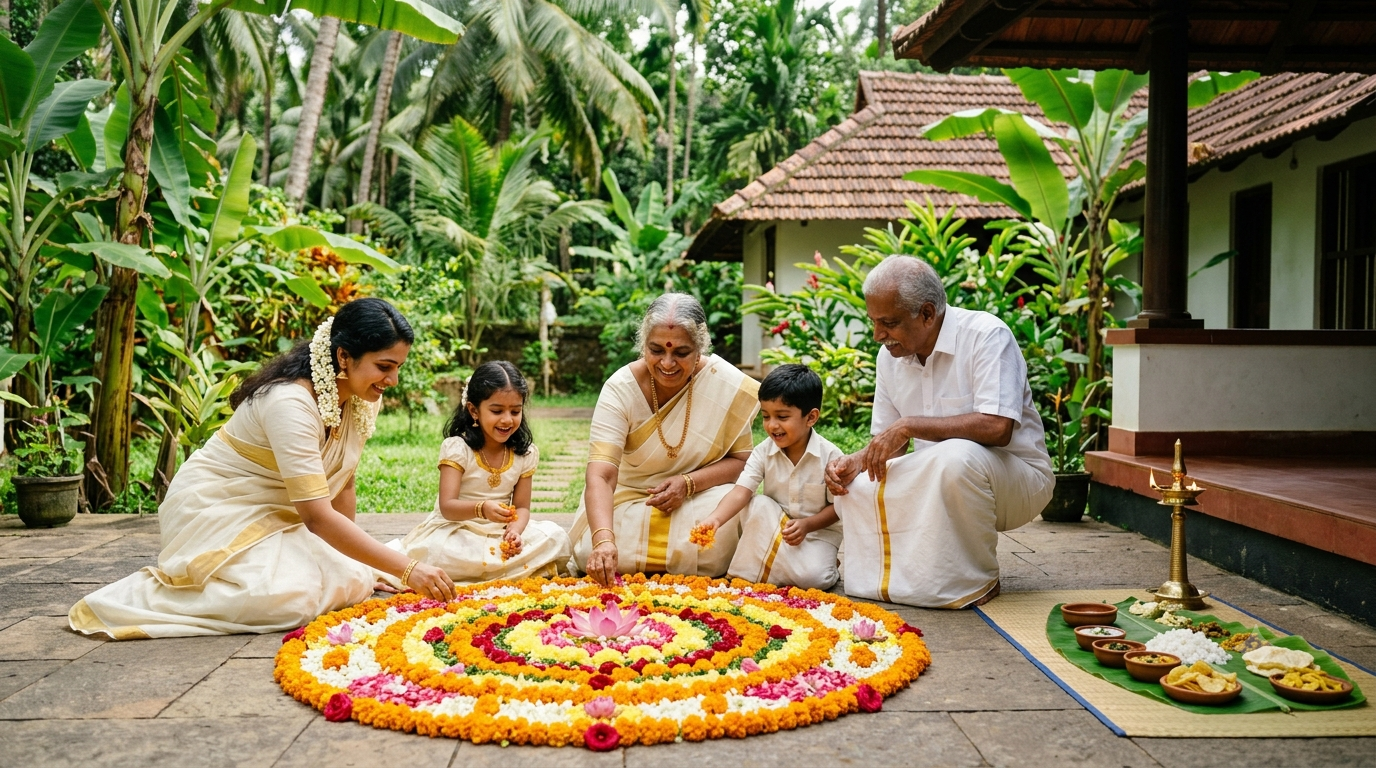
Homes and public spaces create flower carpets called pookalam, families wear festive clothing, temples and churches or civic groups may host community events, and the elaborate vegetarian Onasadya meal is served on banana leaves where available.
Boat races, Pulikali tiger dance, Kaikottikali dance, games, markets, and reunions form part of the wider season, but no single household practices every element.
Mahabali's homecoming
The king’s return expresses memory of a just and generous realm and the enduring bond between ruler and people.
Harvest abundance
Flowers, rice, vegetables, and shared meals give thanks for the land and labor that sustain Kerala.
Plural belonging
Onam functions as both a Hindu sacred festival and a broad Kerala cultural celebration for many communities.
Sacred story and historical setting
In a widely told Vaishnava narrative, Mahabali’s growing power concerns the gods. Vishnu appears as the dwarf Vamana and asks for three paces of land, then expands to stride across the cosmos. Mahabali offers his own head for the final step and receives permission to visit his people each year.
The story supports multiple interpretations: divine humility, the limits of power, Mahabali’s generosity, and the people’s longing for equitable rule. Kerala memory often centers the affection between Mahabali and his people rather than treating him as a simple villain.
Onam should not be reduced to a costume day or used to erase debate about caste, land, labor, and the many religious communities that participate in Kerala culture.
How the festival is observed
The season is built through daily preparation: cleaning, growing pookalam designs, temple visits, new clothing, cultural programs, games, charity, and the Thiruvonam feast.
- Begin a pookalam on Atham and expand it with locally available, responsibly sourced flowers.
- Clean the home and welcome guests without turning hospitality into financial competition.
- Visit a temple or offer a simple prayer to Vishnu, Vamana, or the family deity according to tradition.
- Prepare Onasadya with shared labor and serve elders, children, and guests attentively.
- Support agricultural workers, disaster relief, or a verified community kitchen.
- Attend boat races or public events only through safe, authorized organizers.
Food, offerings, and hospitality
Onasadya is a vegetarian banquet served on a banana leaf in a traditional order. Dishes may include rice, parippu, sambar, avial, olan, thoran, kichadi or pachadi, pickles, pappadam, banana chips, and one or more payasams.
The exact number and order of dishes vary by region and family. A modest, well-cooked meal is more faithful to hospitality than wasteful abundance.
Regional and community traditions
Central and southern Kerala
Temple festivals, pookalam, sadya, dance, games, and family homecoming appear in locally distinctive combinations.
Vallam kali areas
Snake-boat races are major public traditions requiring trained crews, river safety, and formal organization.
Global Malayali diaspora
Associations recreate sadya, dance, music, pookalam competitions, and Mahabali’s welcome while adapting ingredients and schedules.
Observing in Trinidad and Tobago or the wider diaspora
Malayali families and cultural organizations in Trinidad and Tobago can host a weekend Onam program while clearly identifying the actual Thiruvonam date. Local flowers and Caribbean produce can be used without pretending every detail is Kerala-grown.
Invite participants to learn the Mahabali story, Malayalam terms, and proper banana-leaf etiquette rather than treating the event only as a buffet.
A respectful home observance
- Clean the entryway and create a small pookalam from local flowers or reusable natural materials.
- Read the Mahabali and Vamana story from a reliable source and discuss justice and generosity.
- Prepare a manageable sadya with several balanced dishes and minimal waste.
- Wear festive clothing, call relatives, and include someone who might otherwise be alone.
- Donate food or funds through a transparent Kerala or local relief organization.
Good practice: Use flowers without protected species or pesticide residue, supervise children near lamps, and follow river and crowd safety rules. Do not attempt boat-race activities without trained crews and authorized facilities.
Frequently asked questions
Is Onam only a Hindu festival?
Its sacred narrative is Hindu, while in modern Kerala it is also celebrated broadly as a regional cultural and harvest festival by people from several communities.
Who is Mahabali?
Mahabali is a generous asura king remembered for a prosperous reign and an annual return to his people in Kerala tradition.
What is Thiruvonam?
It is the principal day of the Onam season, named for the Thiruvonam lunar mansion in the Malayalam calendar.
Must an Onasadya have a fixed number of dishes?
No. Large counts are popular, but menus vary. Hospitality, flavor, balance, and avoiding waste matter more.
Sources and further reading
- Kerala Tourism – Onam – Official regional guide to events and traditions.
- Encyclopaedia Britannica – Onam – Overview of the festival and Mahabali story.
- Drik Panchang – Onam – Calendar reference for Thiruvonam.
- Sahapedia – Cultural-history context for Kerala arts and festivals.
Editorial and rights note: This educational overview is independently written from cross-checked facts and does not reproduce source text. External sources are cited for verification and further reading; citation does not imply endorsement. The hero is an illustrative AI-generated image created for HinduClarity, not a historical photograph or documentary record. This page is not a substitute for guidance from your temple, family tradition, qualified teacher, or licensed professional. Hindu calendars and practices vary by sampradaya, region, and location.
Back to the complete Hindu Festivals Calendar for 2026-2027
Continue with the Diwali guide or the Ganesh Chaturthi guide.