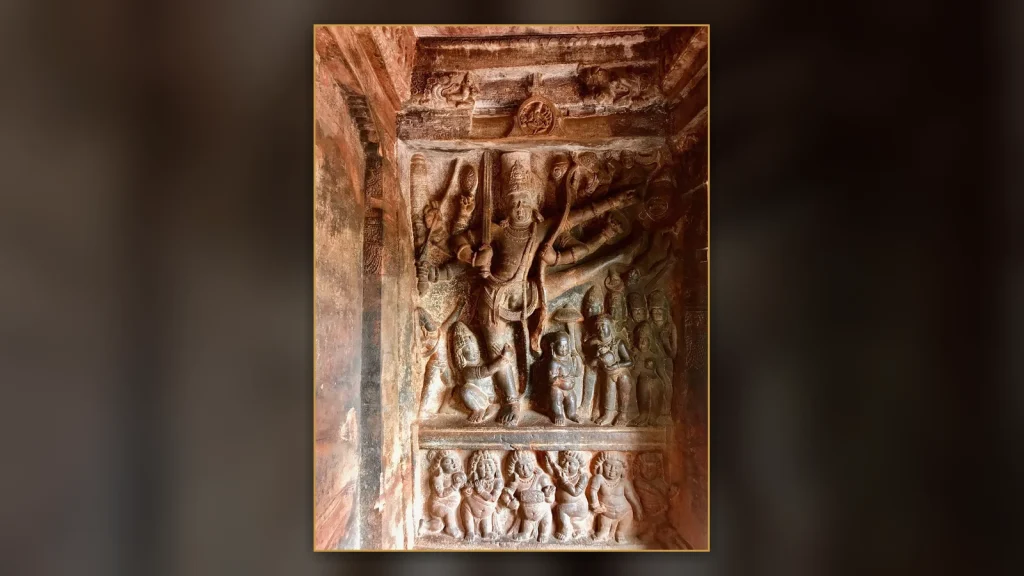
Vamana is Vishnu’s dwarf-brahmin avatar; Trivikrama is the cosmic form in which he spans the worlds with immense strides. In the Bhagavata Purana, Vamana asks King Bali for three paces of land, expands after Bali agrees, and restores heaven to Indra. The story also honors Bali’s truthfulness and generosity, while Kerala’s Onam traditions remember Mahabali with distinctive affection.

Vamana at a glance
| Question | Concise answer |
|---|---|
| Who is Vamana? | A youthful dwarf brahmin form of Vishnu who approaches the ruler Bali |
| Who is Trivikrama? | Vishnu as the cosmic “three-strider” in the Vamana narrative |
| Principal figures | Vamana, Mahabali or Bali, Shukracharya, Aditi, Kashyapa, Indra, and Prahlada |
| Main textual witness used here | Bhagavata Purana, Book 8, chapters 18–23 |
| Central request | Three paces of land, granted during Bali’s sacrifice |
| Major interpretive caution | Divine restoration, royal dispossession, Bali’s virtue, and Onam homecoming are not identical emphases |
Vamana and Trivikrama are related, but not interchangeable
Vamana describes Vishnu’s small brahmin manifestation at Bali’s sacrificial ground. The visual clues may include a youthful or diminutive body, umbrella, water vessel, staff, sacred thread, or other marks of a religious student. The small request appears modest: only the land covered in three steps.
Trivikrama means the great or cosmic three-strider. After Bali confirms his gift, the petitioner expands until his strides encompass the ordered universe. “Vamana” names the small petitioner in the request episode, while “Trivikrama” names the world-spanning manifestation within the same narrative sequence.
What happened between Vamana and King Bali?
In Bhagavata Purana 8.18, Vishnu is born to Aditi and Kashyapa and assumes the appearance of a dwarf brahmin student. He travels to Bali’s sacrifice, where the ruler receives him and offers a gift. In chapter 19, Vamana asks for three paces of land. Bali thinks the request surprisingly small.
Bali’s teacher Shukracharya warns that the visitor is Vishnu and that fulfilling the promise will cost Bali his dominion. The warning exposes the story’s ethical tension: Bali now knows the request is not as simple as it sounded. Nevertheless, he chooses to keep his word. The next chapter narrates the gift and the expansion of Vamana’s body into a cosmic form. With the available realms measured, there is no ordinary place for a third step.
Bali is then bound. In Bhagavata Purana 8.22, his endurance and truthfulness become central. He offers himself rather than deny his pledge. Vishnu grants him a place in Sutala and promises his own presence there; chapter 23 describes Indra’s restoration. Thus the Bhagavata does not portray Bali as merely foolish or evil. He is an asura ruler whose conquest disrupted the devas’ order, but he also becomes an exemplar of generosity and surrender.
What can the three steps mean?
At narrative level, the strides recover cosmic space for the devas. The transformation also reverses appearances: the smallest guest reveals an immeasurable form, and the seemingly all-powerful king discovers the limits of possession. Land that a ruler imagines he can give is already contained within a larger sacred order.
Devotional interpretation often emphasizes humility, surrender, keeping one’s word, and recognizing Vishnu beneath an unexpected appearance. Yet the encounter also invites questions. Was Vamana’s request transparent? How should readers evaluate Bali’s dispossession? Does restoring Indra’s realm settle every moral concern? The text itself gives Bali dignity, and later communities have not all weighted the characters in the same way.
The story therefore should not be reduced to “good god tricks bad demon.” Nor should every theological reading be collapsed into a modern political allegory. Readers can name unequal power and deception-like strategy while also recognizing the Bhagavata’s Vaishnava framework of cosmic restoration and grace.
King Mahabali, Vamana, and Onam
Onam is a major Kerala festival associated with harvest abundance, homecoming, hospitality, and the beloved memory of Mahabali. In widely told Kerala traditions, Mahabali is permitted to return and visit his people. The remembered kingdom expresses hopes for prosperity, equality, generosity, and just rule. Flower carpets, feasts, games, performances, temple observance, public celebrations, and family gatherings belong to the wider season, but no household practices every element.
There is no need to force Onam into a single verdict about Vamana. Some Vaishnava tellings center Vishnu’s restoration of cosmic balance and Bali’s blessed surrender. Popular Kerala memory may center Mahabali’s affection for his people and their longing for his return. Some modern readings foreground hierarchy, land, or political displacement. These emphases can coexist in public culture and sometimes conflict.
Respectful explanation avoids two opposite errors. The first is to dismiss Mahabali’s homecoming as a misunderstanding because it does not repeat one Sanskrit chapter word for word. The second is to claim that all Onam celebrants reject Vamana. Onam is lived across Hindu, regional, civic, and diasporic settings, and participants describe its sacred and cultural meanings differently. For festival practices and current dates, use the dedicated HinduClarity Onam guide.
Vamana and Trivikrama in sacred art
The Cleveland Museum of Art’s eighteenth-century North Indian painting is titled King Bali gives a gift of land to Vamana. It is useful because it fixes one narrative moment: the gift precedes the vast cosmic stride. The museum record establishes the title, region, approximate date, and object; it should not be used as proof that all artists pictured Vamana identically.
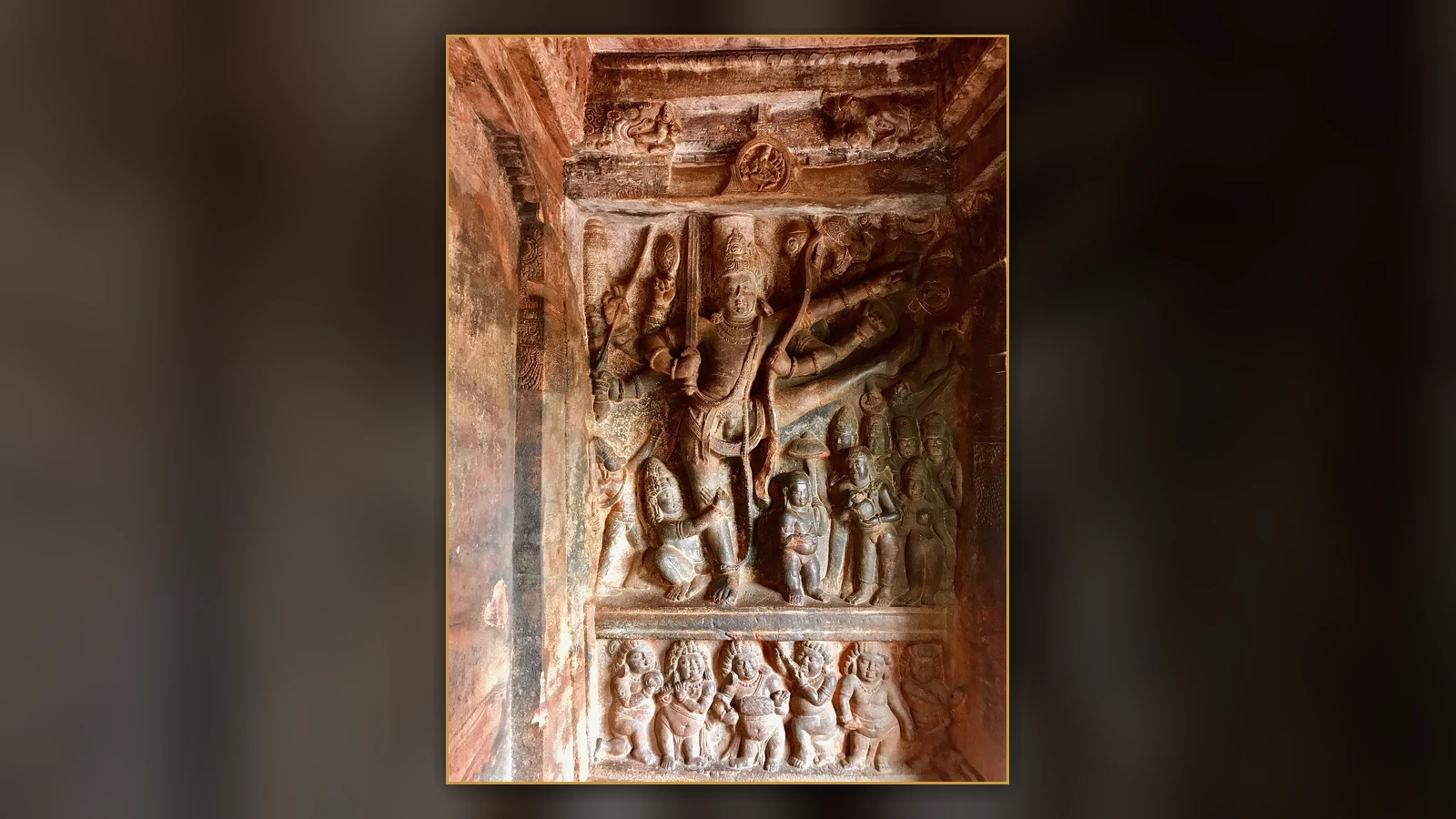
The Cleveland Museum of Art’s eighteenth-century North Indian painting documents the moment when Bali gives land to Vamana, before the cosmic expansion. The Badami relief reproduced near the beginning of this guide depicts the cosmic-striding form. These particular objects illustrate different moments in the narrative; they do not by themselves establish a universal set of attendants, arm counts, or visual conventions.
Textual and regional variation
The Bhagavata Purana
The Bhagavata’s six-chapter arc used here links Aditi’s concern, Vamana’s birth, the request, Shukracharya’s objection, cosmic expansion, Bali’s binding and vindication, Sutala, and Indra’s return. It gives unusually sustained attention to Bali’s integrity. The Bhagavata Purana guide places these chapters within the full text.
The Vamana Purana
The work called the Vamana Purana should not be treated as merely a longer biography of this avatar. Its surviving form contains extensive Shaiva and pilgrimage material alongside Vamana-Bali content. A page about the Purana owns the text-overview question; this page owns the avatar and narrative question.
Kerala and wider living traditions
Kerala’s Mahabali homecoming is a regional tradition with its own ritual and social life. Temple recitation, domestic storytelling, classical and popular art, and diaspora celebrations may choose different names and scenes. “Variation” does not mean that none is meaningful; it means each claim needs a named context.
Common misconceptions
- “Vamana and Trivikrama are two unrelated avatars.” They name the small petitioner and the cosmic-striding manifestation within one narrative sequence.
- “Bali is only a villain.” The Bhagavata criticizes his conquest but praises his gift, truthfulness, endurance, and surrender.
- “All Onam traditions tell the story in exactly the same way.” Sacred, regional, household, civic, and modern political interpretations differ.
- “The Vamana Purana is the only or simplest source for Vamana.” The Bhagavata offers a prominent account; the surviving Vamana Purana has a much wider, strongly Shaiva scope.
- “Worship guarantees prosperity or restored land.” Such outcomes should not be promised.
Frequently asked questions
Why did Vamana ask for only three steps of land?
The modest request tests appearances and Bali’s commitment to giving. Once granted, the measure expands from three small paces into a cosmic act.
Was King Bali good or bad?
The Bhagavata gives a morally layered portrait: Bali opposes the devas and holds their realm, yet he is generous, truthful, steadfast, and ultimately blessed. Kerala traditions often remember him as an exemplary king.
Where was the third step placed?
In Bhagavata Purana 8.22.2, Bali explicitly asks Vamana to place the third lotus footstep on his head so that his promise will remain true. Other retellings and artworks may vary, but this named Bhagavata witness is unambiguous.
Is Onam a Vamana festival or a Mahabali festival?
It can carry both Vaishnava and Mahabali-centered meanings, as well as broad Kerala harvest and homecoming meanings. Community and family emphasis varies.
What does Trivikrama mean?
It refers to Vishnu as the mighty three-strider whose steps encompass the worlds. The term is especially useful for distinguishing the cosmic icon from the dwarf-brahmin request scene.
Related HinduClarity guides
Sources
- Bhagavata Purana 8.18 — Vamana’s appearance and arrival at Bali’s sacrifice; Gaudiya Vaishnava translation and commentary.
- Bhagavata Purana 8.19 — request for three paces and Shukracharya’s warning; same translation tradition.
- Bhagavata Purana 8.20 — Bali’s gift and the cosmic expansion; same translation tradition.
- Bhagavata Purana 8.22 — Bali’s surrender, praise, and Sutala; same translation tradition.
- Cleveland Museum of Art: King Bali gives a gift of land to Vamana — object-specific scene, date, and regional attribution.
- HinduClarity: Onam — the dedicated festival guide owns dates, observance, foods, and practical celebration context.
- Columbia University Press: The Bhagavata Purana—Sacred Text and Living Tradition — scholarly context for the text and its reception.