Navagraha guide
Mangala Dev is the Hindu graha associated with Mars. Also called Aṅgāraka, Bhauma, or Kuja in different texts and regions, Mangala is linked in Jyotiṣa with directed energy, courage, competition, conflict, siblings, and land. In worship he is a sacred celestial presence; in astronomy Mars is a rocky planet. Astrological meanings are tradition-specific interpretations, not proof that Mars causes personality, accidents, illness, or marriage outcomes.
_-_relief_from_the_British_Museum.jpg)
Names require context: popular accounts give Mangala different parentage and origin stories. “Bhauma” can mean “son of the Earth,” while other narratives connect him with Shiva or other sacred events. These versions should be attributed to their texts or regional traditions, not merged into one universal biography.
Mangala Dev at a glance
| Common names | Mangala, Aṅgāraka, Bhauma, Kuja |
|---|---|
| Navagraha correspondence | Mars |
| Weekday | Tuesday (Mangalavara) |
| Common Jyotiṣa themes | Initiative, courage, heat, competition, conflict, siblings, land |
| Common visual cues | Red color, weapons or protective gestures, and sometimes a ram; conventions vary |
| Astronomy | The fourth planet from the Sun, a cold rocky world |
| Parent guide | The Navagraha |
Who is Mangala?
Mangala is one of the nine Navagraha, the sacred celestial agents used in many Hindu ritual and astral traditions. His name can carry a surprising range of meaning: mangala commonly means auspicious or favorable, yet the Mars graha is also associated with heat, force, injury, and contention. The combination is not necessarily contradictory. Disciplined force can protect and build; uncontrolled force can damage.
Aṅgāraka evokes a burning coal or fiery redness. Bhauma and Kuja can identify him as earth-born or a son of the Earth. These names connect the graha with the red planet’s visible color and with terrestrial themes such as land, boundaries, construction, and property in later Jyotiṣa. Etymology, narrative, ritual, and horoscope interpretation are related layers, but one should not be used as automatic proof of all the others.
Stories of Mangala’s birth
There is no single origin account accepted in every Hindu tradition. Purāṇic and regional tellings preserve different genealogies for Mangala, and a version should be attributed to its specific text, recension, or community before its details are repeated. This guide therefore does not blend several birth stories into one seamless biography.
The broader symbolism is clearer than a fixed family tree: Mangala joins earth and fire, embodied strength and decisive motion. This symbolism can support ethical reflection on how power is used. It does not make anger sacred by itself, nor does it excuse aggression. Hindu teachings on conduct, non-harm, duty, and self-mastery remain essential context.
Mangala in temple art
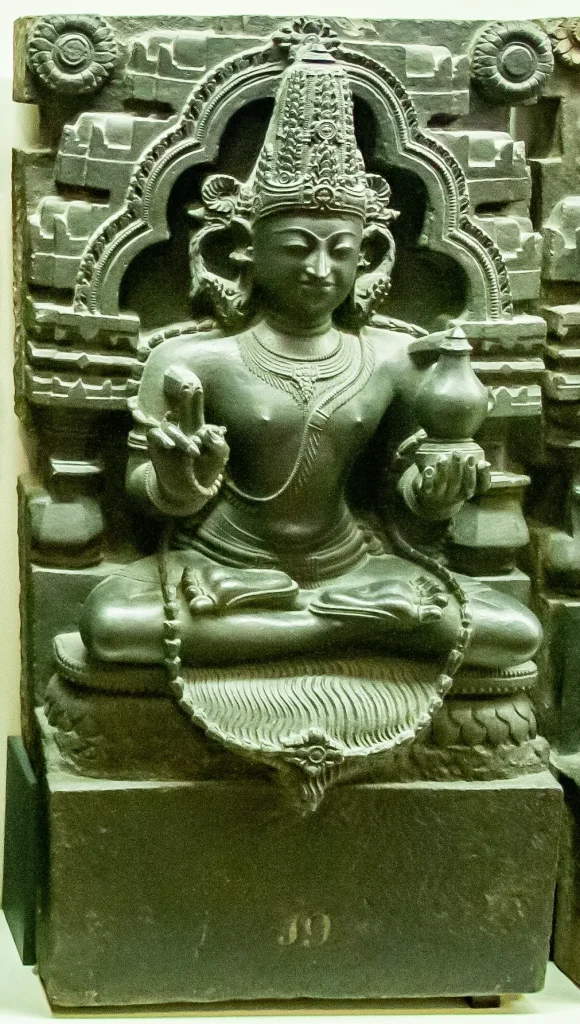
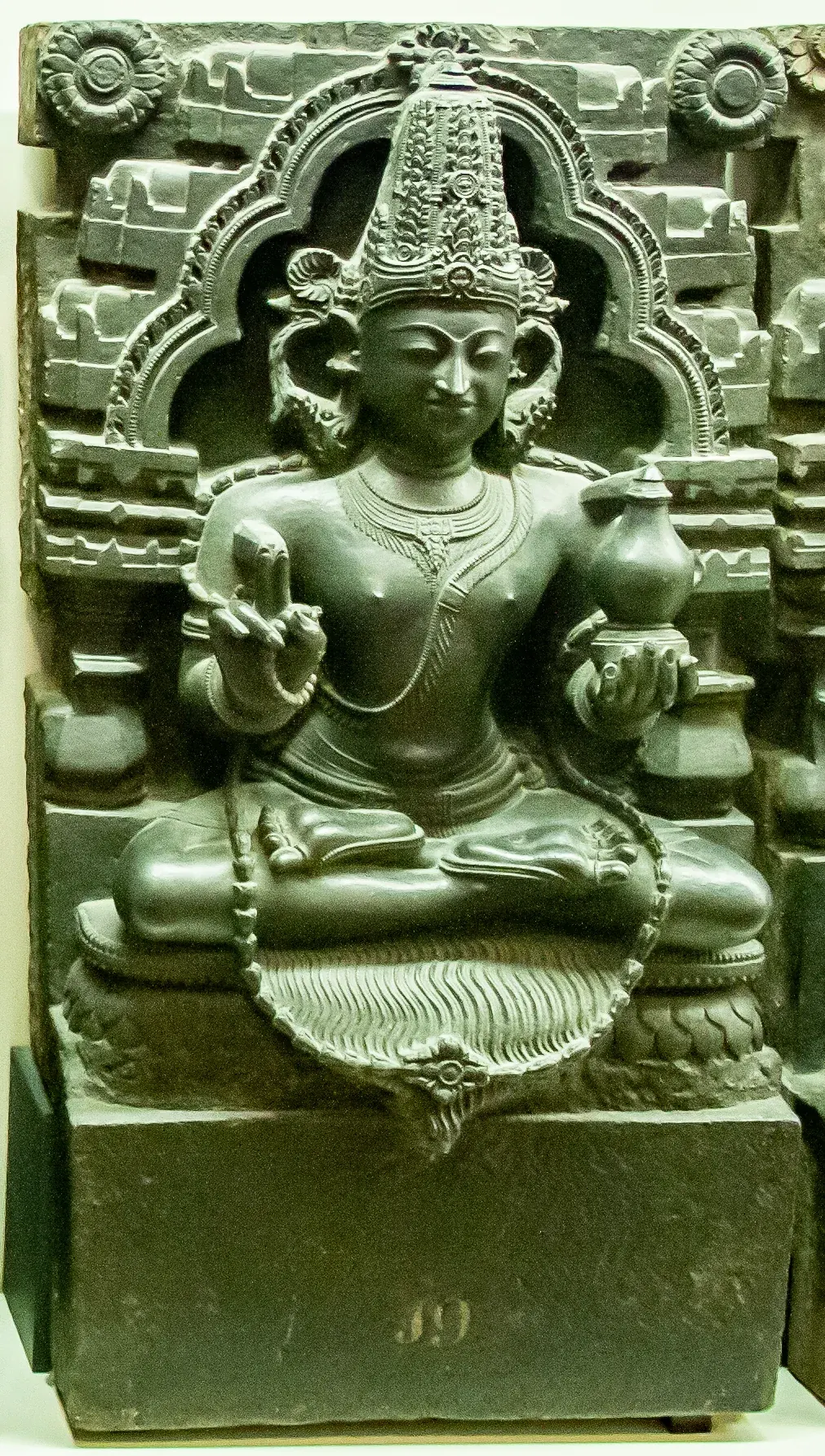
The Cleveland Museum of Art identifies Mangala within an eighth-century Central Indian Navagraha relief and notes that several figures in that ensemble are visually similar. The British Museum relief reproduced on this page is cautiously identified by its source as probably Mangala. These objects support identity and historical representation, not a universal rule about color, weapons, vehicle, hands, or dress.
In group panels, individual grahas can be difficult to identify without a known sequence or inscription. The Cleveland Museum of Art’s Central Indian sandstone Navagraha panel, dated to the 700s, places Mars among a line of nine celestial bodies. Its curatorial description notes that the Moon, Mercury, Venus, Mars, and Jupiter are nearly identical in that particular relief. This is useful evidence against assuming every historical Mangala image always carried the same dramatic red attributes.
Mars in modern astronomy
Mars is the fourth planet from the Sun. Iron minerals in its rocks and dust oxidize, giving the surface its familiar reddish appearance. It has a thin atmosphere dominated by carbon dioxide, two small moons called Phobos and Deimos, polar ice, giant volcanoes, canyons, and abundant evidence that liquid water existed on its ancient surface. Mars is a physical world explored by telescopes, orbiters, landers, and rovers.
The planet takes about 687 Earth days to orbit the Sun and rotates once in a little more than 24 hours. Its apparent brightness and position change as Earth and Mars move in their orbits. Premodern observers could track that wandering motion without knowing modern geology or spacecraft data. The identification of Mangala with the visible red wanderer is historical and cultural; NASA’s findings do not validate horoscopic predictions.
Mangala in Jyotiṣa
Jyotiṣa texts and schools interpret Mangala through their own rules and complete-chart contexts. Their readings should not be reduced to a modern keyword list or presented as evidence that the physical planet Mars causes courage, conflict, accidents, illness, or a person’s profession.
No graha should be interpreted from a keyword alone. A practitioner may consider sign, house, lordship, aspects, conjunctions, dignity, divisional charts, planetary periods, and the chart as a whole. Different lineages also weigh combinations differently. A generic online statement such as “Mars in this house always causes divorce” is neither careful Jyotiṣa nor responsible relationship advice.
What is Manglik or Maṅgala doṣa?
Maṅgala doṣa, often called Maṅgala doṣa in English-language discussion, is a horoscope category used in some matchmaking traditions. Definitions, exceptions, and the importance assigned to it differ among schools. It should never be treated as a moral defect, a medical condition, proof that someone will harm a spouse, or a reason to coerce or stigmatize a person.
Fear-based claims can stigmatize people and pressure families into costly services or unwanted decisions. Marriage requires consent, compatibility, communication, safety, and practical judgment. Those realities should not be overridden by a single chart rule. If astrology is important to a couple, consult a reputable practitioner who explains uncertainty and respects both people’s autonomy; never use a chart to justify abuse or discrimination.
Tuesday worship and common practices
Tuesday is Mangalavara, the weekday associated with Mangala. Yet Tuesday devotion can center Hanuman, Durga, Skanda, or another deity according to family and regional custom. Mangala worship may occur at a Navagraha shrine through darshan, a lamp, red flowers, recitation, charity, or a priest-led puja. Red lentils, cloth, or other red items are mentioned in some contemporary practices, but no offering is universal.
- At a temple: ask which offerings are permitted and follow the local sequence around the Navagraha shrine.
- At home: keep fire safety in mind, use a stable lamp holder, and choose a simple prayer learned from a trusted source.
- Charity: give without humiliating recipients and choose an accountable organization rather than treating a person as an astrological instrument.
- Fasting: modify or avoid it when health, pregnancy, medication, age, or eating-disorder history makes food restriction unsafe.
Devotees may ask for courage, self-control, reconciliation, or wise use of strength. The practice can frame disciplined action, but it cannot guarantee victory in litigation, acquisition of property, removal of debt, a marriage, conception, protection from accidents, or a medical cure. Pair prayer with the relevant professional advice and concrete ethical work.
Mantras, gemstones, and responsible guidance
Several Sanskrit prayers and seed-mantra forms circulate for Mangala. Their wording, initiation requirements, meter, and repetition counts can differ. Rather than presenting one internet formula as universally authorized, this guide recommends learning from a temple or lineage that can explain pronunciation, purpose, and conduct. A short sincere prayer in one’s own language is also meaningful in many devotional settings.
Red coral is commercially associated with Mars in some gemstone-remedy systems. That association is a tradition, not a scientifically proven treatment or guaranteed way to alter events. Coral also raises cost, authenticity, environmental, and sourcing questions. Do not ingest gemstone powders, delay healthcare, incur debt, or buy under a threat that disaster will occur without the product.
Frequently asked questions
Is Mangala the same as Mars?
Mangala is the sacred graha correlated with the visible planet Mars. In astronomy, Mars is a rocky planet governed by physical processes. In ritual and Jyotiṣa, Mangala is interpreted as a divine and symbolic agent. The two descriptions answer different kinds of questions.
Why is Mangala red?
Mars appears reddish because iron-bearing minerals on its surface have oxidized. Hindu names such as Aṅgāraka and later iconography also emphasize fiery redness, creating a strong cultural association with heat and force.
Who are Mangala’s parents?
Accounts vary. Bhauma is commonly described as connected with or born from Bhumi, the Earth, while other stories involve Shiva. A precise answer should name the source rather than blending versions into a universal genealogy.
Does Maṅgala doṣa prevent marriage?
No chart feature can scientifically prove that a marriage will fail or that a person is dangerous. Jyotiṣa traditions define and modify the condition in different ways. Do not use the label to shame someone or replace consent, compatibility, and safety assessment.
What can I offer on Tuesday?
Temple-approved flowers, a lamp, prayer, food donation, or charity may be appropriate, but practice varies. Ask locally before bringing red cloth, lentils, oil, or other items, and avoid wasteful or environmentally harmful disposal.
Sources and further reading
- NASA Science, “Mars Facts”—modern astronomy, orbit, atmosphere, surface, and exploration.
- Cleveland Museum of Art, Nine Celestial Bodies (Navagraha)—an 8th-century Central Indian ensemble including Mars.
- Metropolitan Museum of Art, Iconographic Drawings of the Secrets of the Nine Luminaries—dated evidence for visual traditions surrounding the nine luminaries.
- David Pingree, Jyotiḥśāstra: Astral and Mathematical Literature—scholarly history and bibliography for Sanskrit astral sciences.
- H. H. Wilson, trans., The Vishnu Purana—historical English translation of a primary text; compare recensions and newer scholarship before assigning narrative details.