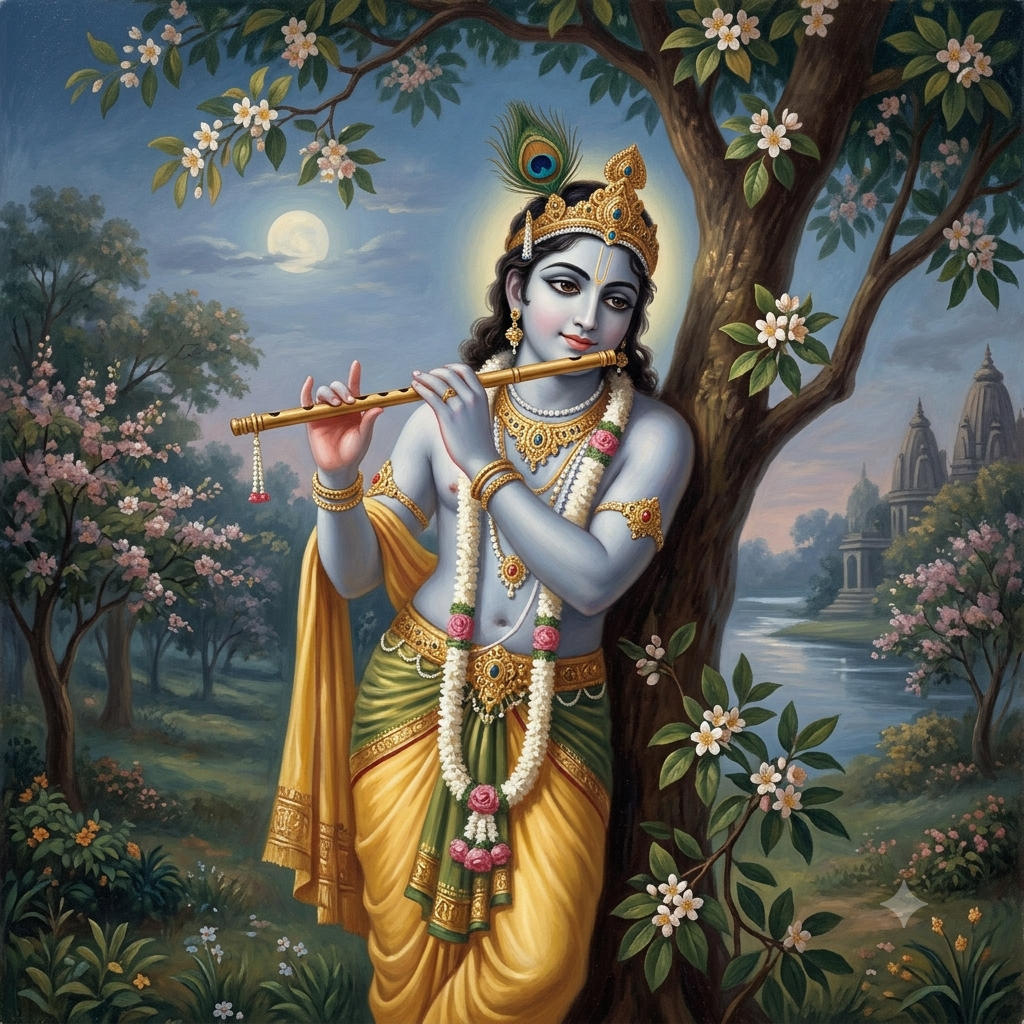
The Bhagavad Gita is an 18-chapter dialogue between Krishna and the warrior Arjuna within the Mahabharata. On the battlefield of Kurukshetra, Arjuna is overcome by grief and moral confusion at the prospect of fighting relatives, teachers, and friends. Krishna responds with teachings about duty, disciplined action, knowledge, devotion, the self, divine reality, and liberation.
The Gita is often summarized as a call to “do your duty,” but that phrase alone is inadequate. The text examines how a person should act when available choices carry painful consequences. It teaches action without possessive attachment to results, yet it does not teach indifference to consequences or provide a simple rule for every ethical dilemma. Its meaning has been debated by Hindu commentators for centuries.
Bhagavad Gita at a glance
- Title: Bhagavad Gītā, commonly translated as “Song of the Lord” or “Song of the Blessed One”
- Setting: Kurukshetra, immediately before a major battle
- Speakers: Primarily Arjuna and Krishna, with the dialogue narrated to King Dhritarashtra by Sanjaya
- Literary context: Part of the Bhishma Parva, the sixth book of the Mahabharata
- Structure: 18 chapters and, in the standard received text, 700 verses
- Major themes: Dharma, karma, yoga, knowledge, devotion, the self, God, nature, and liberation
- Central problem: How to act responsibly without being ruled by ego, despair, or attachment
What happens before Krishna begins teaching?
The Pandavas and Kauravas have reached a catastrophic conflict after failed negotiations, rivalry, humiliation, exile, and disputes over sovereignty. Arjuna asks Krishna, serving as his charioteer, to position their chariot between the armies. When Arjuna sees loved and respected people on both sides, his resolve collapses. He questions the value of victory purchased through the destruction of families and social order.
This opening matters because Arjuna is not merely frightened. He presents ethical arguments and anticipates the wider harm of war. Krishna challenges both his conclusions and the assumptions beneath them. The resulting dialogue addresses Arjuna’s immediate crisis while widening into an inquiry about identity, responsibility, mortality, spiritual discipline, and the nature of reality.
The 18 chapters at a glance
| Chapter | Common title | Primary focus |
|---|---|---|
| 1 | Arjuna’s Despair | The moral and emotional crisis |
| 2 | Sankhya Yoga | The enduring self, wisdom, and disciplined action |
| 3 | Karma Yoga | Action, duty, and freedom from attachment |
| 4 | Knowledge and Action | Divine manifestation, wisdom, and sacrifice |
| 5 | Renunciation of Action | Renunciation and disciplined engagement |
| 6 | Meditation Yoga | Mental discipline and meditation |
| 7 | Knowledge and Realization | Krishna, nature, and divine reality |
| 8 | The Imperishable Brahman | Death, remembrance, and the ultimate goal |
| 9 | Royal Knowledge and Secret | Divine immanence, transcendence, and devotion |
| 10 | Divine Manifestations | Ways Krishna’s greatness is recognized in the world |
| 11 | The Universal Form | Arjuna’s vision of Krishna’s overwhelming cosmic form |
| 12 | Bhakti Yoga | Devotion and the qualities of a beloved devotee |
| 13 | Field and Knower | Body, consciousness, nature, and the knower |
| 14 | The Three Gunas | Sattva, rajas, and tamas |
| 15 | The Supreme Person | The cosmic tree and Purushottama |
| 16 | Divine and Demonic Qualities | Constructive and destructive dispositions |
| 17 | Threefold Faith | Faith and practice shaped by the gunas |
| 18 | Liberation and Renunciation | Synthesis, surrender, and Arjuna’s decision |
English chapter titles vary because translators render Sanskrit terms differently. The titles are useful guides, but each chapter usually contains several interwoven topics.
Major teachings of the Bhagavad Gita
Dharma and responsible action
Dharma can refer to moral order, responsibility, sustaining conduct, or a role-specific duty. Arjuna’s position as a warrior and his participation in a conflict over justice form part of Krishna’s argument. Nevertheless, the Gita is not a blanket command to obey every social role or authority. Arjuna questions, Krishna reasons with him, and the decision remains Arjuna’s at the end of the dialogue.
Applying the battlefield teaching directly to modern disputes can be dangerous. The Gita’s dramatic context belongs to an epic narrative in which diplomacy has failed and every option has costs. Readers have interpreted the battle historically, ethically, symbolically, and spiritually. The text should not be used to sanctify personal anger or political violence without rigorous moral scrutiny.
Karma Yoga: acting without possessiveness
Karma Yoga is disciplined action performed without clinging to personal reward. Krishna tells Arjuna that he has authority over action, not ownership of its fruits. This does not mean that planning or outcomes are irrelevant. It means that ethical work should not be controlled by vanity, greed, fear of failure, or the fantasy that one can command every result.
Non-attachment is also different from emotional numbness. A person may care deeply, prepare carefully, and respond to consequences while surrendering the demand that reality satisfy the ego. The ideal is skillful, responsible participation rather than withdrawal disguised as spirituality.
Jnana: knowledge of the self
Krishna distinguishes the embodied self from the changing body. Bodies pass through childhood, adulthood, old age, and death, while the deepest self—the atman—is described as unborn and enduring. This teaching addresses Arjuna’s grief, but it does not require dismissing bereavement or bodily suffering as unreal in everyday life.
Commentarial schools differ over how the individual self relates to Brahman or the Supreme. Advaita Vedanta emphasizes nondual realization; Vishishtadvaita describes a qualified unity in which souls and the cosmos depend upon Brahman; Dvaita maintains an enduring distinction between God and individual souls. The Gita has supported all three traditions, among others.
Bhakti: devotion and relationship with Krishna
The Gita gives devotion a central place. Krishna asks for loving remembrance and says that even a simple offering—a leaf, flower, fruit, or water—may be accepted when given with devotion. Bhakti is not presented merely as emotion. It includes trust, ethical character, remembrance, worship, and the reorientation of action toward the divine.
Chapter 12 describes the beloved devotee as non-hating, compassionate, self-controlled, steady, and free from possessive ego. These qualities provide an important corrective to any form of religious enthusiasm that produces cruelty, superiority, or contempt.
Meditation and discipline of mind
Chapter 6 describes meditation, posture, moderation, concentration, and the difficulty of restraining the mind. Arjuna compares the mind to the wind; Krishna acknowledges the challenge and recommends practice and non-attachment. The discussion belongs to a broader spiritual discipline rather than a promise that one technique will immediately remove distress.
Meditation may support wellbeing for many people, but the Gita is not a substitute for professional mental-health or medical care. Readers experiencing severe anxiety, depression, trauma, or other health concerns should seek qualified support in addition to any spiritual practice they find meaningful.
The three gunas
The Gita describes material nature through three gunas: sattva, associated with clarity and harmony; rajas, with activity and craving; and tamas, with inertia and confusion. They are interacting qualities, not permanent labels for ranking people. Every person’s behavior may display different combinations in different situations.
Modern charts sometimes equate sattva with “good people,” rajas with “ordinary people,” and tamas with “bad people.” That oversimplifies the text and can encourage spiritual pride. Even attachment to clarity and happiness may bind, according to the Gita; the larger aim is freedom from domination by all three gunas.
Krishna’s universal form
In Chapter 11, Krishna grants Arjuna a divine mode of sight and reveals a form containing innumerable beings, gods, worlds, wonders, and the destructive movement of time. Arjuna responds with amazement, devotion, and terror. This is not simply a beautiful vision. It confronts him with a reality too vast to fit his preferred image of the divine.
Krishna later resumes a gentler form. The sequence holds together intimacy and transcendence: Arjuna’s charioteer and friend is also the cosmic reality that exceeds ordinary perception.
Does the Gita teach one single path?
The Gita brings together action, knowledge, meditation, and devotion rather than presenting them as entirely isolated systems. Different commentators have nevertheless emphasized different paths. Shankara reads the text through knowledge and renunciation; Ramanuja gives devotion and surrender a decisive role; Madhva interprets it through a realist distinction between God and souls. Other Hindu teachers relate the Gita to service, social action, contemplative practice, or Krishna-centered devotion.
This interpretive range is not a defect to be solved by choosing the only “correct” English slogan. It reflects the Gita’s density and its long life within distinct philosophical communities.
How to begin reading the Bhagavad Gita
- Read the first chapter rather than skipping directly to famous quotations. Arjuna’s crisis gives the teaching its urgency.
- Use a translation that identifies the Sanskrit terms it renders. Words such as dharma, yoga, and atman rarely have one exact English equivalent.
- Compare more than one translation when a verse appears unusually absolute or politically convenient.
- Distinguish the base text from a commentator’s explanation. Both may be valuable, but they are not the same layer.
- Read within the Mahabharata’s wider narrative when possible, especially before drawing conclusions about war and duty.
- Ask how the text describes the character of a wise or devoted person, not only what metaphysical claims it makes.
Frequently asked questions
Who wrote the Bhagavad Gita?
Hindu tradition attributes the Mahabharata, including the Gita, to the sage Vyasa. Historical scholarship studies the epic as a work that developed through oral and textual transmission over an extended period. These are different ways of discussing authorship and need not be silently treated as the same claim.
Is the Bhagavad Gita the Hindu Bible?
The comparison may communicate its influence but is structurally misleading. Hindu traditions do not share one closed scriptural canon equivalent to the Bible. The Gita is exceptionally important, yet it exists alongside the Vedas, Upanishads, epics, Puranas, Agamas, and many regional and sectarian texts.
Does the Gita support war?
The dialogue occurs before a war and ultimately leads Arjuna to fight, so violence cannot be removed from its context. At the same time, the text is not a general license for warfare. It presents a particular epic crisis after attempted alternatives have failed and has inspired both martial and nonviolent interpretations.
What is the main message of the Bhagavad Gita?
No single sentence captures the whole work. A responsible summary is that people should act according to discerned responsibility, relinquish egoistic attachment, cultivate knowledge and devotion, and orient life toward the highest reality.
Which translation should a beginner read?
A useful beginner’s edition should clearly separate translation from commentary and explain key Sanskrit terms. The IIT Kanpur Gita Supersite allows readers to compare several translations and traditional commentaries before choosing a print edition.
Sources and further reading
- Gita Supersite, Indian Institute of Technology Kanpur — Sanskrit text with multiple translations and commentaries.
- Internet Encyclopedia of Philosophy: Bhagavad Gita — philosophical overview of the text, its ethical problem, and major teachings.
- Encyclopaedia Britannica: Bhagavad Gita — concise reference overview of setting, structure, and significance.
- Encyclopaedia Britannica: Mahabharata — literary context for the epic in which the Gita appears.
- Stanford Encyclopedia of Philosophy: Shankara — scholarly context for Advaita Vedanta and Shankara’s interpretive tradition.
- Internet Encyclopedia of Philosophy: Ramanuja — context for Ramanuja’s Vishishtadvaita theology and devotional reading.