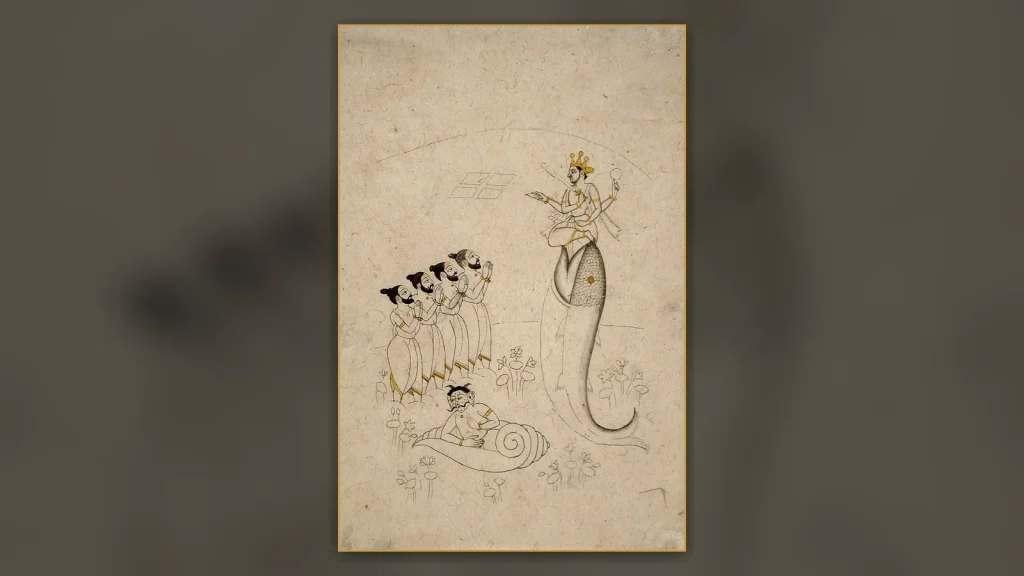
Matsya is Vishnu’s fish avatar, best known for warning Manu of a devastating flood and guiding a vessel to safety. Hindu texts do not tell one identical version: the Śatapatha Brāhmaṇa centers on Manu and a remarkable fish, while later Vaishnava accounts identify the rescuer explicitly with Vishnu and add the preservation of sacred knowledge.

Matsya avatar at a glance
| Question | Concise answer |
|---|---|
| Who is Matsya? | A fish manifestation of Lord Vishnu. |
| Principal human figure | Manu in the Śatapatha Brāhmaṇa; King Satyavrata, linked with the future Manu, in the Bhāgavata Purāṇa. |
| Main narrative role | Warns of a flood, protects a vessel, and preserves continuity across a cosmic crisis. |
| Named textual witnesses | Śatapatha Brāhmaṇa 1.8.1 and Bhāgavata Purāṇa 8.24, among other later tellings. |
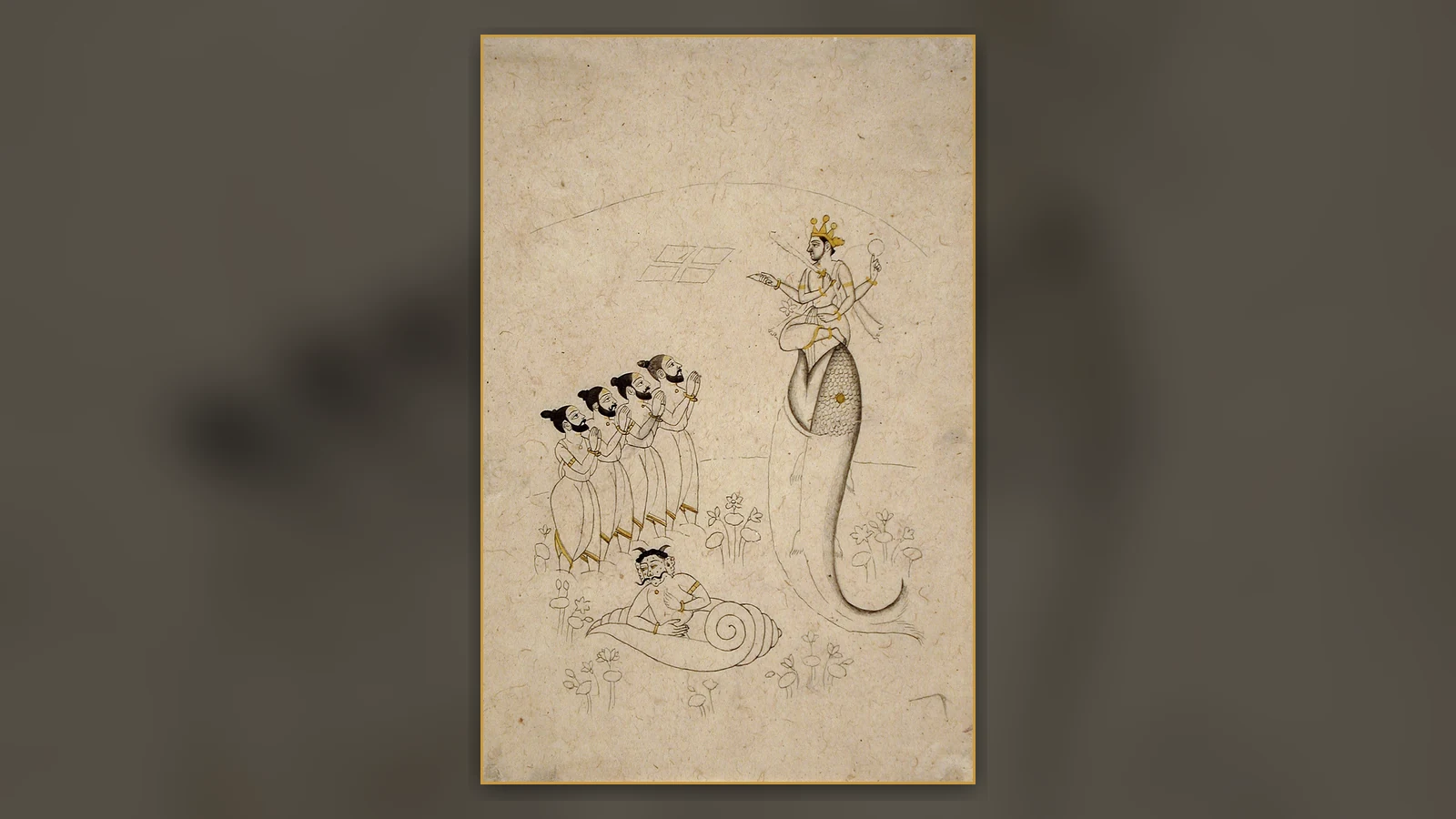
| Common visual forms | A complete fish; or an anthropomorphic Vishnu whose lower body ends in a fish tail. |
| Important caution | Matsya the avatar is not the same subject as the whole Matsya Purana. |
What happens in the Matsya story?
In the best-known outline, a tiny fish asks Manu for protection from larger fish. Manu keeps it first in a vessel and then in progressively larger bodies of water as it grows beyond ordinary scale. The fish warns him that a flood will destroy living creatures and tells him to prepare a boat. When the waters rise, the great fish draws or guides the vessel until safety is reached.
The episode combines two movements. Manu protects a vulnerable being before he knows its full identity; later, the being he protected becomes his protector. That reversal gives the narrative ethical depth without reducing it to a simple moral formula. Care, foresight, and preservation matter, but the story remains a sacred account of continuity through dissolution rather than an instruction for predicting modern disasters.
Named textual witnesses and how they differ
Śatapatha Brāhmaṇa 1.8.1: Manu and the fish
The Śatapatha Brāhmaṇa 1.8.1, available in Julius Eggeling’s nineteenth-century translation, begins with a fish coming into Manu’s hands while he washes. The fish asks to be reared and promises to save him from a flood. Manu builds a ship, boards it when the flood arrives, and fastens it to the fish. The account associates his survival with renewed human continuity and with the ritual figure Iḍā.
This early witness does not present every feature familiar from later Dashavatara charts. It should therefore be described as an early Manu-and-fish flood narrative, not silently rewritten as if it contained the complete later Vaishnava version. The older translation is useful for locating the passage but carries the vocabulary and assumptions of its period.
Bhāgavata Purāṇa 8.24: Matsya, Satyavrata, and sacred knowledge
The Bhāgavata Purāṇa, Canto 8, Chapter 24 explicitly presents the fish as a divine incarnation. Its king is Satyavrata, who is connected with the future Vaivasvata Manu. The narrative includes the growing fish, advance warning, a boat, sages, seeds, the serpent Vāsuki as a fastening rope, and Matsya guiding the vessel. It also links the episode with recovering Vedic knowledge from Hayagrīva.
The linked translation belongs to a modern Gaudiya Vaishnava institution, so its theological framing should be identified rather than treated as a neutral critical edition. It is nevertheless a clear, chapter-level witness to a developed Vaishnava telling. Readers can compare it with the Śatapatha account and see that “the Matsya story” is a family of related narratives, not one frozen script.
Why the Matsya Purana needs its own page
The Matsya Purana is a large, layered Purāṇic work covering creation, sacred geography, gifts, rites, kingship, temples, iconography, and other subjects. Its title and narrative framing connect it with Matsya, but the book is not simply a long biography of the fish avatar. This guide owns the avatar, flood, meaning, and image intent; the Purana guide owns the text’s contents and transmission.
What does Matsya mean?
Matsya is the Sanskrit word for “fish.” In the Dashavatara, the aquatic form is suited to a world overwhelmed by water. The story portrays preservation as active: warning is given, a vessel is prepared, living continuity is carried forward, and knowledge is protected in some versions.
Several interpretations are possible, but they should be labeled as interpretation. Devotional readers may see divine responsiveness: Vishnu takes the form required by the crisis. Ethical readers may emphasize Manu’s care for the small fish before its greatness is apparent. Literary readers may notice how the fish moves from dependency to cosmic guidance. None of these readings proves that the narrative encoded modern flood geology or evolutionary biology.
The boat is also a powerful image of continuity. Depending on the telling, it carries a survivor, sages, seeds, or knowledge through a break between world ages. What matters is not an exact modern inventory but the conviction that life and memory are not left without guidance. This reading respects the story’s cosmic scale while avoiding a universal claim that every Hindu community explains each passenger or preserved item in the same way.
How Matsya appears in sacred art
Matsya iconography is not limited to one design. The Metropolitan Museum of Art records an eighteenth- or nineteenth-century Indian bronze titled “Fish Avatar of Vishnu”. It combines a crowned, upright divine figure with a fish-form lower body. This object supports the existence of an anthropomorphic Matsya type; it does not establish that every region or period used the same attributes.
A later visual tradition appears in the Met’s record for “Matsya Avatara (Vishnu’s Fish Avatar),” a circa 1900–15 chromolithograph. Together, the records show that Matsya has appeared in both sculptural and popular-print settings. Artists may depict a complete fish, a fish bearing divine signs, or a human upper body joined to a fish tail. The surrounding figures and boat details depend on which moment and textual tradition the artist chooses.
Tradition and regional variation
- Textual variation: Manu’s name, the passengers, what is preserved, the method of fastening the boat, and the identity of an opponent differ across works.
- Vaishnava interpretation: Later Purāṇic tellings explicitly identify the fish with Vishnu and place the event within avatar theology. The general logic of divine manifestation is expressed in Bhagavad Gita 4.7–4.8, though those verses do not narrate Matsya’s flood.
- Visual variation: Sculptures, paintings, prints, and Dashavatara ensembles abbreviate the story differently. An object record documents one work, not a universal rule.
- Living tradition: Matsya may be remembered through temple images, recitation, storytelling, or Dashavatara displays. The prominence and ritual setting vary by region, temple, lineage, and family.
Common misconceptions
Is Matsya simply the Hindu version of Noah?
No. Flood narratives invite comparison, but resemblance does not make them identical. Matsya traditions have their own textual history, characters, ritual setting, cosmology, and theological development. Comparison is most responsible when each source is read on its own terms.
Does Matsya prove that the Dashavatara predicted evolution?
No. A fish standing first in a familiar ten-avatar sequence has inspired modern analogies with biological evolution, but the religious narratives were not written as modern evolutionary science. Avatar lists also vary.
Does hearing or displaying the Matsya story guarantee protection?
No educational article can promise safety, health, wealth, or a spiritual result. Devotees may understand the narrative as sacred and protective within their traditions, but personal religious claims should not be converted into guarantees.
Frequently asked questions
Is Matsya the first avatar of Vishnu?
Matsya is first in the most familiar Dashavatara order. Hindu texts also contain longer and differently arranged lists of Vishnu’s manifestations, so “first” refers to that prominent tenfold sequence.
Who is Manu in the Matsya story?
Manu is an ancestral and lawgiving figure associated with humanity and cosmic cycles. The Śatapatha Brāhmaṇa names Manu; the Bhāgavata account uses King Satyavrata and connects him with a future Manu.
What did Matsya save?
The answer depends on the source. The Śatapatha account emphasizes Manu’s survival and renewed continuity. The Bhāgavata version includes sages and seeds and also connects Matsya with recovering Vedic knowledge.
Is Hayagrīva in every Matsya flood story?
No. Hayagrīva’s theft of sacred knowledge belongs to particular later accounts. It should not be inserted into the Śatapatha Brāhmaṇa version.
Is Matsya Purana only about Matsya?
No. It is a broad Purāṇic text with many subjects. See the separate Matsya Purana guide for its structure and themes.
Sources
- Śatapatha Brāhmaṇa 1.8.1, trans. Julius Eggeling — early Manu-and-fish flood witness.
- Bhāgavata Purāṇa 8.24, Bhaktivedanta Vedabase — Vaishnava Matsya and Satyavrata narrative.
- Gita Supersite, IIT Kanpur: Bhagavad Gita 4.7–4.8 — avatar-theology context, not the flood story itself.
- Metropolitan Museum of Art: Fish Avatar of Vishnu, object 39261 — dated bronze and observable Matsya form.
- Metropolitan Museum of Art: Matsya Avatara, object 78267 — early twentieth-century print record.
- HinduClarity: Dashavatara — cluster context and list-variation explanation.