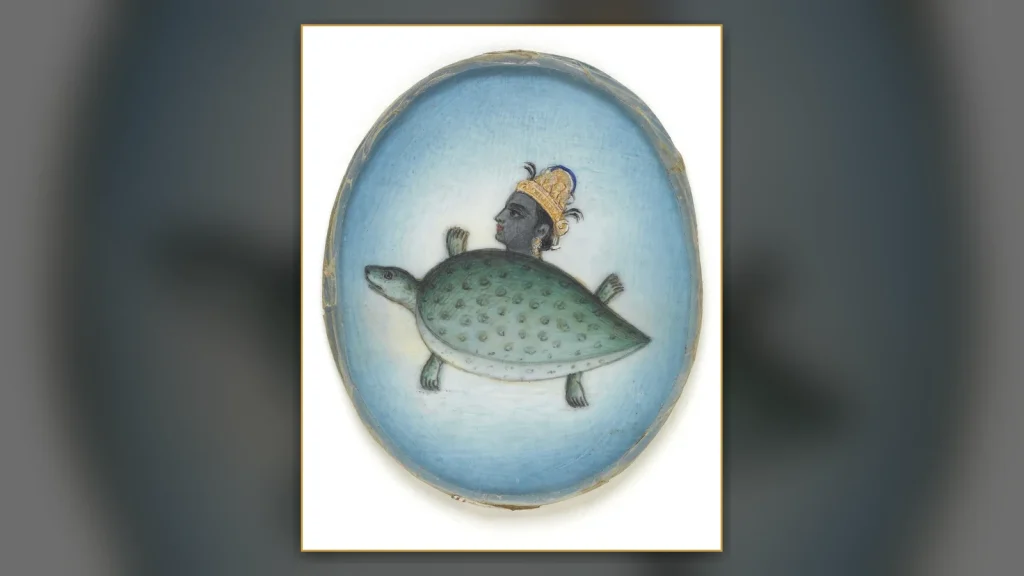
Kurma is Vishnu’s tortoise avatar, who supports Mount Mandara when it sinks during the churning of the cosmic ocean. Devas and asuras perform the churning to obtain amrita, but Kurma’s steady support makes their immense task possible. Texts differ in framing and detail, so the episode is best read through named witnesses rather than one blended retelling.
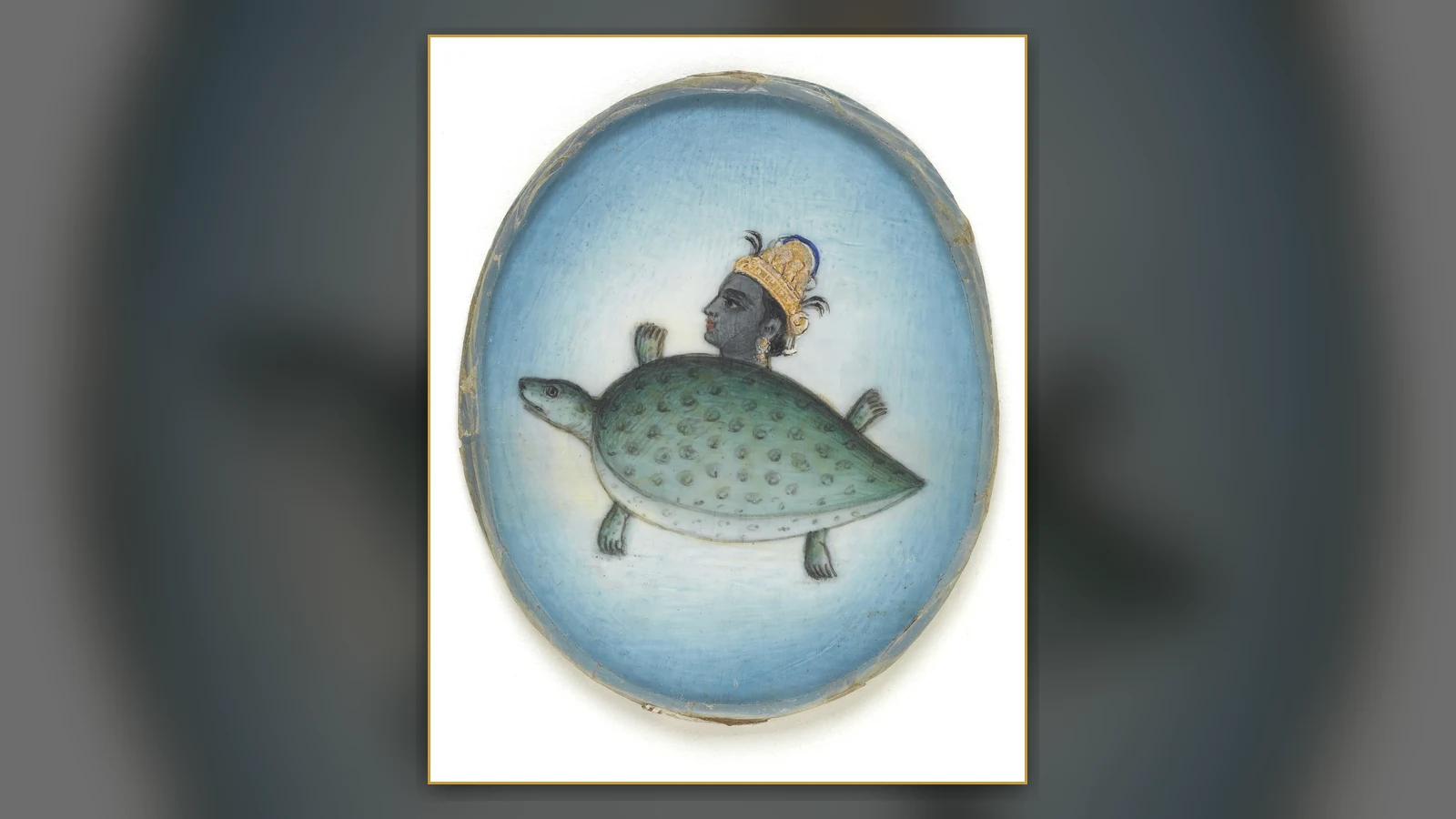

Kurma avatar at a glance
| Question | Concise answer |
|---|---|
| Who is Kurma? | The tortoise manifestation of Lord Vishnu. |
| Central episode | Samudra Manthana, the churning of the ocean. |
| Kurma’s role | Supports Mount Mandara after the churning rod sinks. |
| Other principal figures | Devas, asuras, Vāsuki, Lakshmi, Dhanvantari, Mohini, and Shiva in major Purāṇic tellings. |
| Named textual witnesses | Vishnu Purāṇa 1.9 and Bhāgavata Purāṇa 8.6–12, among others. |
| Important caution | The avatar story is not a summary of the whole Kurma Purana. |
What happens in the churning of the ocean?
In a widely known Purāṇic pattern, the devas lose strength and seek Vishnu’s help. They enter a temporary alliance with the asuras to churn the ocean for amrita, the nectar associated with immortality. Mount Mandara serves as the churning rod, and the great serpent Vāsuki serves as the rope. The two groups pull from opposite sides.
The mountain cannot remain stable and sinks. Vishnu takes the form of an enormous tortoise, descends beneath it, and bears it on his back. With a foundation restored, the churning continues. Poison appears before the desired nectar, and Shiva contains the danger in a famous episode. Other beings and treasures emerge in different enumerations, including the goddess Lakshmi and Dhanvantari carrying amrita. Later, Vishnu’s Mohini form shapes the nectar’s distribution.
This outline joins events spread across chapters and told differently by different works. Kurma’s specific action is clear—supporting the mountain—but the complete Samudra Manthana cycle includes many figures whose roles should not be collapsed into Kurma alone.
Named textual witnesses and narrative differences
Vishnu Purāṇa 1.9: Lakshmi and the ocean churning
Vishnu Purāṇa 1.9, in H. H. Wilson’s public-domain translation, frames the churning within the “Legend of Lakshmi.” Indra’s loss of prosperity, the weakening of the gods, their appeal to Vishnu, and the recovery of divine goods belong to one narrative movement. Vishnu directs the gods and supports Mandara in tortoise form; Lakshmi’s emergence and choice of Vishnu receive central attention.
The chapter therefore does more than explain why Kurma appeared. It connects stability, divine counsel, prosperity, and the restoration of cosmic order. Wilson’s 1840 translation is a useful identified witness, but readers should recognize its dated English and consult newer scholarship for philological questions.
Bhāgavata Purāṇa 8.6–12: an expanded Vaishnava sequence
The Bhāgavata Purāṇa’s eighth canto narrates preparations, the sinking mountain, Kurma’s support, the appearance of poison, Shiva’s intervention, the emergence of treasures and deities, and the contest over amrita across several chapters. Chapter 8.7 explicitly says that Vishnu appears as a tortoise and carries Mandara on his back.
The linked English edition is produced by a Gaudiya Vaishnava institution and openly reflects that theological setting. It is valuable as a readable, chapter-level translation, but it should not be presented as the sole Hindu interpretation. Compared with Vishnu Purāṇa 1.9, it gives a differently paced and elaborated devotional account.
Why the Kurma Purana is a separate subject
The Kurma Purana is a layered Purāṇic text associated with Vishnu’s tortoise form, yet its surviving contents extend far beyond the ocean-churning episode. It contains cosmology, pilgrimage material, ritual and social teaching, yoga, and the Ishvara Gita, with notable Vaishnava and Shaiva dimensions. The title does not mean every chapter is a Kurma biography.
What does Kurma mean?
Kūrma means “tortoise” or “turtle” in Sanskrit usage. Within the Dashavatara, the form answers a precise need: a mountain used for transformation requires a base that can endure enormous motion. Kurma is not the most visually dramatic participant, but the task fails without him.
That makes “support” the most defensible interpretive theme. Stability here is not passivity. Kurma enters the depths and bears pressure so that a difficult process can continue. Readers also find a caution against simplistic success stories: the churning produces poison before nectar, and cooperation between rivals remains tense and temporary. These are interpretations of the narrative, not promises that endurance automatically produces a desired worldly result.
The episode also distinguishes foundation from control. Kurma enables the churning without erasing the choices, rivalries, or responsibilities of its participants. The mountain, serpent, devas, asuras, poison, nectar, and emerging deities retain their own narrative roles. Reading the tortoise only as a generic “symbol of patience” loses this relational structure. A fuller interpretation sees steadiness operating within a complex undertaking whose outcomes must still be confronted ethically.
Kurma and Samudra Manthana in sacred art
The Metropolitan Museum of Art documents an eighteenth- or nineteenth-century Indian bronze titled “Tortoise Avatar of Vishnu”. The figure combines a crowned, anthropomorphic upper body with a tortoise-form base. It demonstrates one way artists made the avatar recognizable while retaining Vishnu’s divine personhood. A single bronze cannot define universal Kurma iconography.
A second Met record, “The Churning of the Ocean of Milk,” circa 1780–90, identifies a painting from Mandi in the Punjab Hills. Its tags and title connect Vishnu, a turtle, a serpent, devas, and asuras within a crowded narrative scene. The painting shows how Kurma may appear as one structural element within a larger composition rather than as an isolated deity.
Temple reliefs and later prints may show Mandara balanced above Kurma, Vāsuki encircling the mountain, and opposing groups pulling the serpent. Other works emphasize treasures or a central Vishnu. Museum dates, places, and materials help readers see historical variation; they do not prove that one composition is prescribed everywhere.
Tradition and regional variation
- Textual emphasis: One work may foreground Lakshmi, another Shiva’s drinking of poison, another the struggle for amrita, and another Vishnu’s multiple forms during the event.
- Lists of treasures: Popular “fourteen treasures” charts are influential, but names and counts are not identical in every textual witness. A chart should be attributed to its source.
- Visual traditions: Kurma can appear alone, as a hybrid divine figure, beneath Mandara, or within a full churning tableau.
- Temple and regional practice: Kurma is honored independently in some places and appears within broader Vishnu or Dashavatara worship elsewhere. The degree of prominence varies by temple, region, and lineage.
- Theological framing: Vaishnava traditions understand the supporting tortoise as Vishnu’s purposeful manifestation. The wider episode also gives major roles to Shiva, Lakshmi, and other deities rather than functioning as a one-deity story.
Common misconceptions
Did Kurma churn the ocean by himself?
No. Kurma supports the mountain. Devas and asuras pull Vāsuki, while Vishnu, Shiva, Lakshmi, Dhanvantari, Mohini, and other figures have distinct roles in major versions.
Is Samudra Manthana a historical or scientific account?
It is a sacred cosmological narrative, not a laboratory description or a datable oceanographic event. Symbolic readings may be meaningful, but they should not be mislabeled as modern science.
Does the story guarantee rewards after hardship?
No. The sequence from poison to nectar can inspire reflection, but it is not a guarantee of health, wealth, success, or spiritual attainment.
Is Kurma Purana only Vaishnava?
Its title and frame are connected with Kurma, but the extant text is layered and contains substantial Shaiva material as well as Vaishnava teaching. See the dedicated text guide for that complexity.
Frequently asked questions
Why did Vishnu become a tortoise?
Mount Mandara sank during the churning. Vishnu became Kurma to provide a stable base beneath it so the process could continue.
What was used as the churning rope?
Major Purāṇic tellings name the serpent Vāsuki. The devas and asuras pull from opposite sides, though details about who holds which end and why vary.
What came out of the ocean first?
In the Bhāgavata sequence, a dangerous poison appears before the nectar. Shiva’s response becomes a major episode in its own right.
Is Kurma always shown as a full tortoise?
No. Art may show a complete tortoise, a crowned human-tortoise form, or a small supporting tortoise beneath Mandara in a larger tableau.
Is Kurma the second avatar?
Kurma is second in the most familiar Dashavatara order, after Matsya. Other lists of Vishnu’s manifestations can be longer or organized differently.
Sources
- Vishnu Purāṇa 1.9, trans. H. H. Wilson — churning narrative and Lakshmi emphasis.
- Bhāgavata Purāṇa 8.7, Bhaktivedanta Vedabase — sinking mountain, Kurma’s support, and poison episode.
- Bhāgavata Purāṇa 8.8 — emergence of Lakshmi and other results of the churning.
- Gita Supersite, IIT Kanpur: Bhagavad Gita 4.7–4.8 — broader manifestation theology, not the churning narrative.
- Metropolitan Museum of Art: Tortoise Avatar of Vishnu, object 39259 — dated bronze and observable hybrid form.
- Metropolitan Museum of Art: The Churning of the Ocean of Milk, object 37989 — regional painting record and scene identification.