Hindu festival guide
Chaitra Navratri
A nine-day guide to spring Navratri, the forms of Devi, kalash sthapana, fasting, regional traditions, and the relationship to Rama Navami.
Chaitra Navratri dates for 2026 and 2027
| Year | Observed date | Planning note |
|---|---|---|
| 2026 | Begins Thursday, March 19 | The nine-day sequence and ashtami/navami observances follow local tithi. |
| 2027 | Begins Wednesday, April 7 | The nine-day sequence and ashtami/navami observances follow local tithi. |
Calendar note: Chaitra Navratri begins with the bright half of the lunar month Chaitra. Ghatasthapana timing, regional new-year observances, and the concluding day should be checked by location.
What Chaitra Navratri means
Chaitra Navratri is the spring observance of the nine nights dedicated to Devi, the divine feminine power expressed through courage, wisdom, nourishment, protection, and transformation.
Many devotees establish a kalash, grow sacred barley or other grains, read the Devi Mahatmya or Ramayana, fast according to ability, and worship a form of Durga on each day. The ninth day often coincides with Rama Navami, linking Devi worship with the celebration of Rama’s birth.
The festival is quieter than the public garba season of Sharad Navratri in many regions, but it is spiritually important in homes, Shakta temples, and North Indian pilgrimage traditions.
Shakti
Devi represents the power through which life, knowledge, protection, and moral courage become active.
Nine-stage discipline
The sequence encourages steady practice rather than a single burst of emotion.
Spring beginning
New growth and regional new-year customs make the festival a time for ethical renewal.
Sacred story and historical setting
Navratri traditions draw on several bodies of sacred literature. The Devi Mahatmya narrates the Goddess overcoming forces such as Mahishasura, Shumbha, and Nishumbha. These are theological stories about restoring cosmic and moral balance, not instructions for hostility toward human groups.
A popular daily sequence honors Shailaputri, Brahmacharini, Chandraghanta, Kushmanda, Skandamata, Katyayani, Kalaratri, Mahagauri, and Siddhidatri. The exact order, colors, foods, and mantras are not uniform in every lineage.
Do not treat viral ‘nine colors’ charts or one commercial fasting list as universal scripture. Follow a trusted temple, family, or sampradaya calendar and state regional variations clearly.
How the festival is observed
A balanced observance combines worship, study, self-restraint, respect for girls and women, charity, and practical care for the household.
- Install a clean kalash only if you can maintain the prayer space safely for nine days.
- Light a lamp, offer flowers and fruit, and recite prayers according to your tradition.
- Read a manageable section of the Devi Mahatmya, Ramayana, or a reliable translation each day.
- If fasting, choose a medically safe form and avoid turning food restrictions into competition.
- Support women and girls through education, safety, health, or charitable service rather than symbolism alone.
- Conclude with gratitude, prasad, and respectful visarjan of temporary items without polluting water.
Food, offerings, and hospitality
Fasting menus may use fruit, milk, potatoes, buckwheat, amaranth, water chestnut flour, or other permitted foods, while some communities eat ordinary vegetarian meals. Rules differ.
Kanya puja meals can include puri, kala chana, and halwa. Children must be treated as guests with dignity, consent, safe food, and no exploitative photography.
Regional and community traditions
North India
Kalash sthapana, fasting, Ramayana recitation, Devi temples, and the approach to Rama Navami are prominent.
Himachal and Shakta centers
Temple pilgrimage and local forms of Devi worship connect the festival with established regional traditions.
Maharashtra and south India
The season may overlap with Gudi Padwa, Ugadi, or other new-year observances, while household Navratri practice varies.
Observing in Trinidad and Tobago or the wider diaspora
Mandirs in Trinidad and Tobago may hold nightly yajna, Devi worship, Ramayana recitation, bhajans, and a Rama Navami conclusion. Check whether the program follows Chaitra Navratri, a local Ramayana tradition, or both.
Families can maintain the nine-day rhythm through short evening prayer and one sustained service project without copying every custom found online.
A respectful home observance
- Choose a clean stable place for a lamp, flowers, water, and a Devi image or symbolic kalash.
- Set a realistic daily time for prayer, reading, silence, or bhajan.
- Practice one restraint, such as reducing gossip, anger, waste, or impulsive spending.
- Support a women’s or children’s charity with verified impact.
- On the final day, distribute prasad and return all materials responsibly.
Good practice: Keep lamps away from fabric and unattended rooms. Anyone with diabetes, pregnancy, an eating disorder, medication needs, or strenuous work should not fast without medical guidance. Never use child worship as a reason to ignore consent or safeguarding.
Frequently asked questions
How is Chaitra Navratri different from Sharad Navratri?
Both honor Devi for nine nights. Chaitra occurs in spring and often leads to Rama Navami; Sharad occurs in autumn and is more strongly associated with Durga Puja, garba, and Vijayadashami in many regions.
Must I worship a different goddess each day?
The Navadurga sequence is beloved but not universal. Follow your lineage or keep one consistent Devi practice.
Is fasting compulsory?
No. Fasting is a discipline, not a test of worth. Prayer, service, study, and ethical restraint are valid when food restriction is unsuitable.
What is ghatasthapana?
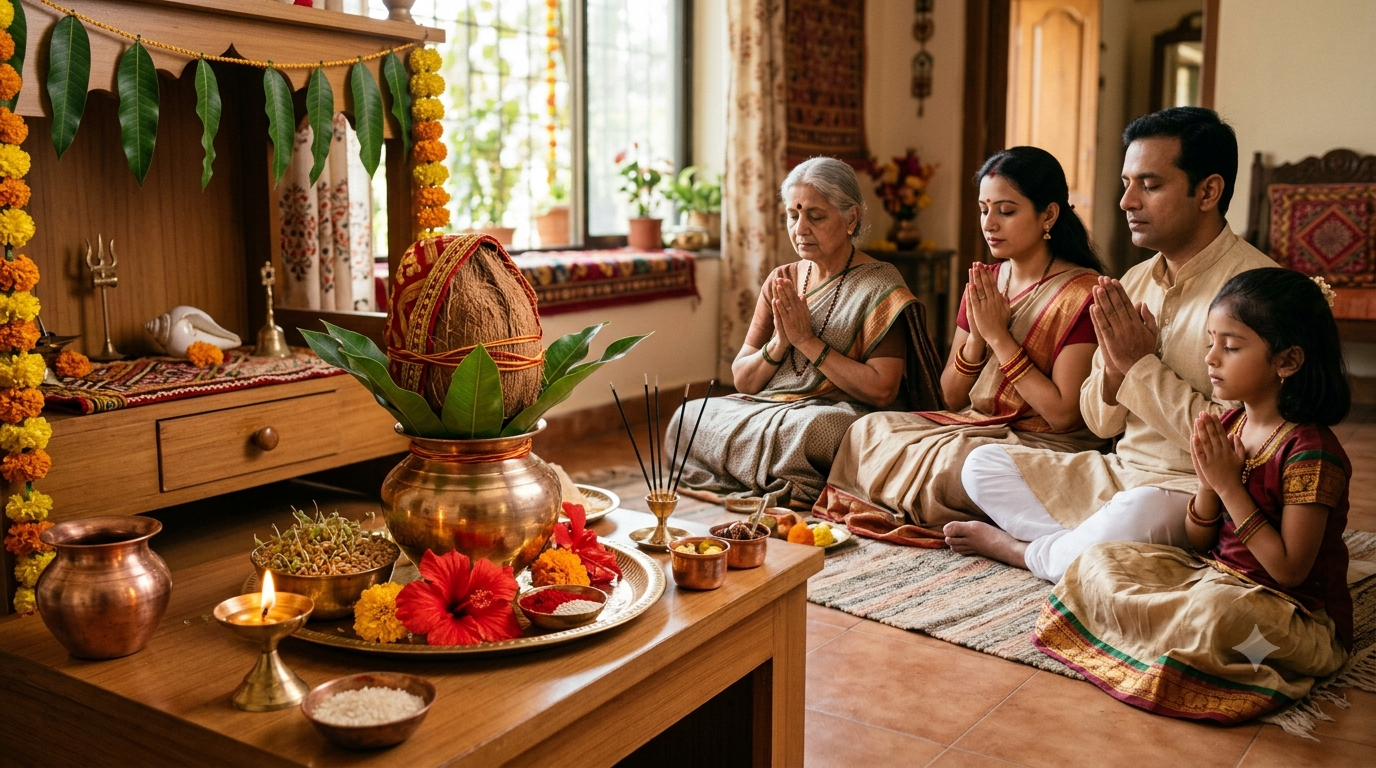
It is the establishment of a sacred pot, often with water, leaves, coconut, and germinating grain, to mark the beginning of worship.
Sources and further reading
- Encyclopaedia Britannica – Navratri – Overview of Navratri traditions.
- Drik Panchang – Chaitra Navratri – Location-sensitive dates and daily sequence.
- Devi Mahatmya overview – Oxford Reference – Scholarly reference context for the Goddess tradition.
- Hindu American Foundation – Navaratri – Community-facing explanation.
Editorial and rights note: This educational overview is independently written from cross-checked facts and does not reproduce source text. External sources are cited for verification and further reading; citation does not imply endorsement. The hero is an illustrative AI-generated image created for HinduClarity, not a historical photograph or documentary record. This page is not a substitute for guidance from your temple, family tradition, qualified teacher, or licensed professional. Hindu calendars and practices vary by sampradaya, region, and location.
Back to the complete Hindu Festivals Calendar for 2026-2027
Continue with the Diwali guide or the Ganesh Chaturthi guide.