Hindu festival guide
Chhath Puja
A detailed guide to the demanding four-day Sun festival, dawn and sunset arghya, sacred foods, community practice, environmental care, and safety.
Chhath Puja dates for 2026 and 2027
| Year | Observed date | Planning note |
|---|---|---|
| 2026 | Sunday, November 15 for the main evening arghya | Nahay Khay and Kharna precede the evening arghya; dawn arghya follows next morning. |
| 2027 | Thursday, November 4 for the main evening arghya | Nahay Khay and Kharna precede the evening arghya; dawn arghya follows next morning. |
Calendar note: The principal Kartika Chhath sequence follows Diwali and spans four days. Sunrise and sunset offerings are location-specific, and local organizers should publish the full sequence.
What Chhath Puja means
Chhath Puja is a rigorous four-day festival honoring Surya, the Sun, and Chhathi Maiya, widely observed in Bihar, Jharkhand, eastern Uttar Pradesh, Nepal’s Madhesh, and diaspora communities.
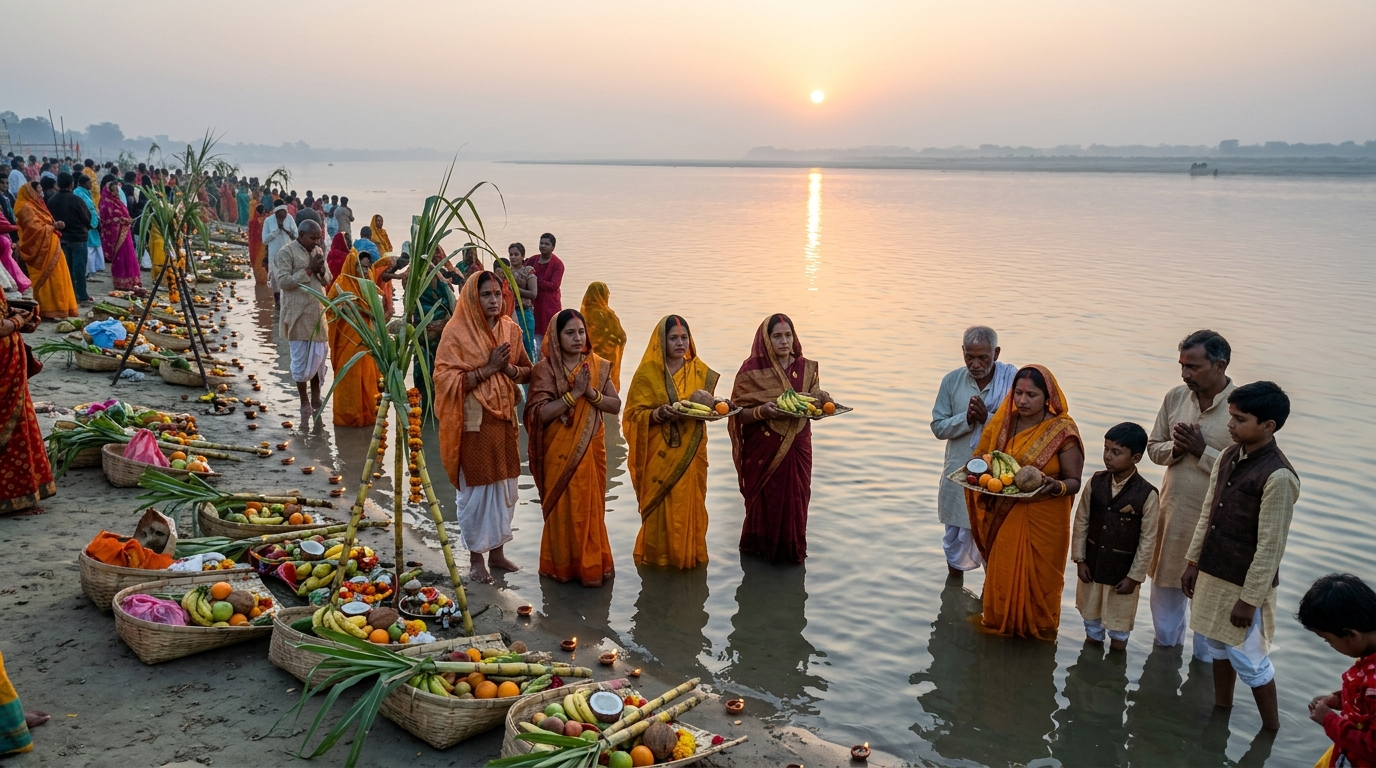
The vrata includes purification, simple food, Kharna, an extended fast, offerings to the setting Sun, a night of devotion, and offerings to the rising Sun. Bamboo baskets hold fruit, sugarcane, thekua, and other carefully prepared items.
Chhath is known for discipline, collective labor, cleanliness, and direct worship without elaborate temple requirements. The vratin, often a woman but not necessarily, is supported by the whole household.
Solar gratitude
Both setting and rising Sun are honored, acknowledging decline and renewal rather than celebrating success alone.
Shared labor
Family and neighbors clean spaces, prepare prasad, arrange transport, and support the vratin.
Purity and restraint
Food preparation, speech, environment, and conduct are approached with unusual care across the sequence.
Sacred story and historical setting
Traditions connect Chhath with ancient Sun worship, the Mahabharata figures Karna and Draupadi, and Chhathi Maiya as a protective mother associated with children and well-being. These associations vary across oral, regional, and later textual traditions.
The living festival is best understood through the disciplined four-day practice maintained by families and communities. Its identity cannot be reduced to a single origin claim.
Chhath’s austere fast should not be romanticized or copied casually. A vratin requires informed choice, health planning, safe water access, transportation, rest, and family support.
How the festival is observed
The common sequence is Nahay Khay, Kharna, Sandhya Arghya, and Usha Arghya, followed by breaking the fast.
- On Nahay Khay, bathe and prepare a simple purified meal according to family rules.
- On Kharna, complete the daytime fast and offer a simple evening prasad before beginning the longer fast.
- Prepare bamboo baskets with fruit, sugarcane, thekua, lamps, and other traditional offerings.
- Offer arghya to the setting Sun only at a supervised, stable water edge.
- Return for dawn arghya with lighting, transport, crowd, and child-safety plans.
- Break the fast gradually and distribute prasad hygienically.
Food, offerings, and hospitality
Thekua, rice, fruits, sugarcane, coconut, ginger, and Kharna preparations such as rice pudding or roti appear in family traditions. Ingredients and kitchens are kept carefully clean.
Purity should include public health: safe water, covered food, clean hands, and protection from insects and contamination.
Regional and community traditions
Bihar and Jharkhand
Riverbanks, ponds, temporary ghats, folk songs, bamboo baskets, and neighborhood cooperation form the festival’s heart.
Eastern Uttar Pradesh and Nepal
Local songs, language, foods, and ghats express related Surya and Chhathi Maiya traditions.
Indian and global cities
Authorities create temporary pools or controlled ghats where natural waterways are unsafe, polluted, inaccessible, or ecologically sensitive.
Observing in Trinidad and Tobago or the wider diaspora
In Trinidad and Tobago, no family should enter an unsafe river, beach, drain, or flooded area. Coordinate with a mandir, local authority, or supervised venue and use a clean temporary pool when appropriate.
The regional Bihari and Bhojpuri identity of Chhath should be respected. Invite tradition-bearers to lead songs and explain the four-day sequence rather than turning the observance into a generic Sun puja.
A respectful home observance
- Consult an experienced family or community leader before undertaking the full vrata.
- Prepare a clean household space and a written schedule for food, transport, rest, medication, and water access.
- Use a stable outdoor vessel or supervised community pool for symbolic arghya if natural water is unsafe.
- Sing traditional songs, offer fruit and thekua, and support the vratin without crowding or filming constantly.
- Remove every lamp, basket, flower, and food item from the site after worship.
Good practice: Drowning, crowd crush, fire, dehydration, hypoglycemia, contaminated water, and predawn traffic are serious risks. Never enter deep or fast-moving water. Use barriers, lighting, first aid, sober drivers, child supervision, and medical guidance.
Frequently asked questions
What are the four days of Chhath?
They are commonly Nahay Khay, Kharna, Sandhya Arghya to the setting Sun, and Usha Arghya to the rising Sun.
Who is Chhathi Maiya?
She is a protective mother figure central to Chhath devotion and associated with children, fertility, and well-being in regional tradition.
Can men keep the Chhath fast?
Yes. Women are prominent among vratins, but men also undertake the vrata in many communities.
Must arghya be offered in a river?
No. Safety and cleanliness come first. A supervised pond, temporary pool, or stable household vessel can be used under community guidance.
Sources and further reading
- Drik Panchang – Chhath Puja – Location-sensitive dates and four-day sequence.
- Incredible India – Chhath – Official regional festival context.
- Sahapedia – Cultural-history resources on regional Indian traditions.
- Encyclopaedia Britannica – Surya – Background on the Hindu Sun deity.
Editorial and rights note: This educational overview is independently written from cross-checked facts and does not reproduce source text. External sources are cited for verification and further reading; citation does not imply endorsement. The hero is an illustrative AI-generated image created for HinduClarity, not a historical photograph or documentary record. This page is not a substitute for guidance from your temple, family tradition, qualified teacher, or licensed professional. Hindu calendars and practices vary by sampradaya, region, and location.
Back to the complete Hindu Festivals Calendar for 2026-2027
Continue with the Diwali guide or the Ganesh Chaturthi guide.