Hindu festival guide
Karwa Chauth
A balanced guide to the North Indian marital fast, its rituals and stories, health considerations, modern reciprocal practice, and regional context.
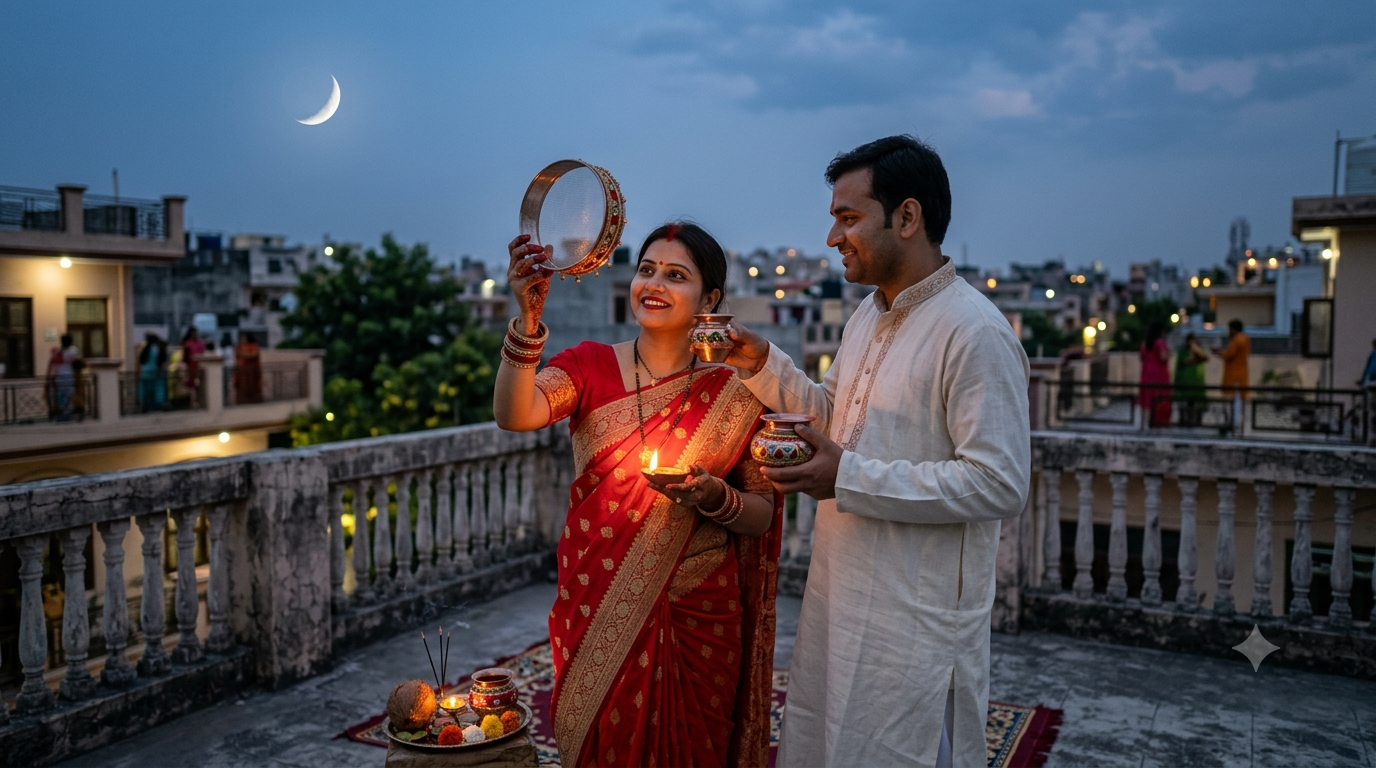
Karwa Chauth dates for 2026 and 2027
| Year | Observed date | Planning note |
|---|---|---|
| 2026 | Wednesday, October 28 | Moonrise and Chaturthi timing must be checked for the observer’s city. |
| 2027 | Monday, October 18 | Moonrise and Chaturthi timing must be checked for the observer’s city. |
Calendar note: Karwa Chauth is observed on the fourth lunar day after the full moon in the relevant regional month-counting system. Moonrise varies significantly by location and weather.
What Karwa Chauth means
Karwa Chauth is a North and northwest Indian festival in which many married Hindu women fast and pray for a spouse’s well-being and the strength of marriage. The day includes pre-dawn food, adornment, group storytelling, puja, moonrise, water, and a shared meal.
Modern families increasingly frame the observance as reciprocal: spouses may fast together, support each other’s health, or choose another act of commitment. Participation should be voluntary and never used to measure love, obedience, or a woman’s worth.
The festival’s visibility in cinema and commerce can obscure its regional character, community networks, and health demands. It is not observed by all Hindu communities.
Marital care
Prayer expresses hope for a spouse’s health and a durable, respectful partnership.
Women's community
Group puja, songs, gifts, and shared preparation create networks among relatives and neighbors.
Reciprocity
Contemporary observance can emphasize mutual care, consent, labor-sharing, and emotional safety.
Sacred story and historical setting
Karwa Chauth vrat kathas vary. Popular narratives include Queen Veeravati, whose fast is interrupted by a false moon, and the devoted Karwa, whose determination protects her husband. Other regions tell stories linked with Savitri or Draupadi.
These are devotional teaching stories, not historical proof or promises that fasting controls another person’s lifespan. Their ethical themes should be interpreted without blaming anyone for illness, widowhood, infertility, or marital difficulty.
No one should be coerced to fast, remain in an unsafe marriage, buy expensive gifts, or delay necessary medication. Domestic abuse is not cured by ritual and requires safety planning and professional help.
How the festival is observed
Common customs include sargi before dawn, a daytime fast, mehndi and festive dress, an evening group puja with the karwa, and breaking the fast after viewing the moon.
- Discuss the fast in advance and choose a medically safe form.
- Eat a balanced pre-dawn meal and hydrate before the fast if waterless fasting is being considered.
- Prepare a karwa, lamp, sweets, water, and puja items according to family custom.
- Listen to a vrat katha while naming its regional or family source.
- At moonrise, view the moon safely through a sieve if customary, offer water, and receive water or food from the spouse.
- End with a light meal and an honest conversation about mutual care.
Food, offerings, and hospitality
Sargi may include fruit, nuts, breads, sweets, and nourishing dishes from the mother-in-law or family. The evening meal varies by region and household.
After a long fast, begin with water and a small, digestible portion rather than heavy fried food. Anyone feeling faint should stop immediately.
Regional and community traditions
Punjab, Haryana, and Delhi
Sargi, baya gifts, group puja, songs, festive clothing, and moonrise rituals are especially visible.
Rajasthan and Uttar Pradesh
Karwa designs, local vrat stories, family gifts, and regional food traditions shape the observance.
Urban and diaspora settings
Apps and forecasts help with moonrise, while couples may adopt reciprocal fasting or non-fasting commitments.
Observing in Trinidad and Tobago or the wider diaspora
In Trinidad and Tobago, cloud cover and local moonrise make city-specific timing essential. Families should not use an India-based moonrise time.
A diaspora observance can remain culturally meaningful while rejecting dowry expectations, gender coercion, beauty pressure, and public comparison of gifts.
A respectful home observance
- Agree freely on whether and how to participate.
- Plan health needs, medication, child care, work, and the evening meal before dawn.
- Offer a simple puja and read a clearly identified vrat story.
- At moonrise, complete the ritual without dangerous rooftop access or driving while weak.
- Exchange one concrete commitment to shared labor, respectful speech, and relationship safety.
Good practice: Waterless fasting may be dangerous with diabetes, kidney disease, pregnancy, breastfeeding, medication, heat, strenuous work, or an eating disorder. Consult a clinician and stop for dizziness, confusion, faintness, chest pain, or severe weakness.
Frequently asked questions
Is Karwa Chauth required for all married Hindu women?
No. It is a regional vrata and is not universal. Participation should be voluntary.
Can husbands or partners fast too?
Yes. Many couples choose reciprocal fasting or another shared discipline, though this is a modern adaptation in some families.
What if the moon is hidden by clouds?
Follow local family or temple guidance. Moonrise calculations, a brief wait, or a symbolic completion may be used; safety comes first.
Does breaking the fast early cause harm to a spouse?
No. Illness and mortality are not punishments for stopping a fast. Health takes priority.
Sources and further reading
- Wikipedia – Karva Chauth – Overview used only to cross-check names, stories, and regional practice; the article prose is independently written.
- Drik Panchang – Karwa Chauth – Location-sensitive moonrise and puja timing.
- Sahapedia – Indian cultural-history context.
- NHS – Fasting and health – General health considerations for religious fasting.
Editorial and rights note: This educational overview is independently written from cross-checked facts and does not reproduce source text. External sources are cited for verification and further reading; citation does not imply endorsement. The hero is an illustrative AI-generated image created for HinduClarity, not a historical photograph or documentary record. This page is not a substitute for guidance from your temple, family tradition, qualified teacher, or licensed professional. Hindu calendars and practices vary by sampradaya, region, and location.
Back to the complete Hindu Festivals Calendar for 2026-2027
Continue with the Diwali guide or the Ganesh Chaturthi guide.