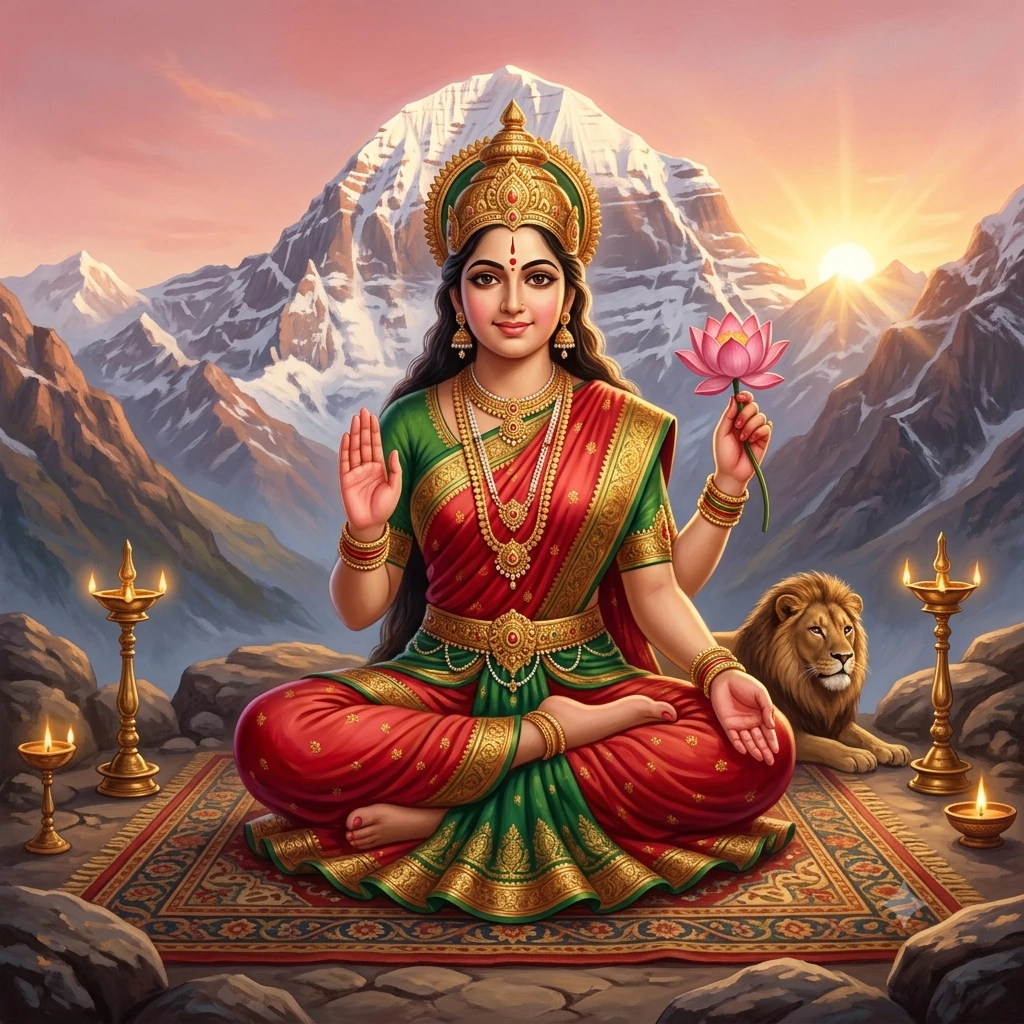
Mother Parvati is a major Hindu goddess associated with spiritual power, loving strength, fertility, family life, and disciplined practice. Her stories move between mountain solitude, royal dignity, motherhood, and partnership with Shiva. They present household life and contemplation not as opposites, but as paths that can deepen one another.
Hindu texts, regions, and lineages do not explain every form of the Goddess in exactly the same way. This guide therefore describes widely shared traditions without treating one interpretation as universal. For a broader introduction, visit the Hindu Devis guide.
Who Is Mother Parvati?
In many Puranic narratives, Parvati is the daughter of Himavan, the personified Himalayas, and Mena. Her name is commonly understood as “daughter of the mountain.” Many accounts also identify her as the rebirth of Sati, who returns to reunite with Shiva, although details differ among texts and retellings.
Parvati is Shiva’s divine partner, but she is not merely an accessory to him. She acts, chooses, teaches, performs tapas, and embodies Shakti—the power through which life and transformation become possible. Ardhanarishvara, the form composed of Shiva and the Goddess, is often read as an image of inseparable divine realities. Philosophical interpretations vary, and complementarity should not be reduced to fixed gender roles.
Parvati, Uma, Gauri, Durga, and Kali
Uma and Gauri are prominent names associated with Parvati. Uma has ancient textual associations and is often used for the Goddess beside Shiva. Gauri, “the radiant” or “fair one,” commonly emphasizes an auspicious, luminous aspect. The names can overlap in worship, but their stories and emphasis may differ by region, scripture, and family tradition.
Durga and Kali require additional care. Some Puranic and popular accounts connect them closely with Parvati or describe them as her powerful manifestations. Many Shakta traditions, however, worship Durga or Kali as the Supreme Goddess rather than as secondary forms derived from another deity. Kali’s fierce imagery can express time, protection, transformation, and liberation; it should not be flattened into a simple “dark side” of gentle Parvati. Read the dedicated guides to Mother Durga and Maha Kali for their distinct traditions.
Tapas, Marriage, and the Divine Family
One of Parvati’s best-known narratives tells of her determined tapas, or disciplined spiritual practice. Seeking union with Shiva, she meditates and accepts austerity until her purpose and spiritual stature are recognized. The story is often told in relation to marriage, yet its meaning is wider: Parvati demonstrates agency, concentration, patience, and the capacity to transform herself through practice. It should not be used to promise a spouse or to encourage harmful fasting.
Her union with Shiva brings ascetic and household ideals into conversation. Their relationship includes devotion, debate, instruction, play, and tension across different stories. Parvati is also widely honored as the mother of Ganesha and Skanda, known in many communities as Kartikeya or Murugan. Divine-family narratives explore belonging, protection, conflict, reconciliation, and responsibility; versions of each child’s birth and family role vary considerably.
Symbols and Iconography
Peaceful images of Parvati may show her with two or four arms, richly dressed and adorned, seated or standing alone or beside Shiva. A lotus can suggest purity and spiritual unfolding; a rosary may indicate meditation and tapas. Other images include a mirror, offering vessel, or gestures of blessing and reassurance. Attributes are not identical in every artistic tradition, so an unfamiliar object should be identified from the specific temple, museum, or lineage rather than guessed.
Family groupings may include Shiva, Ganesha, and Skanda. A lion or tiger appears more often in sovereign or protective goddess forms. Multiple arms are symbolic signs of divine capacity, not anatomical claims. Color, posture, vehicle, companions, and hand gestures work together to identify the form represented.
Festivals and Regional Traditions
Hartalika Teej, Gangaur, and several Gauri observances honor Parvati or closely related forms, especially in parts of India. Worship may include songs, storytelling, decorated images, processions, family gatherings, and fasting. Navaratri also honors the Divine Feminine, but its nine nights are interpreted and celebrated differently across regions and communities. Festival dates follow local Hindu calendars and can vary by location.
Fasting is optional within many communities and is not a measure of devotion. Children, older adults, pregnant people, and anyone with a medical condition should follow appropriate health guidance and family or temple counsel rather than imitate severe austerities from sacred narratives.
A Simple, Publicly Safe Home Practice
- Clean a quiet space and place a respectful image of Parvati, if you use one.
- Offer fresh water, flowers, or fruit. Keep a lamp on a stable, nonflammable surface and never leave it unattended.
- Speak a familiar prayer, read a Parvati story, or sit quietly while reflecting on courage, care, and self-discipline.
- Conclude with gratitude, then express devotion through ethical action—shared responsibilities, patient listening, and care that does not erase healthy boundaries.
This is a general devotional framework, not a substitute for a family or temple tradition. Specialized tantric rites and initiated mantras should be learned from a qualified lineage, not from simplified online instructions. Worship does not guarantee marriage, fertility, health, wealth, or any other outcome.
Parvati Devotion in Trinidad and Tobago
In Trinidad and Tobago, Hindu practice developed through the lives and institutions of the Indo-Caribbean community and continues in mandirs, homes, and cultural organizations. Parvati may be honored by name, beside Shiva, or within wider Shakti and Navaratri worship. Maha Shivaratri can also provide a setting for remembering Shiva’s relationship with Parvati, although the festival centers on Shiva and local observances vary.
Families should follow the pronunciation, offerings, music, and calendar used by their own mandir or tradition. Indian regional customs such as Gangaur or Teej should not be presented as universal Trinidad and Tobago practice unless a particular community observes them.
Frequently Asked Questions
Is Parvati the same as Shakti?
Shakti means divine power and can also name the Supreme Goddess. Parvati is widely worshipped as a personal form of Shakti, while schools differ on how the personal goddess relates to ultimate reality.
Are Parvati and Durga the same?
They are closely identified in many traditions, and Durga may be described as a protective manifestation connected with Parvati. In other Shakta traditions, Durga is foregrounded as the Supreme Devi. Both explanations deserve context.
Why did Parvati perform tapas?
Many narratives connect her tapas with union with Shiva. The story also communicates spiritual agency, self-mastery, and unwavering purpose; it is not an instruction to undertake unsafe austerities.
Can anyone pray to Mother Parvati at home?
Simple prayer, respectful offerings, reading, and meditation are publicly shared practices. Follow your family or mandir for specific procedures, and seek qualified guidance for restricted or initiated practices.
Related Guides
- Hindu Devis: Major Goddesses, Forms, and Worship
- Mother Durga
- Maha Kali
- Mother Lakshmi
- Mother Saraswati
Sources and Further Reading
- Encyclopaedia Britannica: Parvati
- Encyclopaedia Britannica: Shaktism
- The Metropolitan Museum of Art: Hinduism and Hindu Art
- David Kinsley, Hindu Goddesses: Visions of the Divine Feminine in the Hindu Religious Tradition (University of California Press, 1986).
- Wendy Doniger O’Flaherty, Śiva: The Erotic Ascetic (Oxford University Press, 1981).
Traditions note: Narratives, names, festival customs, and theological relationships vary by scripture, region, sampradaya, temple, and family. This article offers a respectful general introduction rather than a single universal account.