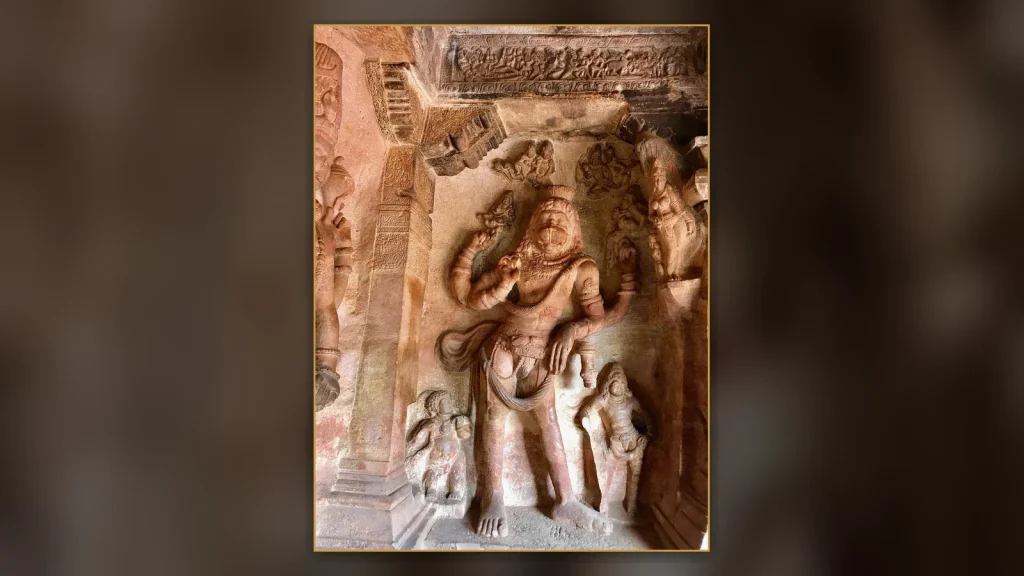
Narasimha is Vishnu’s man-lion avatar, who appears to protect the devotee Prahlada and end the rule of Hiranyakashipu. The best-known Bhagavata Purana account places the encounter at a doorway and at twilight: the form and setting answer the ruler’s carefully worded protection. The story concerns devotion, power, accountability, and grace—not a guarantee that violence or danger will disappear.
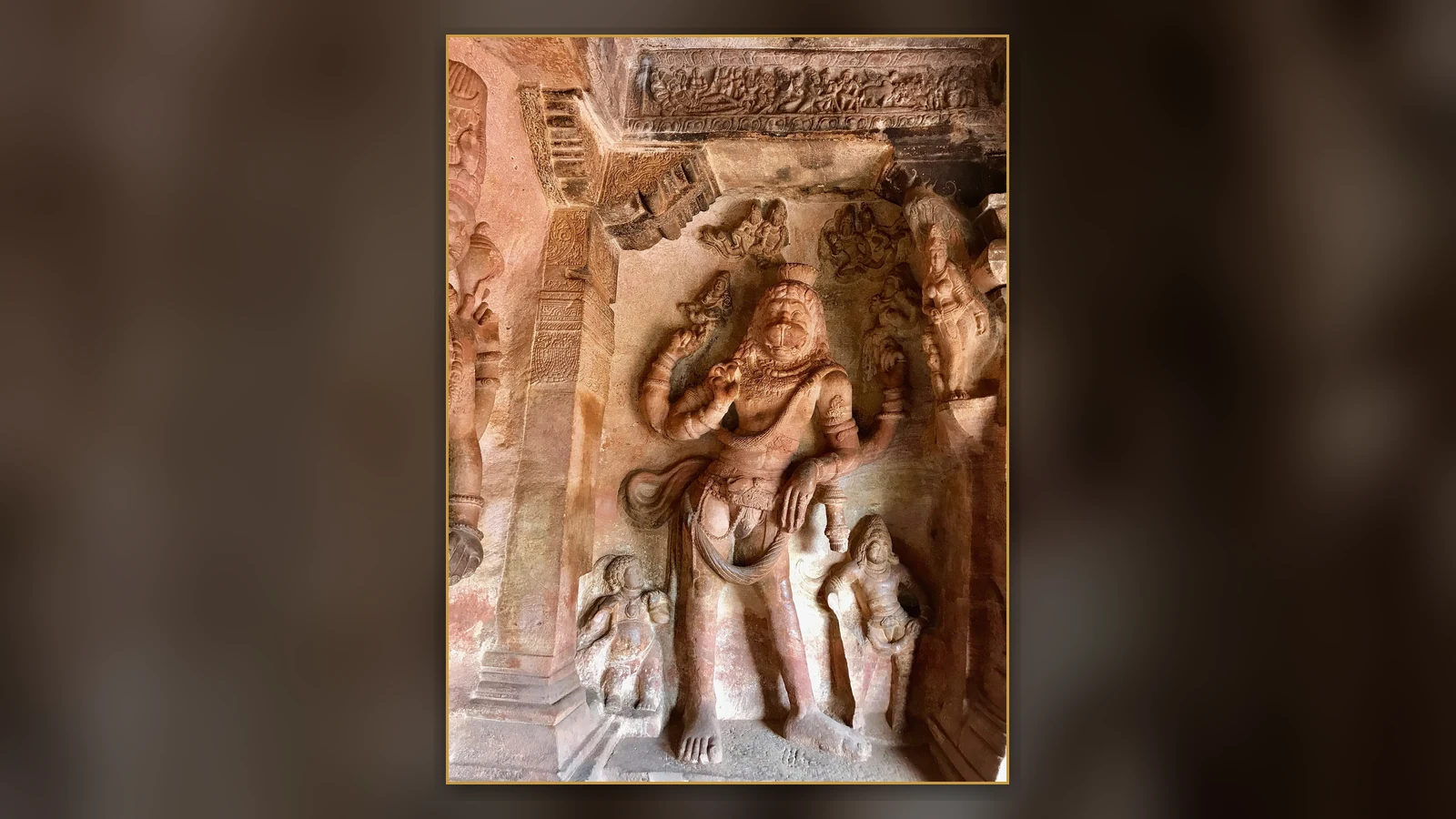

Narasimha at a glance
| Question | Concise answer |
|---|---|
| Who is Narasimha? | A form of Vishnu combining a human body with a lion’s head or leonine features |
| Principal figures | Prahlada, Hiranyakashipu, Vishnu-Narasimha, Brahma, and Lakshmi in many devotional forms |
| Best-known textual witness | Bhagavata Purana, Book 7, especially chapters 8–10 |
| Central event | Narasimha emerges from a pillar and kills Hiranyakashipu at the threshold at dusk |
| Museum-documented form | A circa-1250 South Indian Yoga Narasimha bronze shows a four-armed, lion-headed deity in a yogic posture |
| Important caution | One narrative, one sculpture, or one temple form does not define every Narasimha tradition |
Why did Vishnu take the Narasimha form?
In the Bhagavata Purana’s seventh book, Hiranyakashipu cannot tolerate his son Prahlada’s devotion to Vishnu. The ruler has gained extraordinary protections and treats them as permission to dominate others. He asks whether Prahlada’s Lord is present in a pillar, strikes it, and Narasimha appears.
The form is neither simply human nor simply animal. The confrontation occurs neither conventionally indoors nor outdoors, but at an entrance; neither in full day nor full night, but at twilight. Narasimha places Hiranyakashipu on his lap and uses claws rather than an ordinary weapon. These details make the episode a narrative answer to the boon’s conditions. They should not be turned into a legalistic formula for defeating enemies in real life.
The chapter’s violence is unmistakable, yet the story does not end with the killing. In Bhagavata Purana 7.9, gods hesitate before the still-fierce form, and Prahlada approaches with prayers. The transition from wrath to relationship matters: Narasimha’s force is directed at an abusive ruler, while Prahlada’s response emphasizes devotion rather than personal revenge.
Prahlada is more than a passive child
Prahlada repeatedly refuses to make political power his highest loyalty. The Bhagavata presents him as a teacher of devotion even while he is threatened. His importance is therefore not limited to being rescued. He embodies steadfastness without controlling when or how divine help must arrive.
Readers sometimes summarize the episode as “God always saves a devotee immediately.” That goes beyond what responsible teaching can promise. Devotional communities may find courage in Prahlada’s trust, but the narrative is not a guarantee of physical safety, victory, health, or freedom from suffering. People facing abuse should seek practical help as well as spiritual support.
What does the Narasimha story mean?
The story’s threshold imagery is often read as a challenge to false certainty. Hiranyakashipu tries to make his power absolute by covering categories—human and animal, day and night, inside and outside. Narasimha appears where those categories meet. The symbolism is compelling because injustice cannot secure moral legitimacy merely by exploiting wording.
A second theme is the difference between protection and possession. Prahlada does not command Vishnu. His devotion is remembered as trust, remembrance, and refusal to worship the ruler’s ego. A third theme is accountability: political or supernatural privilege does not make cruelty righteous.
These are interpretations, not a single compulsory decoding. Vaishnava teachers explain the episode through their own theologies of bhakti, divine embodiment, and grace. Art historians may instead ask how a period represented royal power, yogic discipline, or narrative movement. Both approaches can illuminate the figure without being silently merged.
Narasimha in sacred art: fierce, peaceful, and yogic forms
Narasimha iconography is not limited to the killing scene. The Cleveland Museum of Art’s circa-1250 South Indian Yoga Narashimha bronze shows a four-armed lion-headed deity seated with crossed legs held by a yoga band and holding a flaming discus. This object documents one yogic form; it does not establish a universal taxonomy of Narasimha images.
Textual versions and traditions should remain distinct
The Bhagavata Purana narrative
The Bhagavata gives a sustained devotional account of Prahlada, his father’s hostility, the pillar manifestation, and the prayers that calm Narasimha. This guide uses it as the main narrative witness because its sequence is clear and influential. The HinduClarity Bhagavata Purana guide explains the larger twelve-book work and its commentarial diversity.
Other Puranic and epic references
The story also appears in other Sanskrit sources, but details and theological emphasis are not identical. A short allusion in an avatar list is not the same evidence as a long narrative chapter. Later hymns, ritual texts, vernacular songs, and temple traditions further develop names and forms. Responsible retelling should name its source rather than stitching every detail into a supposedly original version.
Regional temple traditions
Narasimha has major living traditions in South India and elsewhere, including sites that emphasize particular forms, local narratives, festivals, or sacred landscapes. Such traditions are not merely illustrations of a book: they are communities of worship with their own histories. Nor does one famous temple stand for all current devotion.
Narasimha in worship today
Devotees may honor Narasimha through temple darshan, household images, recitation, music, offerings, or festivals such as Narasimha Jayanti. Practices depend on family, temple, sampradaya, region, and personal commitment. Some worshippers especially associate Narasimha with refuge in fear; others focus on Prahlada’s bhakti or contemplative images such as Yoga Narasimha.
Claims that a particular mantra, vow, image, or pilgrimage certainly removes enemies, cures illness, or guarantees protection should be treated cautiously. Ritual instruction belongs with a trusted temple or teacher, and spiritual practice should not replace medical, legal, or emergency help. The devotional point can be stated without marketing certainty: Narasimha offers many devotees a language for courage and trust when power appears overwhelming.
Common misconceptions
- “Narasimha is simply an angry lion god.” He is understood as a form of Vishnu; the Bhagavata narrative includes both fierce action and Prahlada’s prayers, while the cited museum object documents a yogic image.
- “The story celebrates uncontrolled violence.” The Bhagavata directs the violence toward Hiranyakashipu’s abusive rule and follows it with Prahlada’s prayers and restoration. Ethical discomfort should not be erased.
- “Every image shows the same event.” The cited Yoga Narasimha object does not depict the pillar episode, showing why each artwork should be identified from its own record rather than a universal template.
- “Devotion guarantees immunity from harm.” The narrative inspires trust but is not a contract promising a particular worldly outcome.
- “Narasimha has one universal worship method.” Living practice varies across communities and lineages.
Frequently asked questions
Is Narasimha half man and half lion?
“Man-lion” is the clearest short description. The hybrid form is central to the narrative because it does not fit Hiranyakashipu’s protected categories, while individual artworks vary in body, posture, arms, and attributes.
Who is Prahlada?
Prahlada is Hiranyakashipu’s son and a devoted follower of Vishnu. In the Bhagavata account, his steadfast devotion brings him into conflict with his father’s demand for absolute loyalty.
Why does Narasimha emerge from a pillar?
Hiranyakashipu challenges Prahlada’s claim that Vishnu is present everywhere and strikes a pillar. The manifestation answers that challenge and dramatizes divine presence beyond the ruler’s control.
Is Narasimha worship only about protection?
No. Protection is prominent, but traditions also emphasize bhakti, humility, kingship, yogic concentration, grace, and the restoration of order.
Related HinduClarity guides
Sources
- Bhagavata Purana, Book 7, Chapter 8 — pillar manifestation and the death of Hiranyakashipu; a Gaudiya Vaishnava translation and commentary.
- Bhagavata Purana, Book 7, Chapter 9 — Prahlada’s prayers and the calming of Narasimha; same translation tradition.
- GRETIL, University of Göttingen: Bhagavata Purana Sanskrit e-text — Sanskrit textual witness; not an English translation.
- Columbia University Press: The Bhagavata Purana—Sacred Text and Living Tradition — scholarship on text, interpretation, and reception.
- Cleveland Museum of Art: Yoga Narashimha, Vishnu in his Man-Lion Avatar — object-specific iconography, date, culture, and public-domain status.