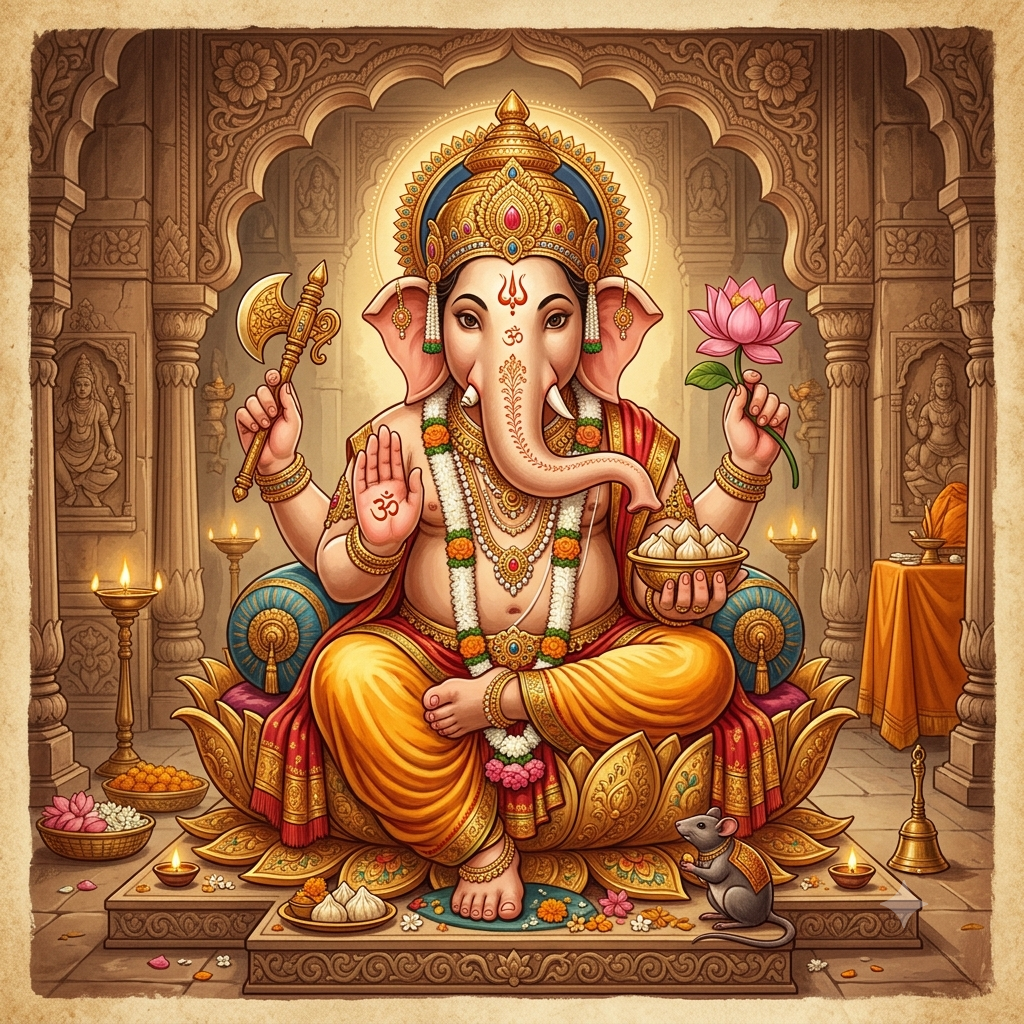
Lord Ganesha, lovingly called Ganesh Baba in many Indo-Caribbean homes, is honoured at beginnings and thresholds. With his elephant head, rounded belly, broken tusk, and small mouse vehicle, he unites wisdom, strength, attentiveness, humility, and good humour. Devotees ask him not for a life without effort, but for clear judgment and steadiness when obstacles appear.
Who Is Lord Ganesha?
Ganesha is widely known as the son of Shiva and Parvati. His names include Ganapati, leader of the ganas; Vinayaka; Ekadanta, the one-tusked; and Vighneshvara, lord of obstacles. He is worshipped across many Hindu traditions, including Shaiva, Shakta, Vaishnava, and Smarta settings, and is often invoked before puja, study, travel, marriage rites, business, or a new project.
“Remover of obstacles” is only part of his role. Some traditions also understand Ganesha as the deity who places a necessary obstruction when a plan is careless, harmful, or mistimed. His blessing therefore encourages preparation and ethical action rather than guaranteed success.
How Ganesha Received His Elephant Head
Hindu texts preserve several birth accounts. In a widely told Purāṇic version, Parvati creates a boy and asks him to guard her privacy. The child faithfully blocks Shiva, whom he does not recognize. Conflict leads to the boy’s beheading; Parvati’s grief and power compel his restoration with an elephant’s head. Shiva then grants him an honoured place as leader of the ganas and one worshipped before auspicious undertakings.
Details differ by text: who creates Ganesha, how the head is obtained, and which blessings follow are not identical everywhere. The story can be read as a teaching about duty, family conflict, transformation, and grace, but symbolic readings should not be mistaken for the only meaning of the narrative.
Meaning of Ganesha’s Form
- Elephant head: intelligence, memory, strength, and broad understanding.
- Large ears: listening carefully before acting.
- Curved trunk: power joined with sensitivity and adaptability.
- Broken tusk: sacrifice, perseverance, and preserving what matters.
- Full belly: generosity and the ability to contain life’s varied experiences.
- Mushika, the mouse: desire or restless thought brought into service rather than allowed to rule.
- Modaka: the sweetness of wisdom and the fruit of disciplined practice.
Ganesha images vary in hand gestures, objects, posture, and number of arms. A noose, goad, sweets, axe, rosary, or blessing hand may appear. Meanings are shaped by scripture, temple tradition, and artistic context.
Ganesha and the Mahabharata
A famous tradition presents Ganesha as scribe while Vyasa dictates the Mahabharata. Ganesha agrees to write without stopping, and Vyasa requires him to understand each verse before recording it. The episode beautifully joins speed with comprehension. It is associated with later framing traditions around the epic and should not be treated as a simple eyewitness account.
Ganesh Chaturthi and Indo-Caribbean Devotion
Ganesh Chaturthi celebrates Ganesha with puja, bhajans, scripture, sweets, and community gatherings. Public clay images are immersed in many regions, while other families keep a permanent murti. Environmentally responsible observance uses natural, non-toxic materials and follows local waterway rules.
In Trinidad and Tobago, Ganesh Baba may be honoured at mandir, during family puja, before school examinations, or at the opening of a home or business. Customs vary across families. Devotion is deepest when prayer is joined with honest study, sound planning, and respect for others.
Simple Worship and Mantras
Offer fresh water, fruit, flowers, or a sweet on a clean altar. Light a diya safely and recite Om Gam Ganapataye Namah, “Salutations to Ganapati,” or the opening prayer Vakratunda Mahakaya. Pronunciation and ritual counts vary; intensive mantra practice is best learned from a qualified teacher.
Prayer does not guarantee medical, financial, academic, or romantic outcomes. It can help orient the devotee toward calm effort, humility, and wise decisions. Keep lamps and incense away from children, pets, curtains, and unattended rooms.
A useful Ganesha-inspired pause before any beginning is to ask three questions: Is my purpose honest? Have I prepared properly? Who could be affected by this decision? Such reflection makes worship practical and keeps “removing obstacles” connected to responsibility rather than wishful thinking.
Frequently Asked Questions
Why is Ganesha worshipped first?
He governs beginnings and obstacles, so devotees seek clarity and an auspicious foundation before proceeding.
Is the mouse literally Ganesha’s pet?
The mouse is his vahana, or vehicle, and also carries symbolic meanings in devotional interpretation.
Sources and Further Reading
Source note: Birth stories, broken-tusk narratives, hand-object meanings, mantra provenance, and obstacle-removal promises are currently under-sourced.
- Metropolitan Museum of Art — Standing Ganesha — Supports identification and historical elephant-headed Ganesha iconography without universalizing every symbolic interpretation.
- J. L. Shastri (ed.), The Shiva Purana, Part 2 — Supports edition-specific later Rudra-samhita narratives including Ganesha, Skanda, battles, and related Shaiva traditions.
Continue exploring: Visit the Devas guide and learn more about Lord Shiva.