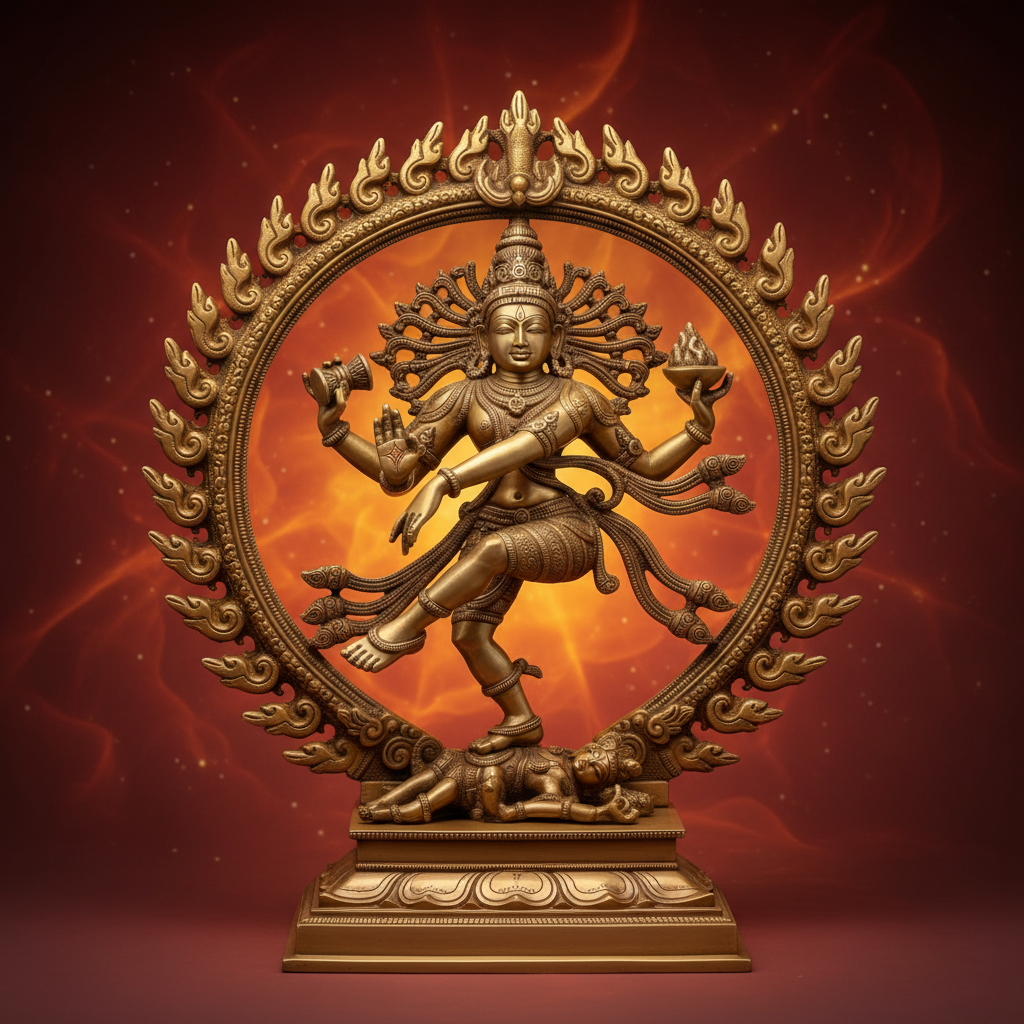
Nataraja, “Lord of Dance,” is Lord Shiva shown in a dynamic sacred form. His dance expresses a universe that is never merely static: worlds arise, endure, change, dissolve, and open toward liberation. In Trinidad and Tobago, some devotees affectionately say “Natraj Baba,” while Nataraja is the standard Sanskrit form of the name.
Shiva as the Lord of Dance
The celebrated bronze form developed with particular brilliance in South India, especially under the Cholas, although Shiva’s relationship with dance is older and appears in multiple texts and temple traditions. Nataraja is closely associated with Chidambaram in Tamil Nadu, where Shiva’s dance is central to temple theology.
The blissful dance is often called Ananda Tandava. Some explanations describe five divine activities: creation, preservation, dissolution, concealment, and grace. Exact terminology and emphasis vary across Shaiva schools. The image is therefore both a work of sacred art and a compact theological teaching.
Reading the Iconography
- Damaru drum: the beat of manifestation, rhythm, and the emergence of ordered sound.
- Flame: dissolution and transformation—the ending that makes renewal possible.
- Abhaya mudra: the raised hand offers reassurance and freedom from fear.
- Gajahasta gesture: the crossing hand directs attention toward the lifted foot, commonly interpreted as refuge and liberating grace.
- Apasmara: the small figure beneath Shiva’s planted foot represents forgetfulness or spiritual ignorance, not a human community or physical disability.
- Ring of fire: the radiant field of ceaseless cosmic activity.
- Flowing hair: the force of the dance; some images include Ganga, the crescent moon, a skull, or other Shaiva emblems.
Nataraja’s calm face within vigorous movement is essential. It suggests still awareness at the heart of change. His lifted foot does not promise escape from every worldly problem; it points toward freedom from ignorance and constricted identity.
The Dance at Chidambaram
Temple traditions connect Nataraja’s dance with the Chidambaram forest and with sages whose pride is overcome. Narratives differ in the Shiva Purana, Tamil Shaiva literature, and temple retellings. Another beloved Tamil tradition describes Shiva’s dance contest and the devotion of saints. These stories should be identified as particular transmitted accounts rather than blended into one supposedly universal version.
Chidambaram also gives special importance to sacred space and the subtle presence of Shiva beyond visible form. For many worshippers, Nataraja therefore unites image and formlessness, movement and stillness, art and contemplation.
Nataraja, Music, and Dance
Dancers and musicians may honour Nataraja before rehearsal or performance. This is not simply a request for applause. It places artistic discipline within a sacred frame: practise carefully, respect the teacher, control ego, and offer one’s ability for something larger than personal fame.
For Indo-Caribbean artists, Nataraja can be a meaningful bridge between inherited Hindu traditions and contemporary performance. Classical forms should be credited and learned respectfully, while local expression may develop through sincere community practice rather than claims of an unchanged ancient lineage.
A Simple Home Practice
- Place a clean Nataraja image or Shiva murti on a stable altar.
- Offer water, fruit, flowers, or bilva leaves where available and customary.
- Safely light a diya and chant Om Namah Shivaya or Om Natarajaya Namah.
- Sit quietly and reflect on meeting change without losing inner steadiness.
- If offering dance or music, begin and end with gratitude rather than treating performance as spectacle alone.
Ritual details vary by family and lineage. Do not pour liquids over a metal image unless you know the material and altar can be cleaned safely. Mantra and worship support devotion but do not guarantee artistic success, healing, or supernatural protection.
What Nataraja Teaches Today
Nataraja does not ask us to pretend that change is easy. The image holds loss and creation in one circle while the face remains composed. Its practical lesson is to release what has ended, protect what is worthy, and act without allowing noise to erase awareness.
For a student, parent, artist, or worker, this may mean balancing motion with rest. A few quiet breaths before the next task can become a modest meditation on Shiva’s stillness within the dance.
Frequently Asked Questions
Is Nataraja a separate god from Shiva?
No. Nataraja is Shiva in his form as Lord of Dance.
Does the dance only mean destruction?
No. It can express creation, continuity, dissolution, concealment, and liberating grace together.
Sources and Further Reading
Source note: The five acts, dwarf-underfoot symbolism, ring-of-fire interpretation, Chidambaram claims, and modern cosmic-dance readings require separately named sources.
- Metropolitan Museum of Art — Shiva as Lord of Dance (Nataraja) — Supports Chola-period Nataraja identification and iconographic description.
- Ananda K. Coomaraswamy, The Dance of Shiva — Supports a named modern interpretation of Shiva Nataraja; it should be attributed rather than treated as the sole traditional reading.
Continue exploring: Visit the Devas guide and the full guide to Lord Shiva.