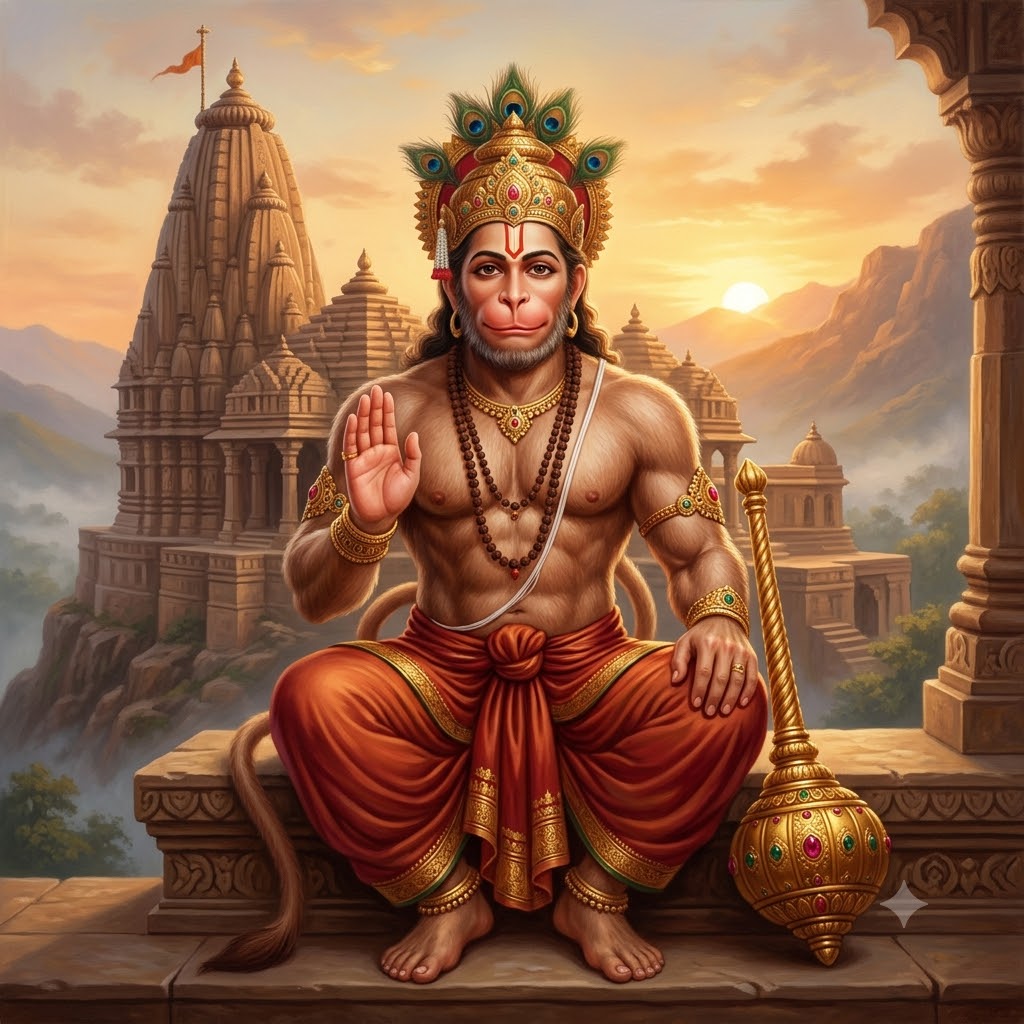
The Hanuman Chalisa is a beloved forty-verse devotional hymn praising Hanuman as courageous, wise, disciplined, and wholly devoted to Rama. Traditionally attributed to the North Indian poet-saint Tulsidas, it is composed in Awadhi rather than classical Sanskrit. Devotees recite it in temples, homes, group gatherings, and personal prayer—often on Tuesdays or Saturdays, though it may be recited on any day.
The hymn asks Hanuman for strength, clarity, protection, and freedom from distress, but it should not be marketed as a guaranteed cure or a supernatural contract. Its deepest model of power is service: Hanuman’s extraordinary abilities are directed toward Rama’s work, the recovery of Sita, and the welfare of others.
What does “Hanuman Chalisa” mean?
Hanuman is the celebrated devotee of Rama whose story is central to the Ramayana tradition. Chālīsā derives from the Hindi word for forty, referring to the hymn’s forty principal chaupāīs, or quatrain-like verse units in common printed layouts. Opening and closing dohās frame those forty verses. Page layouts and performance styles can make the visible line count look different, so “forty” refers to the received structure, not every printed line on a page.
Hanuman is portrayed in Hindu literature and worship as a figure of strength, learning, devotion, and self-control. His role in assisting Rama against Ravana made him one of Hinduism’s most widely revered deities.[2]
Who wrote the Hanuman Chalisa?
Tradition attributes the hymn to Tulsidas, the sixteenth-century poet-devotee best known for the Ramcharitmanas, his influential retelling of Rama’s story in Awadhi. Britannica dates Tulsidas to the sixteenth and early seventeenth centuries and describes the Ramcharitmanas as his principal work.[3]
Popular accounts sometimes give exact circumstances for the Chalisa’s composition—for example, that Tulsidas wrote it during a particular imprisonment. Such stories are meaningful in devotional memory, but they should not be stated as established biography without historical evidence. The secure educational claim is that the hymn is traditionally ascribed to Tulsidas and belongs to the North Indian Rama-bhakti world associated with his work.
What language is the Hanuman Chalisa?
The Chalisa is in Awadhi, an Indo-Aryan literary language strongly associated with Tulsidas, with Sanskrit-derived devotional vocabulary. Calling it “a Sanskrit prayer” is therefore inaccurate, even though Sanskrit names and concepts occur throughout it.
Roman spellings vary because editors may transliterate the original language precisely or simply help Hindi- and English-speaking readers sing it. For example, the famous first chaupai appears as:
जय हनुमान ज्ञान गुन सागर ।
जय कपीस तिहुँ लोक उजागर ॥
Reader-friendly transliteration:
Jaya Hanumāna jñāna guna sāgara,
jaya kapīsa tihũ loka ujāgara.
Sense: “Victory to Hanuman, ocean of wisdom and virtue; victory to the lord of the vanaras, renowned throughout the three worlds.”
You may also see gyān gun sāgar, jnana guna sagara, or gyaan goon saagar. These spellings reflect different goals and accents. In Awadhi singing, inherited pronunciation does not always match a letter-by-letter Sanskrit reconstruction. Follow a reliable edition or the form used in your community instead of combining versions mid-recitation. The Hindu American Foundation’s guide presents the hymn with explanatory context for comparison.[1]
How the Hanuman Chalisa is structured
The opening dohas
The opening bows to the guru and asks for a purified mind so the poet can recount Rama’s stainless glory. A second doha acknowledges the speaker’s limitations and calls upon Hanuman for strength, understanding, and knowledge. The posture is important: the hymn begins not with self-assertion but with humility and dependence on grace.
Verses 1–10: Hanuman’s qualities and identity
The first section praises Hanuman’s knowledge, virtues, strength, golden appearance, sacred thread, mace, banner, and radiant presence. It names him as the son of Anjani and also as Pavana-suta, son of the wind. It presents him as intelligent, eager to serve Rama, and delighted by Rama’s story.
Descriptions of Hanuman’s parentage vary across the large Ramayana and Purana traditions. “Son of the wind” expresses Vayu’s divine role; it need not erase the narrative roles of Anjani and Kesari. The hymn layers these identities in devotional praise.
Verses 11–20: deeds in Rama’s story
This group recalls Hanuman’s service during the search for Sita and the war in Lanka. He assumes a subtle form to appear before Sita, a fearsome form to burn Lanka, and a mighty form in battle. He brings the life-restoring herb for Lakshmana and earns Rama’s embrace and praise.
These allusions assume familiarity with the Rama narrative. The critical emphasis is not spectacle alone: Hanuman changes form according to what service requires. Strength, strategy, tenderness, and restraint work together.
Verses 21–30: cosmic praise and protective presence
The hymn declares that sages, deities, poets, and even the thousand-mouthed Shesha cannot fully express Hanuman’s glory. It refers to his help for Sugriva and Vibhishana, his leap toward the sun in childhood, and his crossing of the ocean with Rama’s ring.
Several lines describe difficulties becoming easier through Hanuman’s grace and hostile forces not approaching one who remembers him. Devotees understand these as assurances of protection. Responsible interpretation does not turn poetic praise into a promise that no reciter will face illness, grief, accident, or injustice.
Verses 31–40 and the closing doha
The final section praises Hanuman as guardian, healer of suffering, servant of Rama, giver of spiritual benefit, and companion at life’s end. It recommends focused devotion and repeated recitation. The speaker asks Hanuman to dwell in the heart together with Rama, Lakshmana, and Sita.
The closing doha addresses Hanuman as son of the wind and remover of distress:
पवनतनय संकट हरन, मंगल मूरति रूप ।
राम लखन सीता सहित, हृदय बसहु सुर भूप ॥
Sense: “O son of the wind, remover of distress, embodiment of auspiciousness: dwell in my heart together with Rama, Lakshmana, and Sita.” Exact segmentation and translation vary by edition.
Key teachings of the Hanuman Chalisa
Strength governed by devotion
Hanuman has immense power, yet the hymn repeatedly identifies him as Rama’s servant and messenger. His greatness is not domination for its own sake but capable action aligned with devotion and duty.
Wisdom alongside courage
The opening calls Hanuman an ocean of jñāna and guna—knowledge and excellent qualities. Later verses praise his cleverness and discernment. The ideal is not brute force but intelligent, ethical courage.
Humility and remembrance
The poet begins by acknowledging limitation and seeking help. Recollection of Hanuman and Rama becomes a way to reorient attention toward steadiness, service, and hope.
Many forms of service
Hanuman consoles Sita gently, confronts injustice fiercely, carries a mountain when he cannot identify one herb, and delivers messages accurately. Devotion is adaptable: different needs call for different forms of help.
How to recite the Hanuman Chalisa respectfully
- Use a dependable text. Choose Devanagari, regional script, or a consistent transliteration with a translation you understand.
- Begin cleanly and calmly. A bath, lamp, or shrine may support practice, but elaborate materials are not required in every household.
- Set an intention. You might dedicate the recitation to courage, devotion, someone’s welfare, or steadiness during difficulty.
- Recite without rushing. Group melodies differ. Clear attention matters more than copying the fastest recording.
- Reflect on one quality. Consider how wisdom, restraint, loyalty, or practical service could shape your next action.
- Conclude according to your tradition. This may include a brief prayer, ārati, or silent remembrance of Rama and Hanuman.
Tuesdays and Saturdays are common days for Hanuman worship in many communities, but this is a practice pattern rather than a limitation. Some recite the Chalisa once; others use cycles such as seven, eleven, or one hundred repetitions during a vow. Counts and dietary observances differ. Avoid extreme fasting or exhausting repetition, especially if it conflicts with health needs.
About promised “benefits”
The Chalisa itself uses devotional language about protection, the removal of distress, freedom from fear, and spiritual attainment. Practitioners may experience courage, focus, comfort, or belonging through recitation. Those are meaningful possibilities, not guaranteed outcomes. A prayer should not be used to blame suffering people for insufficient faith, discourage medical treatment, or promise immunity from harm.
When facing danger, illness, abuse, or a mental-health crisis, combine spiritual support with appropriate practical action and qualified professional care. Hanuman’s example favors resourceful service, not passivity.
Frequently asked questions
Does the Hanuman Chalisa have exactly 40 verses?
It has forty principal chaupais, framed by opening and closing dohas. Printed line counts differ because each unit may be broken across lines.
Is the Hanuman Chalisa part of the Ramcharitmanas?
It is traditionally attributed to the same poet, Tulsidas, and draws on Rama’s story, but it is circulated as a separate hymn rather than a chapter of the Ramcharitmanas.
Must it be recited in Awadhi?
The received hymn is in Awadhi, and reciting the original preserves its sound and poetry. Reading a careful translation is valuable for understanding. Many devotees do both.
Can beginners recite it?
Yes. Begin with a reliable recording and text, learn a few lines at a time, and prioritize respectful attention over perfect performance.
Can women recite the Hanuman Chalisa?
Women widely recite and sing the Chalisa. Local taboos sometimes circulate, including rules related to menstruation, but these are not uniform across Hindu traditions. Follow your informed conscience and community context without presenting one household custom as universal doctrine.
Does reciting it remove Shani’s influence?
Some later devotional traditions connect Hanuman worship with relief from difficulties associated with Shani. The Chalisa itself praises Hanuman’s protective power, but astrology-based claims and remedies vary. No recitation guarantees that hardship will disappear.
Related HinduClarity Guides
Sources
- Hindu American Foundation, “All About the Hanuman Chalisa” — community educational guide to the hymn, its language, structure, and devotional context.
- Encyclopaedia Britannica, “Hanuman” — reference overview of Hanuman’s narrative role and worship.
- Encyclopaedia Britannica, “Tulsidas” — biographical and literary context for the poet traditionally credited with the hymn.
- Philip Lutgendorf, Hanuman’s Tale: The Messages of a Divine Monkey, Oxford University Press — scholarly study of Hanuman’s expanding literary and devotional traditions.