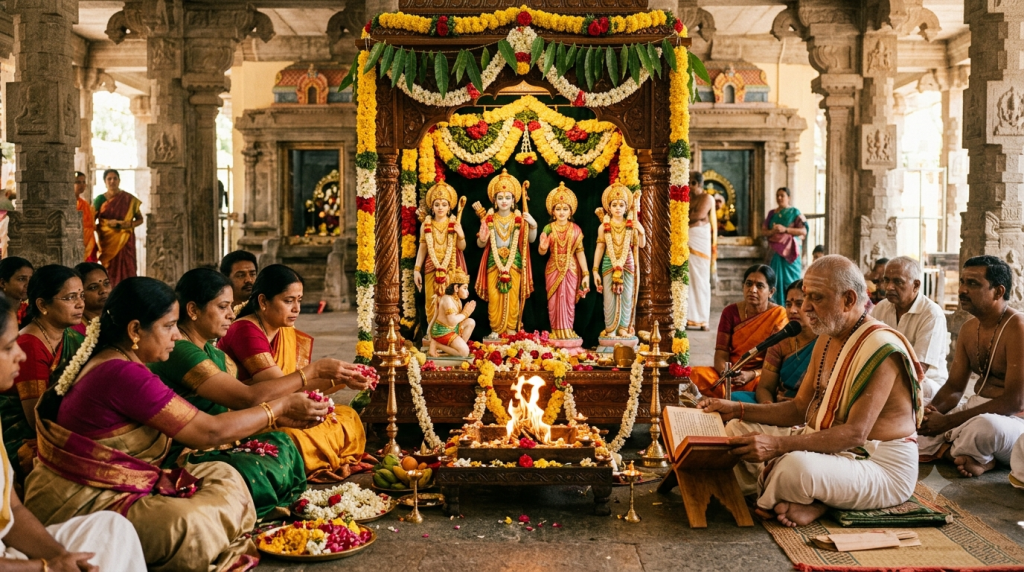
The Ramayana is an ancient Sanskrit epic centered on Rama, Sita, Lakshmana, Hanuman, and Ravana. Its main narrative follows Rama’s exile from Ayodhya, Sita’s abduction by Ravana, the search that brings Rama into alliance with Hanuman and Sugriva, the war in Lanka, and the return to Ayodhya. For many Hindus, Rama is an avatar of Vishnu and the epic is sacred literature as well as an exploration of dharma.
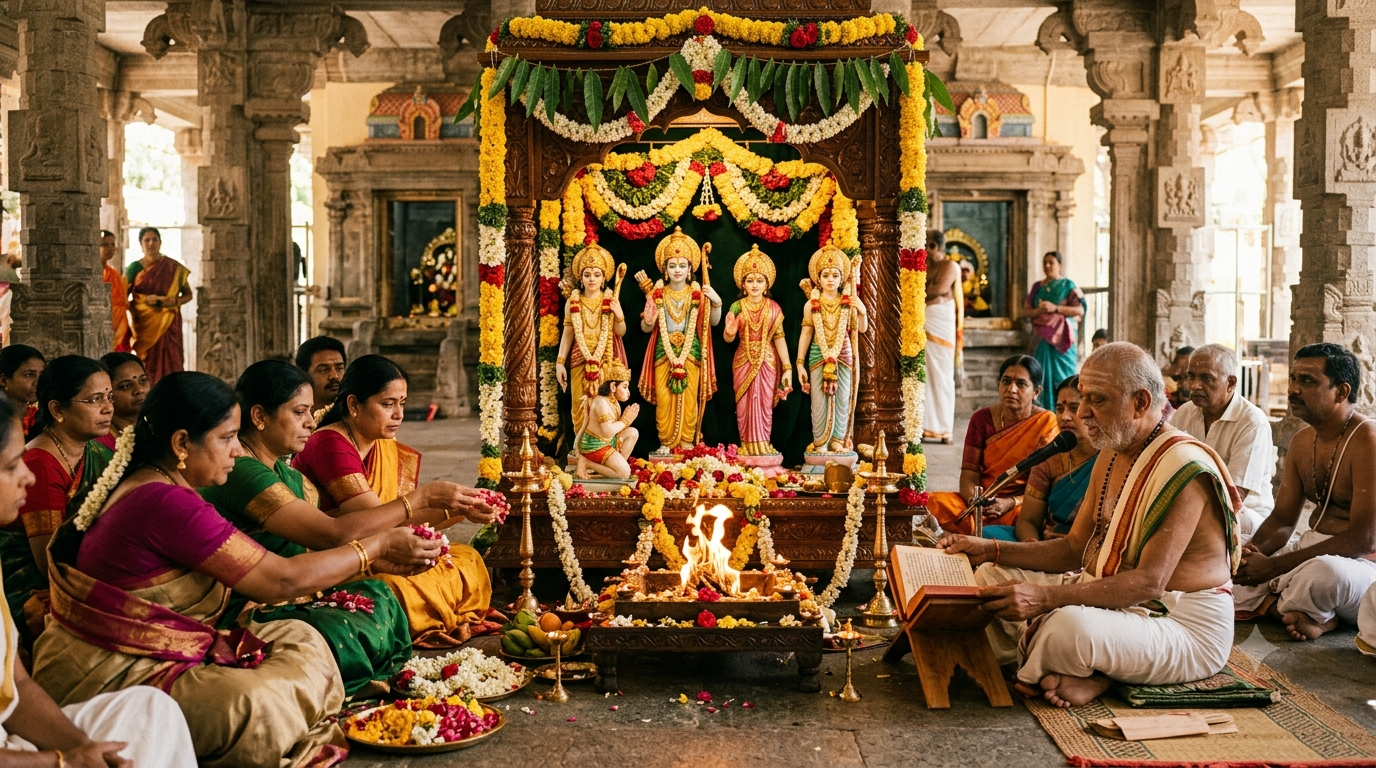
There is not only one Ramayana in cultural practice. Valmiki’s Sanskrit Ramayana is foundational, but poets, performers, teachers, and communities across India and Asia have retold the story in numerous languages and artistic forms. These works may change emphasis, characterization, theology, or even individual events. It is therefore more accurate to speak of a Ramayana tradition anchored by influential texts than of one uniform version known everywhere.
Ramayana at a glance
- Traditional author: The sage Valmiki
- Original language: Sanskrit
- Traditional structure: Seven kandas, or books
- Central figures: Rama, Sita, Lakshmana, Bharata, Hanuman, Ravana, Kaikeyi, Dasharatha, Sugriva, and Vibhishana
- Main settings: Ayodhya, forest hermitages, Kishkindha, the ocean crossing, and Lanka
- Major themes: Dharma, loyalty, kingship, exile, devotion, power, family obligation, gender, and justice
- Living forms: Scripture, recitation, theatre, dance, temple art, television, storytelling, and festival performance
The seven kandas
| Kanda | What happens |
|---|---|
| Bala Kanda | Rama’s youth, Vishvamitra’s guidance, Sita’s marriage, and early sacred narratives |
| Ayodhya Kanda | The planned coronation, Kaikeyi’s demands, Rama’s exile, and Dasharatha’s death |
| Aranya Kanda | Forest life, encounters with rakshasas, and Sita’s abduction |
| Kishkindha Kanda | Rama’s alliance with Sugriva and the organization of the search for Sita |
| Sundara Kanda | Hanuman crosses the ocean, finds Sita, and carries Rama’s message |
| Yuddha Kanda | The crossing to Lanka, battle with Ravana, Sita’s recovery, and return to Ayodhya |
| Uttara Kanda | Later events in Rama’s reign, Sita’s exile, Lava and Kusha, and the story’s conclusion |
Scholars have long examined the textual history of the Bala and Uttara Kandas and the epic’s development over time. Within devotional reading, however, all seven books commonly form the received Ramayana. It is best to identify the historical-critical question without presenting it as though living religious communities simply disregard these books.
The story of the Ramayana
Rama’s birth and marriage to Sita
King Dasharatha of Ayodhya longs for heirs. His sons Rama, Bharata, Lakshmana, and Shatrughna are born after a royal sacrifice. Rama and Lakshmana later accompany the sage Vishvamitra, protect his rites, and receive instruction. At Mithila, Rama strings and breaks the great bow associated with Shiva, fulfilling the condition for Sita’s marriage.
Many later Vaishnava traditions explicitly present Rama and Sita as Vishnu and Lakshmi. The Valmiki Ramayana also portrays them within the human demands of royal life, allowing Rama’s divine significance and his exemplary or contested human decisions to coexist.
The exile from Ayodhya
Dasharatha prepares to crown Rama, but Queen Kaikeyi invokes two boons previously promised to her. She asks that Bharata become king and that Rama live in the forest for fourteen years. Rama accepts the exile to preserve his father’s word. Sita insists on accompanying him, and Lakshmana joins them.
Bharata rejects the ambition attributed to him and condemns his mother’s scheme. Unable to persuade Rama to return, he governs as Rama’s representative, traditionally placing Rama’s sandals on the throne. The episode contrasts power sought for itself with authority held in trust.
Forest life and Sita’s abduction
Rama, Sita, and Lakshmana visit hermitages and encounter a world in which ascetics, animals, rulers, and rakshasas share contested spaces. The conflict escalates after the encounter with Shurpanakha and the deaths of Khara and other rakshasas. Ravana then plots to abduct Sita, using Maricha’s deceptive golden-deer form to draw Rama away.
Jatayu, the aged vulture-king, tries to rescue Sita and is mortally wounded. His resistance has made him an enduring figure of courage: he acts against injustice despite knowing the personal risk. Ravana carries Sita to Lanka, where she refuses his demands and remains in the Ashoka grove.
Rama’s alliance with Sugriva
Rama and Lakshmana meet Hanuman, whose intelligence, humility, and command of speech immediately stand out. Hanuman brings them to Sugriva, a displaced vanara ruler. Rama agrees to help Sugriva regain his kingdom from his brother Vali, and Sugriva promises assistance in finding Sita.
Rama’s killing of Vali from concealment becomes one of the epic’s most discussed ethical episodes. Vali challenges Rama directly, and Rama offers a defense based on royal jurisdiction and Vali’s conduct toward Sugriva. Readers and performers have continued to debate whether the defense fully resolves the problem. The text’s willingness to stage such arguments is part of its moral complexity.
Hanuman finds Sita
In the Sundara Kanda, Hanuman crosses the ocean to Lanka, overcomes obstacles, and searches the city. He finds Sita in the Ashoka grove and gives her Rama’s ring as proof of his mission. Sita sends a token and message in return.
Hanuman could carry Sita away in some tellings, but she declines, citing concerns that vary by version: the danger of the attempt, propriety, and Rama’s responsibility to confront Ravana. Hanuman later allows himself to be captured, warns Ravana, escapes when his tail is set alight, and burns much of Lanka. His combination of strength, judgment, courage, and devotion makes him one of the epic’s most widely worshipped figures.
The war in Lanka
Rama’s allies reach Lanka after constructing a passage across the sea. Ravana’s brother Vibhishana urges him to return Sita and eventually joins Rama after Ravana rejects the advice. The war includes the deaths of major figures such as Kumbhakarna and Indrajit before Rama defeats Ravana.
Ravana is not portrayed as lacking every admirable quality. He is learned, powerful, and devoted to Shiva in many traditions. His accomplishments do not excuse abduction, coercion, or the refusal to correct injustice. This combination makes him more morally instructive than a one-dimensional monster: knowledge and religious achievement do not automatically overcome arrogance or abusive desire.
Return to Ayodhya
After the exile ends, Rama, Sita, and Lakshmana return to Ayodhya, where Rama is crowned. This homecoming is closely associated with Diwali in many parts of northern India, although Diwali has other regional and theological meanings as well. The ideal of Rama Rajya invokes just and prosperous rule, but modern political uses of the phrase vary and should not be treated as a single scriptural program.
Sita’s later exile
The Uttara Kanda presents the most painful part of the story. Despite Sita having demonstrated her fidelity, public gossip leads Rama to send her away while she is pregnant. She finds refuge in Valmiki’s hermitage and raises the twins Lava and Kusha. They later recite the Ramayana before Rama. In the conclusion, Sita calls upon the Earth, her mother, to receive her.
Some devotional explanations stress Rama’s conflict between personal love and royal responsibility. Many readers, including Hindu poets and performers, criticize the decision or center Sita’s dignity and suffering. The episode should not be softened into a rule that a spouse must accept mistreatment. It is an ethical wound within the tradition and has generated centuries of reflection, protest, reinterpretation, and alternative endings.
Central characters and what they represent
Rama
Rama is revered as Vishnu’s avatar, an exemplary prince, and an ideal king. The title Maryada Purushottama associates him with excellence within moral and social boundaries. Yet “ideal” does not mean that every reader agrees about every decision attributed to him. His dilemmas invite examination of what happens when duties to family, spouse, subjects, truth, and kingship collide.
Sita
Sita is much more than a passive symbol of obedience. She chooses to accompany Rama into exile, rebukes Ravana, sustains herself through captivity, speaks forcefully in moments of injustice, and ultimately refuses another externally demanded proof by returning to the Earth. Different Ramayanas emphasize her divinity, endurance, anger, independence, or connection with the land.
Hanuman
Hanuman embodies devotion expressed through service, intelligence, courage, and disciplined strength. His humility does not prevent decisive action. He listens, assesses, communicates, and adapts. This is why devotees often see him not only as powerful but also as an ideal messenger and servant of Rama.
Lakshmana and Bharata
Lakshmana shares Rama’s exile and protects Rama and Sita, though his intensity sometimes produces conflict. Bharata refuses to benefit from Kaikeyi’s demand and safeguards the kingdom for Rama. Together they present different forms of fraternal loyalty: physical companionship in exile and principled stewardship at home.
Ravana
Ravana is the learned king of Lanka and the epic’s principal antagonist. His downfall follows not from a lack of intelligence but from desire, entitlement, and refusal to accept wise counsel. Describing him as a devotee or scholar should deepen the ethical warning, not romanticize Sita’s abduction.
Many Ramayanas, not one uniform retelling
Valmiki’s Sanskrit epic is foundational, but the Ramayana has been recreated across languages and communities. Tulsidas’s Ramcharitmanas is central to many North Indian devotional traditions. Kamban’s Tamil Ramavataram has its own poetic and theological character. Other influential traditions include Krittivasa’s Bengali Ramayana, Ezhuthachan’s Malayalam retelling, the Thai Ramakien, and the Old Javanese Kakawin Ramayana.
Jain and Buddhist narratives reshape characters and moral assumptions in significant ways. Folk songs may focus on Sita’s suffering, regional performances may elevate a local character, and Southeast Asian versions adapt the story to their own courts, landscapes, aesthetics, and religious histories. “Different” does not automatically mean “corrupted”; retelling has been one of the tradition’s primary ways of remaining alive.
How the Ramayana is practiced and remembered
The epic is encountered through household reading, temple recitation, storytelling, dance, painting, sculpture, film, and television. Ramlila performances dramatize episodes leading to Rama’s victory, especially around Dussehra in many North Indian communities. Recitation of the Sundara Kanda and the Ramcharitmanas is also widespread.
Festival associations vary. Dussehra may emphasize Rama’s defeat of Ravana, while Diwali may celebrate the return to Ayodhya. In other regions, the same festivals foreground Durga, Lakshmi, Krishna, Kali, or local traditions. No single explanation should erase this diversity.
Frequently asked questions
Was the Ramayana a true historical event?
Hindu devotees hold a range of views, from sacred history to theological epic and symbolic teaching. Archaeology and historical scholarship cannot verify every person and event exactly as narrated. It is best to distinguish faith claims, literary analysis, geography, and material evidence rather than presenting one as proof of all the others.
Who wrote the Ramayana?
Hindu tradition honors Valmiki as the adikavi, or first poet, and author of the Sanskrit Ramayana. Textual scholarship studies the work’s composition and transmission across time. Later Ramayanas have their own named poets and community histories.
Is Hanuman a monkey?
English summaries commonly call Hanuman and the vanaras “monkeys.” The Sanskrit vanara belongs to the epic’s own imaginative and cultural world and does not map perfectly onto a modern zoological category. Sacred art represents Hanuman with simian features while worshipping him as a divine figure.
Why is Ravana sometimes shown with ten heads?
The ten heads communicate extraordinary power and identity in epic iconography. Later interpreters give them symbolic meanings, such as extensive knowledge or uncontrolled faculties, but not every popular symbolism comes directly from the earliest text.
Does the Ramayana teach that wives must obey husbands?
No single slogan captures the epic’s treatment of marriage or gender. Sita makes choices, argues, condemns injustice, and refuses coercion. Some passages reflect ancient patriarchal settings, while later women’s tellings challenge those structures. The epic should never be used to justify abuse or deny someone’s safety and dignity.
What is the best Ramayana for beginners?
Begin with a reputable translation of the Valmiki Ramayana that identifies its textual basis and includes notes. Then compare a regional version such as the Ramcharitmanas or Ramavataram. Reading more than one telling makes the tradition’s richness and disagreements visible.
Sources and further reading
- Encyclopaedia Britannica: Ramayana — concise overview of the Sanskrit epic, its plot, structure, and cultural influence.
- Encyclopaedia Britannica: Ramcharitmanas — reference context for Tulsidas’s influential retelling.
- The Metropolitan Museum of Art: Storytelling in Indian Art — context for the representation and transmission of Indian sacred narratives.
- UNESCO: Ramlila, the Traditional Performance of the Ramayana — documentation of Ramlila as living cultural heritage.