Hindu festival guide
Hanuman Jayanti
A practical guide to honoring Hanuman through courage, devotion, service, scripture, and community worship, with important regional date variations.
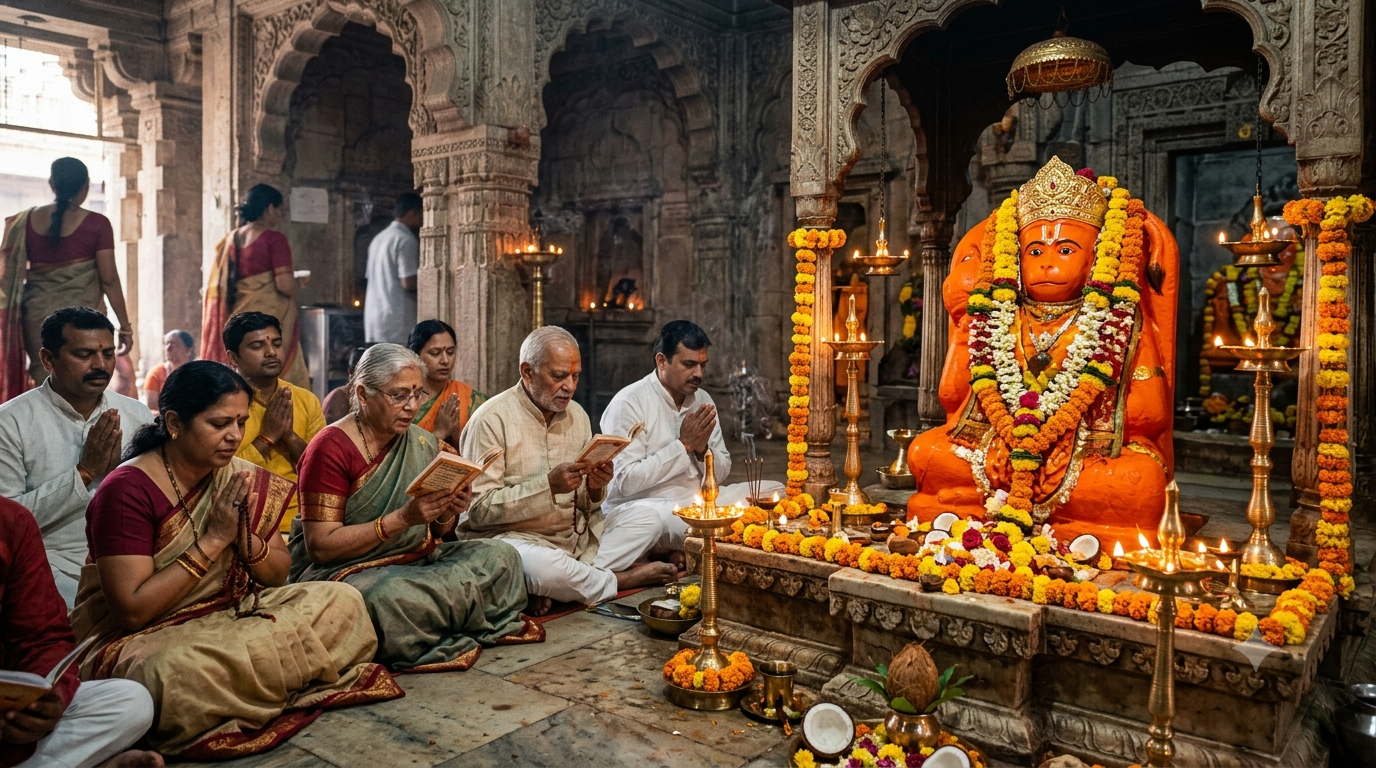
Hanuman Jayanti dates for 2026 and 2027
| Year | Observed date | Planning note |
|---|---|---|
| 2026 | Wednesday, April 1 | These dates follow the common Chaitra Purnima observance; regional dates differ. |
| 2027 | Tuesday, April 20 | These dates follow the common Chaitra Purnima observance; regional dates differ. |
Calendar note: Hanuman’s birth festival is not observed on one uniform date across India. Chaitra Purnima is common in north India, while several southern traditions use dates in Margashirsha, Vaishakha, or other months.
What Hanuman Jayanti means
Hanuman Jayanti honors Hanuman, the exemplary devotee of Rama, celebrated for strength guided by humility, disciplined intelligence, courage, loyalty, and selfless service.
Devotees gather for Hanuman Chalisa, Sundara Kanda or Ramayana recitation, puja, sindoor and flower offerings, bhajan, fasting, and acts of service.
The day is not only about physical power. Hanuman’s greatness lies in remembering whom his abilities serve and in acting without ego when others need help.
Strength with restraint
Power becomes dharmic when it protects, serves, and remains under wise control.
Bhakti
Hanuman’s identity is shaped by loving service to Rama and Sita rather than personal fame.
Learning and skill
The Ramayana depicts Hanuman as eloquent, observant, strategic, and capable of both bold action and careful speech.
Sacred story and historical setting
Traditions name Anjana and Kesari as Hanuman’s parents and connect his birth with Vayu, the wind deity. Childhood stories describe great energy, including his leap toward the Sun, followed by lessons that channel power through discipline.
In the Ramayana, Hanuman discovers Sita in Lanka, carries Rama’s message, consoles her, assesses the enemy, and later brings the life-restoring herb when Lakshmana is wounded. His service combines devotion with judgment, communication, and courage.
Hanuman should not be reduced to a symbol of anger, bodybuilding, or aggression. Traditional devotion emphasizes humility, celibacy in many traditions, wisdom, protection, and service to Rama.
How the festival is observed
Temple schedules may begin before sunrise and include long recitations. A short, attentive home observance is also meaningful.
- Offer flowers, fruit, lamp light, and sindoor only where appropriate and without damaging a murti.
- Recite the Hanuman Chalisa with a translation so its praise and petitions are understood.
- Read Sundara Kanda or a shorter Ramayana passage from a named edition.
- Perform physical exercise safely as discipline, not display, and pair it with service.
- Donate to emergency relief, elder care, or another cause that protects vulnerable people.
- Avoid feeding monkeys processed food or encouraging unsafe animal contact at pilgrimage sites.
Food, offerings, and hospitality
Boondi, laddus, bananas, roasted gram, fruit, and regional sweets are common offerings. Some devotees fast or eat one vegetarian meal.
Prasad is an expression of grace and sharing. It should be prepared hygienically and never thrown to animals in ways that create dependency or conflict.
Regional and community traditions
North India
Chaitra Purnima temple worship, Hanuman Chalisa recitation, sindoor, processions, and community meals are widespread.
South Indian calendars
Hanuman Jayanti may occur on different lunar dates and may be observed over a longer period according to local tradition.
Wrestling and service traditions
Akhara culture sometimes honors Hanuman as a model of disciplined strength, while temples and youth groups organize seva and food distribution.
Observing in Trinidad and Tobago or the wider diaspora
In Trinidad and Tobago, Hanuman worship is central to many mandirs and Ramayana communities. Programs may include Chalisa, Ramayana readings, tassa or bhajan, and community feeding.
Use the occasion to teach young people that courage includes protecting others, controlling anger, studying carefully, and admitting mistakes.
A respectful home observance
- Clean the altar and place a Hanuman or Rama-family image respectfully.
- Offer a lamp, fruit, flowers, and a measured amount of sindoor if it is part of your practice.
- Recite the Chalisa slowly and read its meaning.
- Complete one practical act of service without seeking recognition.
- Reflect on how strength, speech, and technology can be used with restraint.
Good practice: Do not climb structures, use fire, perform extreme exercise, or undertake long fasts without preparation. Never imitate Hanuman’s legendary feats literally. Follow temple rules for oil and sindoor offerings.
Frequently asked questions
Why do Hanuman Jayanti dates vary?
Different regions and lineages preserve different birth-date traditions. Chaitra Purnima is common but not universal.
Why is sindoor offered to Hanuman?
A popular devotional story connects Hanuman’s use of sindoor with complete service to Rama. Temple practice varies, and materials should be applied only where permitted.
Is the Hanuman Chalisa scripture?
It is a beloved forty-verse devotional hymn attributed to Tulsidas, distinct from the Sanskrit Valmiki Ramayana.
Can women worship Hanuman?
Yes. Customs about touching particular murtis may vary locally, but Hanuman devotion is not limited to men.
Sources and further reading
- Encyclopaedia Britannica – Hanuman – Background on Hanuman’s role and iconography.
- Drik Panchang – Hanuman Jayanti – Location-sensitive date and regional notes.
- Valmiki Ramayana – IIT Kanpur – Primary-text resource with translation.
- BAPS Swaminarayan Sanstha – Devotional and educational context.
Editorial and rights note: This educational overview is independently written from cross-checked facts and does not reproduce source text. External sources are cited for verification and further reading; citation does not imply endorsement. The hero is an illustrative AI-generated image created for HinduClarity, not a historical photograph or documentary record. This page is not a substitute for guidance from your temple, family tradition, qualified teacher, or licensed professional. Hindu calendars and practices vary by sampradaya, region, and location.
Back to the complete Hindu Festivals Calendar for 2026-2027
Continue with the Diwali guide or the Ganesh Chaturthi guide.