Hindu festival guide
Pongal
An in-depth guide to the Tamil harvest festival, from Bhogi and Surya Pongal to Mattu Pongal and Kaanum Pongal.
Pongal dates for 2026 and 2027
| Year | Observed date | Planning note |
|---|---|---|
| 2026 | Wednesday, January 14 for the main Pongal day | Bhogi normally precedes the main day; Mattu and Kaanum Pongal follow. |
| 2027 | Thursday, January 14, with a possible January 15 regional variation | Bhogi normally precedes the main day; Mattu and Kaanum Pongal follow. |
Calendar note: The main day is tied to the Tamil month of Thai and the solar transition associated with Makar Sankranti. Local calendars should be checked for the exact four-day sequence.
What Pongal means
Pongal is one of the most important Tamil festivals. It gives thanks for the harvest and honors the Sun, the earth, rain, cattle, farmers, and family networks that sustain life.
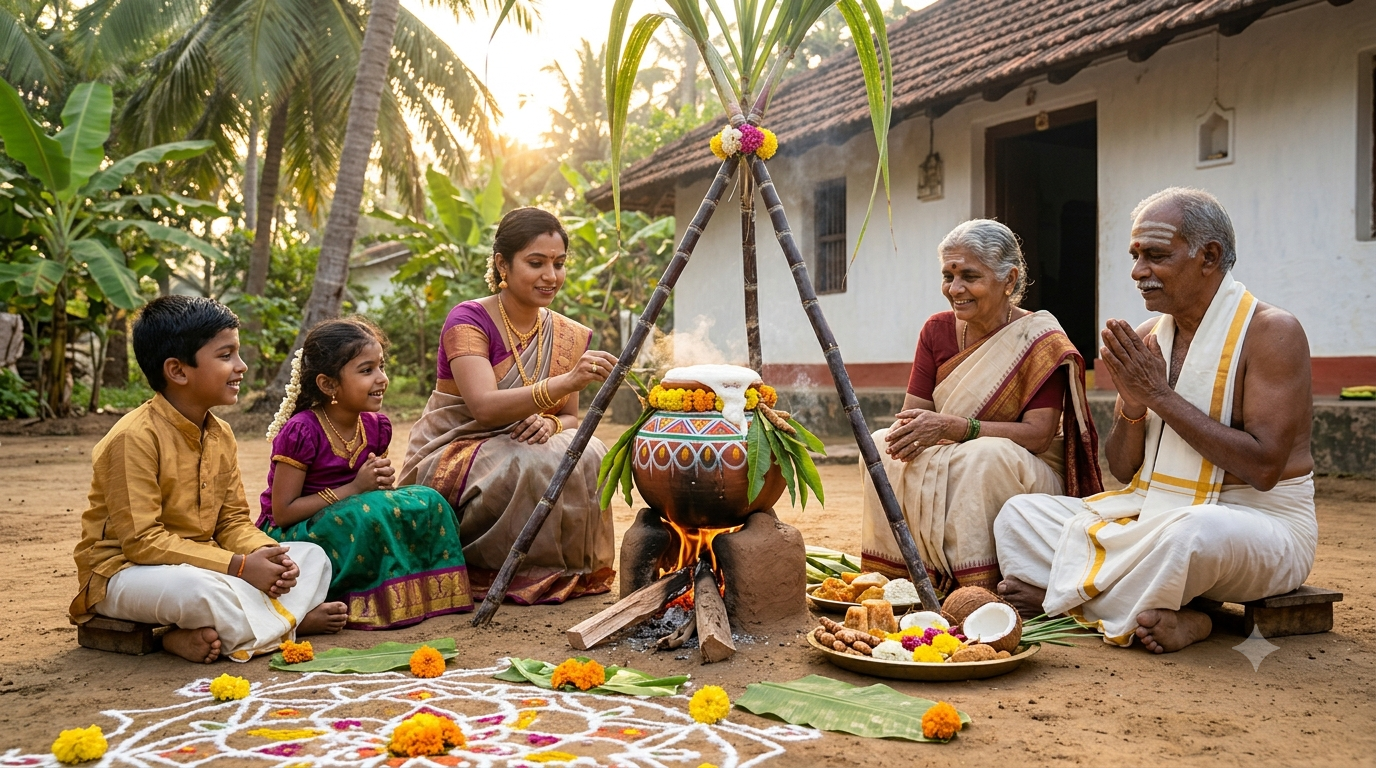
The word pongal means ‘to boil over’ and names both the festival and its signature rice dish. As milk and new rice rise above the pot, families call out ‘Pongalo Pongal,’ welcoming abundance with gratitude rather than wastefulness.
The observance commonly unfolds over Bhogi, Surya Pongal, Mattu Pongal, and Kaanum Pongal. Customs differ across Tamil Nadu, Sri Lanka, Malaysia, Singapore, South Africa, the Caribbean, and other Tamil communities.
Renewal
Bhogi creates space for a fresh beginning. Today, renewal should avoid burning plastics or creating harmful smoke.
Sacred ecology
Surya, cattle, soil, water, and human work are honored as an interdependent whole.
Community
Meals, visits, kolam art, and gifts reinforce family and neighborhood bonds.
Sacred story and historical setting
Pongal is rooted in agrarian life rather than one exclusive myth. Surya is thanked for ripening the fields, while cattle are honored for their traditional role in ploughing, transport, and dairy life.
Stories associated with Krishna lifting Govardhan and Shiva’s bull Nandi are sometimes told in connection with harvest gratitude and cattle. Their prominence varies, so they should be presented as regional or devotional associations, not as a single universal origin.
Pongal is not merely the Tamil name for Makar Sankranti. The festivals overlap in solar season, but Pongal has a distinctive Tamil four-day pattern, cuisine, language, and social history.
How the festival is observed
The festival is expressed through household cleaning, kolam designs, the cooking of pongal, gratitude to Surya, cattle care, temple visits, gifts, and family gatherings.
- On Bhogi, clean and repair the home; donate usable goods instead of burning waste.
- Draw kolam patterns at the entrance with rice flour or eco-safe materials.
- Cook sweet or savory pongal in a clean pot and allow the rising boil to symbolize abundance.
- Offer the first portion with gratitude before the family meal.
- On Mattu Pongal, care for cattle humanely; avoid paint, forced decoration, frightening noise, or exploitative displays.
- Use Kaanum Pongal for visits, community outings, elder respect, and renewing relationships.
Food, offerings, and hospitality
Sakkarai pongal combines newly harvested rice, milk, jaggery, ghee, and often cardamom, cashews, or raisins. Ven pongal is savory, commonly seasoned with pepper, cumin, ginger, and lentils.
Sugarcane, coconut, bananas, vadai, sambar, and vegetable preparations may complete the meal. Recipes vary, and hospitality matters more than uniformity.
Regional and community traditions
Tamil Nadu
Village and urban observances include kolam, temple worship, harvest displays, cattle thanksgiving, and family feasts.
Sri Lankan Tamil communities
Pongal remains a major expression of Tamil religious and cultural identity, often centered on home, temple, and community gatherings.
Global Tamil diaspora
Temples and cultural organizations combine prayer, music, dance, food, and education so younger generations can understand the festival’s language and values.
Observing in Trinidad and Tobago or the wider diaspora
Tamil families in Trinidad and Tobago and the Caribbean can adapt the four-day rhythm to work and school schedules while preserving its core: gratitude, careful cooking, elder respect, and generous hospitality.
Use locally grown produce where possible and acknowledge Caribbean agricultural labor and history. A community food drive can express the harvest ethic in a practical way.
A respectful home observance
- Clean the entrance and create a modest kolam with washable, non-toxic material.
- Prepare a safe outdoor or kitchen cooking area; keep children away from flame and hot milk.
- Offer pongal, fruit, flowers, and water with a prayer of thanks to Surya and all who produce food.
- Share the meal, call elders, and give a portion or donation to someone in need.
- Discuss one household action to reduce food waste or support sustainable agriculture.
Good practice: Do not burn plastic, painted furniture, or mixed waste for Bhogi. Protect people and animals from smoke, fire, loud noise, paint, and forced handling. Food should be cooked hygienically and hot pots closely supervised.
Frequently asked questions
What are the four days of Pongal?
They are commonly Bhogi, Surya Pongal, Mattu Pongal, and Kaanum Pongal, though names, emphasis, and schedules can vary.
Why is the rice allowed to boil over?
The overflowing pot symbolizes welcomed abundance and the hope that prosperity will be shared.
Is Pongal only a religious festival?
It is both religious and cultural. Temple and household worship coexist with agricultural, family, artistic, and community traditions.
Can Pongal be observed without cattle?
Yes. Families can honor the principle through humane animal care, gratitude for agricultural labor, ethical food choices, and support for farmers.
Sources and further reading
- Encyclopaedia Britannica – Pongal – Overview of the Tamil harvest festival.
- Incredible India – Tamil Nadu – Official regional context and cultural information.
- Drik Panchang – Pongal – Location-sensitive festival dates.
- Hindu American Foundation – Hindu holidays – Community educational context.
Editorial and rights note: This educational overview is independently written from cross-checked facts and does not reproduce source text. External sources are cited for verification and further reading; citation does not imply endorsement. The hero is an illustrative AI-generated image created for HinduClarity, not a historical photograph or documentary record. This page is not a substitute for guidance from your temple, family tradition, qualified teacher, or licensed professional. Hindu calendars and practices vary by sampradaya, region, and location.
Back to the complete Hindu Festivals Calendar for 2026-2027
Continue with the Diwali guide or the Ganesh Chaturthi guide.