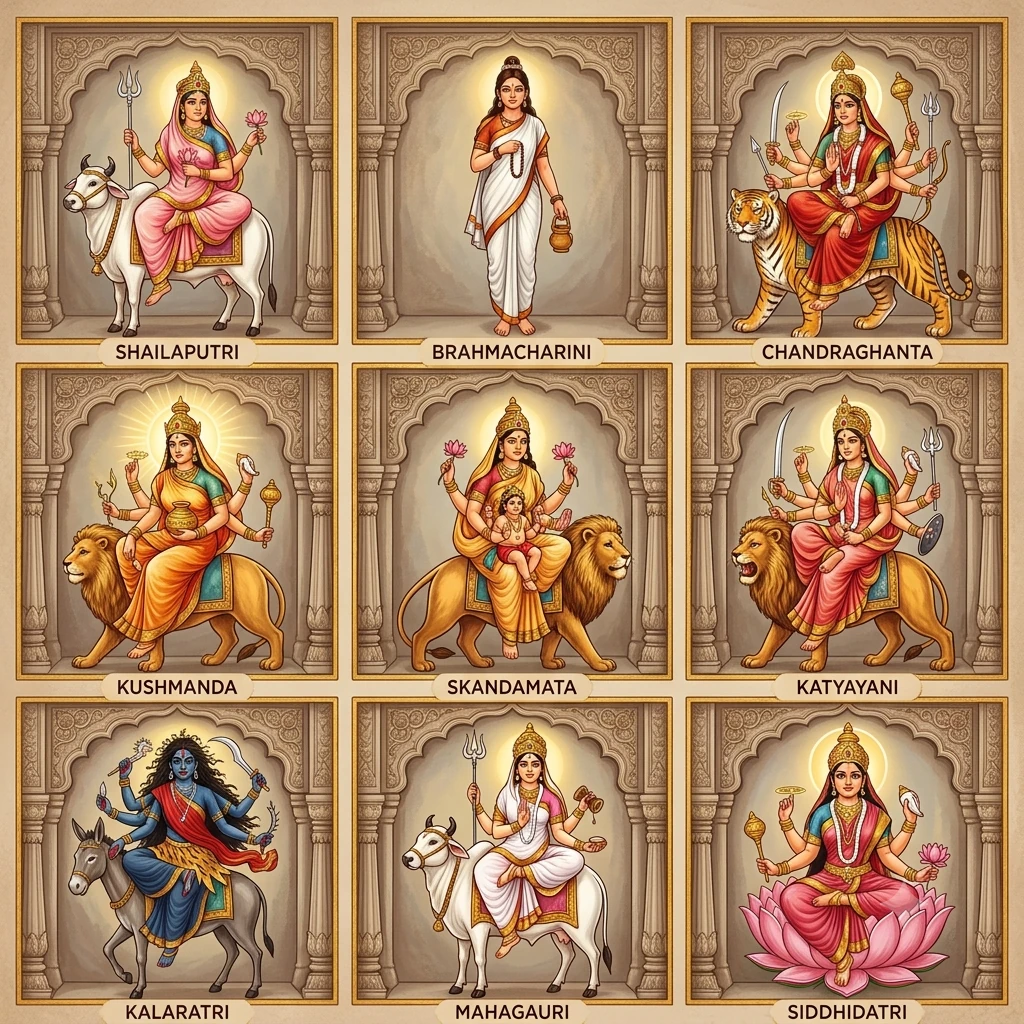
Navadurga is the widely known sequence of nine forms of Goddess Durga honoured across the nine nights and days of Navaratri. Each form brings a distinct sacred image and devotional emphasis—from steadiness and disciplined practice to courage, compassion, purification and spiritual completeness. Together, they help devotees contemplate the many dimensions of the one Divine Mother.
The sequence below is the common popular order used for Navaratri worship. Hindu traditions are richly diverse: names, visual details, colours, offerings and day-by-day practices can differ by region, temple, family and lineage. A local pandit or trusted tradition should guide any formal observance.
What does Navadurga mean?
Nava means “nine,” while Durga names the Goddess as divine protection and power. Navadurga therefore means the nine forms of Durga. These are not nine unrelated goddesses. Devotees commonly understand them as distinct manifestations or contemplative aspects of one Devi—the supreme divine feminine reality known as Shakti.
The sequence can also be read as a devotional journey. It begins with grounded strength, moves through restraint, awakened courage, creative abundance and motherly care, then turns toward determined action, fearless encounter with darkness, purification and fulfilment. This is a devotional interpretation rather than a promise that worship will produce a particular worldly result.
The nine forms of Durga
This table gives common festival associations and recognisable attributes. Sacred art is not mechanically uniform, so the number of arms, mount and objects may vary in particular images.
| Day | Form | Common iconographic attributes | Devotional meaning |
|---|---|---|---|
| 1 | Shailaputri | Rides a bull; often holds a trident and lotus; a crescent moon may appear on her head. | Groundedness, resolve and the strength to begin a sacred discipline. |
| 2 | Brahmacharini | Walks barefoot, carrying prayer beads and a water pot. | Self-restraint, study, patience and wholehearted spiritual effort. |
| 3 | Chandraghanta | Bears a bell-shaped crescent; commonly rides a lion or tiger and carries protective weapons. | Alert courage, dignity and readiness to confront injustice. |
| 4 | Kushmanda | Often shown with eight arms, a lion mount, weapons, beads and a vessel. | Creative radiance, vitality and the life-giving abundance of the cosmos. |
| 5 | Skandamata | Holds the child Skanda; often seated on a lotus or lion and shown with lotuses. | Protective motherhood, tenderness and strength joined with care. |
| 6 | Katyayani | Usually lion-mounted; often holds a sword and lotus, with hands offering protection and blessing. | Determination, moral clarity and courageous action. |
| 7 | Kalaratri | Dark-complexioned with flowing hair; commonly shown on a donkey, carrying weapons while granting protection. | Fearlessness, the removal of ignorance and facing what is difficult without denial. |
| 8 | Mahagauri | Radiant or white-clad; often rides a bull and holds a trident and small drum. | Purification, serenity, forgiveness and renewed clarity. |
| 9 | Siddhidatri | Seated on a lotus or shown with a lion; commonly holds a discus, conch, mace and lotus. | Spiritual completeness, wisdom and grace. “Siddhi” should not be reduced to guaranteed supernatural gain. |
Some communities use other Durga sequences or focus on broader threefold worship of Durga, Lakshmi and Saraswati during Navaratri. That difference is not an error; it reflects Hinduism’s regional and lineage-based diversity.
Navadurga, Durga and Navaratri
Mother Durga is revered as the powerful, compassionate Devi who protects cosmic and moral order. Navadurga is one way devotees encounter her fullness through nine named forms. The grouping is especially visible during Navaratri, although Durga devotion continues throughout the year.
Navaratri means “nine nights.” In many North Indian observances, one Navadurga form receives particular attention each day. Elsewhere, the festival may centre on Durga Puja, Garba, household doll displays, the worship of learning and tools, recitation, fasting or communal worship. Sharad Navratri is the prominent autumn celebration, while Chaitra Navratri falls in spring. Calendars and local customs should be checked for the observance followed in your community.
Understanding Navadurga iconography
Navadurga images communicate theology through visual symbols. The lion or tiger can suggest sovereign courage; the lotus evokes purity and spiritual unfolding; a trident conveys divine power; prayer beads suggest disciplined remembrance; and open palms may express reassurance or generosity. Weapons in Devi imagery signify protection and the defeat of destructive forces, not aggression for its own sake.
Mounts, gestures, colours and held objects help distinguish one form from another, but artists and traditions do not always depict them identically. Kalaratri’s formidable appearance, for example, is paired with protective gestures, while Skandamata’s image joins maternal tenderness to regal strength. Read the whole image rather than isolating one symbol.
A respectful home observance
- Clean a quiet space and place a respectful image of Durga or the Navadurga. A simple lamp or battery candle and flowers are sufficient.
- Begin with a calm intention. Offer water, fruit or flowers according to your household custom and practical circumstances.
- Read the day’s name and meaning, then spend a few minutes in prayer, silent reflection or a familiar devotional song.
- Choose one matching virtue—patience, courage, care or clarity—and practise it through an ordinary act of service.
- Conclude with gratitude. Share offered food respectfully and keep the space clean.
No elaborate display is required. People who do not fast can participate fully through prayer, charity, study and service. If your family follows a particular calendar, mantra or offering tradition, preserve that inheritance rather than replacing it with a generic online checklist.
Navadurga in Trinidad and Tobago and the diaspora
In Trinidad and Tobago, Navaratri devotion lives within a wider Indo-Caribbean Hindu heritage carried, preserved and adapted by generations descended in large part from Indian indentured labourers. Mandirs and homes may host nightly worship, singing, readings and community meals, while work schedules, mixed family traditions and local temple calendars shape how people participate.
Some devotees follow the nine-form sequence closely; others emphasise Durga, Lakshmi and Saraswati in phases, or attend only selected nights. Diaspora practice is not a lesser copy of Indian practice. It is a living expression of Sanatana Dharma, sustained through memory, community institutions and local experience. Visitors should follow the host mandir’s guidance, dress modestly, ask before photographing worship and avoid assuming every congregation uses the same sequence.
Safety and lineage
This guide offers general education, not initiation or a substitute for a guru, acharya or pandit. Formal deity installation, specialised mantra practice, fire rites and other lineage-governed procedures require qualified guidance. Keep flames attended and away from cloth, children and pets. Anyone considering fasting—especially during pregnancy, childhood, illness, frailty, an eating-disorder history or while using glucose-lowering medicine—should prioritise health and seek appropriate medical advice. Protecting health is not a spiritual failure.
Frequently asked questions
Are Navadurga and Durga the same?
Navadurga refers to nine forms of the one Goddess Durga. The forms highlight distinct qualities, but they are commonly worshipped as manifestations of the same Divine Mother.
Must each form be worshipped on a fixed day?
The day-one-to-day-nine order shown above is widespread, especially in popular Navaratri observance. Practices can vary by region and lineage, so follow your temple or family calendar when it differs.
Is Kalaratri the same as Kali?
They are closely related in themes of time, darkness and fierce protection, and traditions may connect them. However, Maha Kali and Kalaratri have distinct names, iconographic traditions and devotional contexts; they should not be flattened into a single universal identity.
Can I honour Navadurga without fasting?
Yes. Prayer, ethical discipline, service, scriptural reading, devotional singing and attending mandir worship are meaningful forms of participation. Fasting is not safe or required for everyone.
Sources and further reading
- Incredible India: Navratri — Government of India tourism overview of the festival, regional diversity and common Navadurga sequence.
- Encyclopaedia Britannica: Durga — reference overview of Durga’s theology, mythology and major visual attributes.
- Hindu American Foundation: Nine things to know about Navaratri — community-oriented explanation of worship and regional variation.
- NALIS: Indian Arrival Day — Trinidad and Tobago background on Indian indentureship and Indo-Trinidadian heritage.