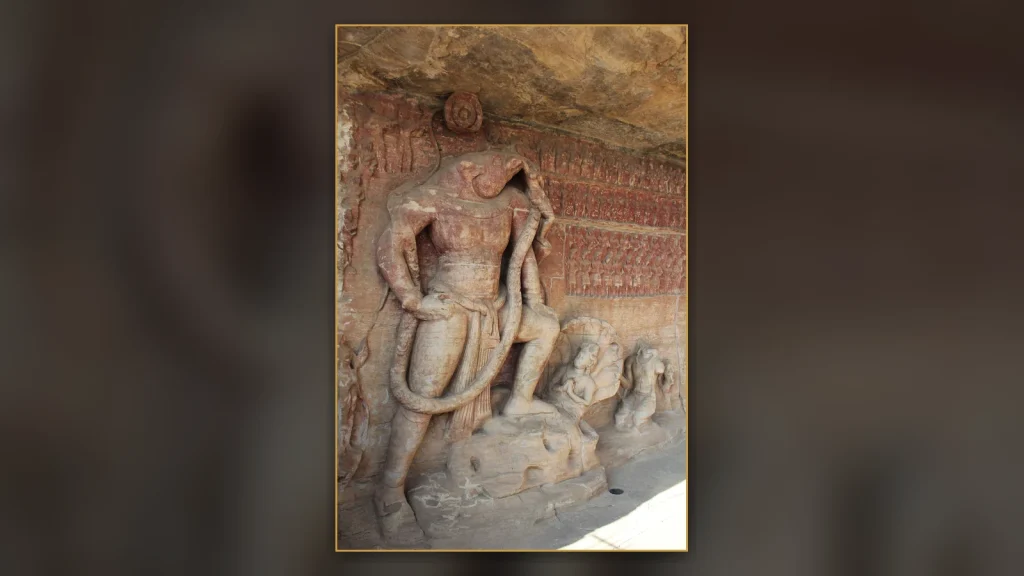
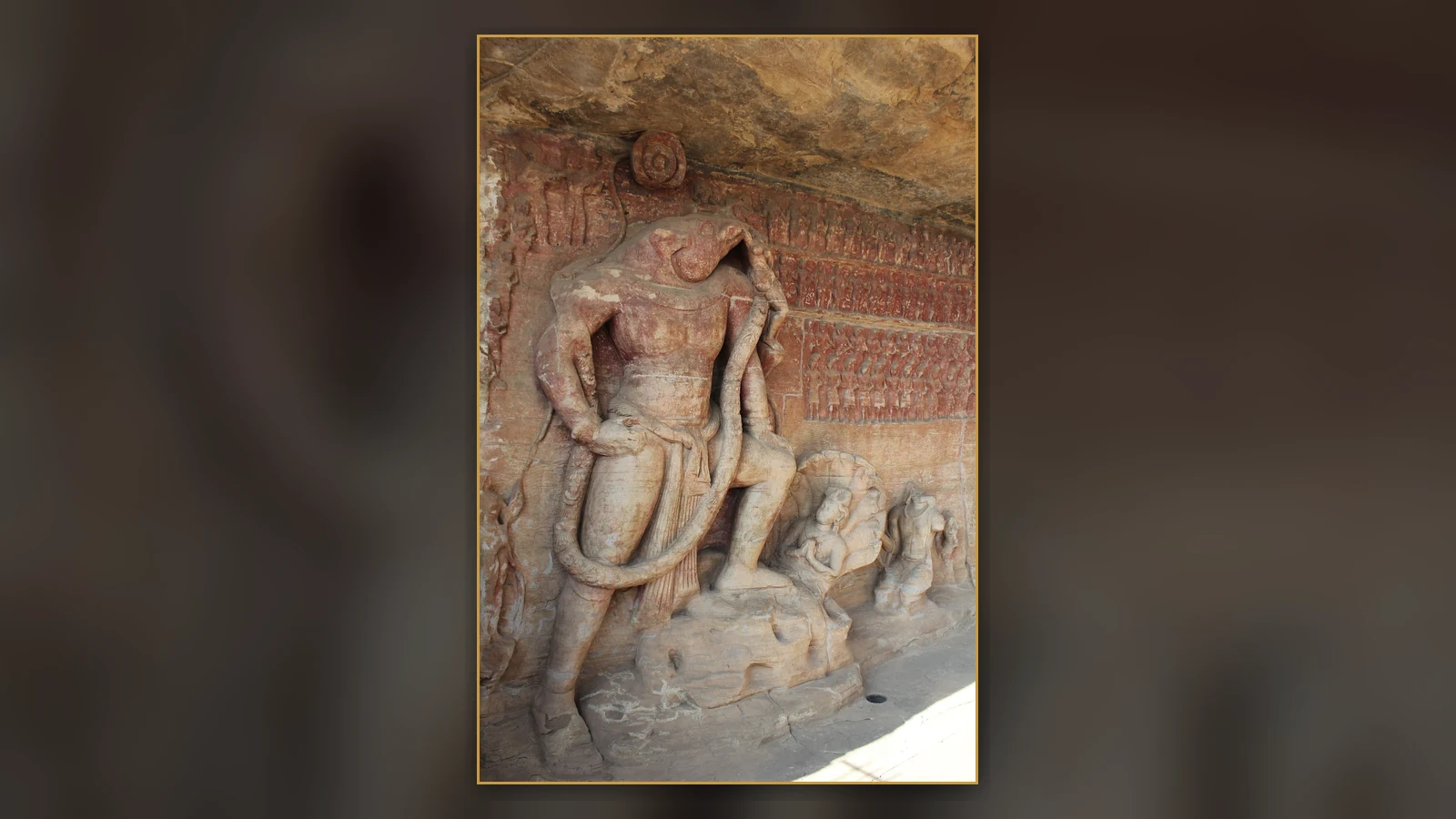
Varaha is Vishnu’s boar avatar, who enters the cosmic waters and raises the Earth, revered as the goddess Bhudevi, back to her proper place. Some Purāṇic narratives add a battle with the asura Hiranyaksha; others emphasize creation and restoration. Varaha art likewise ranges from an animal form to a powerful boar-headed divine figure supporting Bhudevi.
.jpg)
Varaha avatar at a glance
| Question | Concise answer |
|---|---|
| Who is Varaha? | The boar manifestation of Lord Vishnu. |
| Whom does Varaha rescue? | Earth, personified and worshipped as Bhudevi or Prithivi. |
| Opponent in major later accounts | Hiranyaksha, an asura who has carried or held Earth in the waters. |
| Named textual witnesses | Vishnu Purāṇa 1.4 and Bhāgavata Purāṇa 3.13–19, among others. |
| Common visual forms | A boar; or a human-bodied, boar-headed Vishnu, often with Bhudevi. |
| Important caution | Bhudevi is a goddess and participant, not merely scenery or an anonymous object. |
What happens in the Varaha story?
The Earth has disappeared beneath the cosmic waters. Vishnu manifests as Varaha, enters the depths, finds her, and raises her upward. In developed Purāṇic versions, the asura Hiranyaksha confronts him, and Varaha defeats the threat before restoring Earth to an ordered position.
The narrative is often summarized as “a boar lifts the Earth on his tusks,” but that shorthand can hide its theological relationships. Varaha is Vishnu acting in a form suited to entering the waters and bearing the Earth. Bhudevi is the divine Earth, addressed, praised, represented as a goddess, and worshipped in her own right. Their encounter can signify rescue, restoration, and the renewal of an inhabitable cosmos without reducing Bhudevi to a prop.
Different sources arrange the rescue, creation, praise, and battle differently. A production-quality account therefore names its witness rather than stitching every familiar detail into a supposedly single original version.
Named textual witnesses and how they differ
Vishnu Purāṇa 1.4: raising and ordering the Earth
Vishnu Purāṇa 1.4, in H. H. Wilson’s public-domain translation, describes Narayana taking the boar form at the beginning of a kalpa. Earth addresses him, he raises her from beneath the waters, and sages praise him. The chapter proceeds into the restoration and ordering of the world.
This telling places Varaha strongly within cosmogony. Its chapter summary does not foreground Hiranyaksha as the reason for every action. Readers who know only the battle-centered version should not insert that opponent into this chapter without attribution. Wilson’s 1840 English is an identified historical translation, valuable for passage location but not the last word in current philology.
Bhāgavata Purāṇa 3.13–19: appearance, rescue, and battle
The Bhāgavata Purāṇa, Canto 3, Chapter 13 narrates Varaha’s appearance, growth, entry into the water, and raising of Earth. The following chapters develop Hiranyaksha’s challenge and his battle with Varaha, concluding with the asura’s defeat. The source gives readers a long Vaishnava narrative rather than a one-paragraph episode.
The linked translation is from a Gaudiya Vaishnava institution and includes tradition-specific theological commentary. Citing the chapter by name keeps that perspective visible. It supports the Bhāgavata version; it does not prove that every Varaha image or temple tradition follows the same sequence.
What the Varaha Purana is—and is not
The Varaha Purana is framed through teaching associated with Varaha and Bhudevi, but its extant form is not simply the complete battle biography of the avatar. It devotes extensive attention to worship, pilgrimage, sacred geography, vows, images, and religious practice. This avatar guide owns the rescue narrative, Bhudevi relationship, meaning, art, and worship variation; the Purana guide owns the work’s textual scope.
What does Varaha mean?
Varāha means “boar.” The form is not comic or degrading: in the narrative, it is purposeful, powerful, and able to enter a realm where the Earth must be recovered. In the Dashavatara, Varaha follows Matsya and Kurma in the most familiar sequence, but the story should not be presented as a scientific stage in biological evolution.
“Cosmic restoration” is a grounded interpretive theme. Varaha does not abandon the material world as unworthy; he retrieves and re-establishes it. Readers may also see an ethic of reverence for Earth, especially because Earth is encountered as Bhudevi. That is a respectful contemporary interpretation, not proof that an ancient chapter taught a modern environmental policy in today’s vocabulary.
Bhudevi’s place in the narrative
Bhudevi—“Earth Goddess”—is one of the central relationships that makes Varaha intelligible. Texts and images may call her Bhū, Bhudevi, Dharaṇī, or Prithivi in different contexts. She embodies Earth while also appearing as a personal goddess. In art she can be a small female figure raised near Varaha’s tusk, held at his side, or seated on an arm or elbow.
Scale in sacred art does not determine spiritual worth. A comparatively small Bhudevi can help an artist show the vastness and force of the rescue within limited stone or bronze. Good description names her and her agency rather than calling her “a tiny woman” or treating her as decorative landscape.
Varaha and Bhudevi in museum records
The Cleveland Museum of Art’s “Varaha, Boar Incarnation of Vishnu” is a sandstone sculpture from central India, probably Madhya Pradesh, dated to the 700s–800s. Its curatorial description identifies the boar-headed, warrior-bodied Vishnu, his conch and discus, and an elbow extended as a seat for the rescued Earth goddess. The record supports those observations for this object, not a universal formula.
The Art Institute of Chicago records an eleventh-century red sandstone “Varaha Lifting the Earth Goddess Bhudevi” from Rajasthan. Its title, region, date, and material provide a second institutional witness to the paired image. Comparing it with Cleveland’s sculpture makes regional and historical variety visible.
A later narrative mode appears in the Metropolitan Museum of Art’s API record for “Varaha Triumphant,” a late eighteenth-century work from Sawar, Rajasthan. Sculpture can present a stable devotional icon, while painting can emphasize motion, confrontation, or triumph. Neither medium exhausts Varaha’s meanings.
Tradition, temple, and regional variation
- Cosmogonic emphasis: Some witnesses center Earth’s emergence and the reordering of creation.
- Battle emphasis: Major later narratives develop Hiranyaksha’s confrontation with Varaha across multiple chapters.
- Bhudevi relationship: Images range from the instant of lifting to calmer paired forms in which Varaha and Bhudevi appear as divine companions.
- Visual form: Varaha may be entirely animal, boar-headed and human-bodied, two-armed or multi-armed, standing dynamically or enthroned. Attributes depend on region, period, and iconographic program.
- Worship: Varaha can be honored in independent shrines, Vishnu temples, Dashavatara programs, and sites where a particular local form is central. Ritual prominence and festival observance are not uniform across all Hindu communities.
The general theological logic of divine manifestation is famously expressed in Bhagavad Gita 4.7–4.8. Those verses help explain why Vishnu’s presence is associated with restoring dharma, but they do not narrate Varaha, Bhudevi, or Hiranyaksha directly.
Common misconceptions
Is Bhudevi just a symbol for soil?
No. Bhudevi can symbolize and embody Earth, but she is also a personal goddess in texts, images, and worship. Symbol and divine personhood need not cancel each other.
Is Hiranyaksha present in every Varaha account?
No. Hiranyaksha is central in important Purāṇic battle narratives, including the Bhāgavata sequence, but Varaha’s Earth-raising also appears in cosmogonic tellings with different emphasis.
Does Varaha prove an ancient theory of evolution?
No. Reading fish, tortoise, and boar as evolutionary stages is a modern analogy, not a scientific claim established by the texts. The Dashavatara is a theological and narrative tradition, and lists vary.
Does worship of Varaha guarantee protection or prosperity?
No. Devotional communities may articulate hopes and sacred meanings, but an educational guide should not promise health, wealth, safety, liberation, or any other outcome.
Frequently asked questions
Why did Vishnu take the form of a boar?
The form enables Vishnu to enter the cosmic waters, find Earth, and lift her. Later narratives also make Varaha the form that defeats Hiranyaksha.
Who is Bhudevi?
Bhudevi is the Earth Goddess. She is the Earth embodied and a divine person, often represented with Vishnu in Varaha imagery and other Vaishnava contexts.
Where does Varaha carry Bhudevi?
Descriptions and images vary. She may be raised near a tusk, supported by an arm or elbow, or shown beside Varaha after rescue. One pose should not be treated as universal.
Is Varaha the third avatar?
Varaha is third in the most familiar Dashavatara order, after Matsya and Kurma. Other scriptural lists of manifestations may be longer and structured differently.
Is the Varaha Purana mainly the Varaha battle?
No. Its surviving form contains extensive pilgrimage, worship, sacred-geography, and ritual material. See the separate Varaha Purana guide.
Sources
- Vishnu Purāṇa 1.4, trans. H. H. Wilson — cosmogonic Earth-raising and restoration.
- Bhāgavata Purāṇa 3.13, Bhaktivedanta Vedabase — Varaha’s appearance and raising of Earth.
- Bhāgavata Purāṇa 3.18 — battle with Hiranyaksha in this Vaishnava telling.
- Cleveland Museum of Art: Varaha, Boar Incarnation of Vishnu — central Indian sculpture and curatorial iconography.
- Art Institute of Chicago: Varaha Lifting Bhudevi — eleventh-century Rajasthan object record.
- Metropolitan Museum of Art: Varaha Triumphant, object 74648 — late eighteenth-century Rajasthan painting record.
- Gita Supersite, IIT Kanpur: Bhagavad Gita 4.7–4.8 — manifestation context, not a Varaha narrative.