Hindu festival guide
Rama Navami
A complete guide to the celebration of Lord Rama’s birth, including sacred story, puja, Ramayana recitation, regional traditions, and thoughtful home practice.
Rama Navami dates for 2026 and 2027
| Year | Observed date | Planning note |
|---|---|---|
| 2026 | Thursday, March 26 | Madhyahna puja timing and tithi depend on location. |
| 2027 | Wednesday, April 14 | Madhyahna puja timing and tithi depend on location. |
Calendar note: Rama Navami falls on the ninth lunar day of the bright half of Chaitra and commonly concludes Chaitra Navratri. Local temples may schedule readings and worship across several days.
What Rama Navami means
Rama Navami celebrates the birth of Lord Rama, the central figure of the Ramayana and a major avatar of Vishnu. Devotees honor Rama’s commitment to dharma, courage, self-control, compassion, and public responsibility.
The festival is observed through puja, Ramayana reading, bhajan, kirtan, fasting, processions, charity, and the ceremonial worship of a child-form of Rama at midday.
Rama’s story is transmitted through many respected Ramayanas, including Valmiki’s Sanskrit epic, Tulsidas’s Ramcharitmanas, Kamban’s Tamil work, and regional and performance traditions. Their differences should be acknowledged rather than flattened.
Dharma
Rama’s life invites reflection on difficult duties, truthful conduct, and the consequences of power.
Devotion
Sita, Lakshmana, Bharata, Hanuman, and many others show distinctive forms of loyalty and spiritual relationship.
Rama rajya
The ideal of just rule should inspire accountability and care, not a slogan that excludes or silences others.
Sacred story and historical setting
The Ramayana tells that King Dasharatha of Ayodhya performed a sacrifice seeking heirs. Rama was born to Queen Kausalya, with Bharata, Lakshmana, and Shatrughna born to the other queens. Later tradition understands Rama as Vishnu’s avatar who confronts Ravana and restores order.
The epic is morally rich because its characters face exile, grief, conflicting duties, war, family loyalty, and the burden of kingship. Responsible teaching does not hide difficult passages or pretend every retelling resolves them identically.
Rama devotion should not be used to vilify living communities, reduce the Ramayana to partisan politics, or erase the dignity and agency of Sita and other characters.
How the festival is observed
A meaningful Rama Navami joins worship with reading, service, ethical reflection, and the remembrance of the full Rama family and Hanuman.
- Bathe, clean the altar, and offer flowers, fruit, tulsi where customary, and lamp light.
- Read or listen to a reliable Ramayana passage and identify the edition or tradition.
- Chant Shri Ram Jai Ram Jai Jai Ram, Ram naam, or a lineage-approved prayer with attention rather than speed.
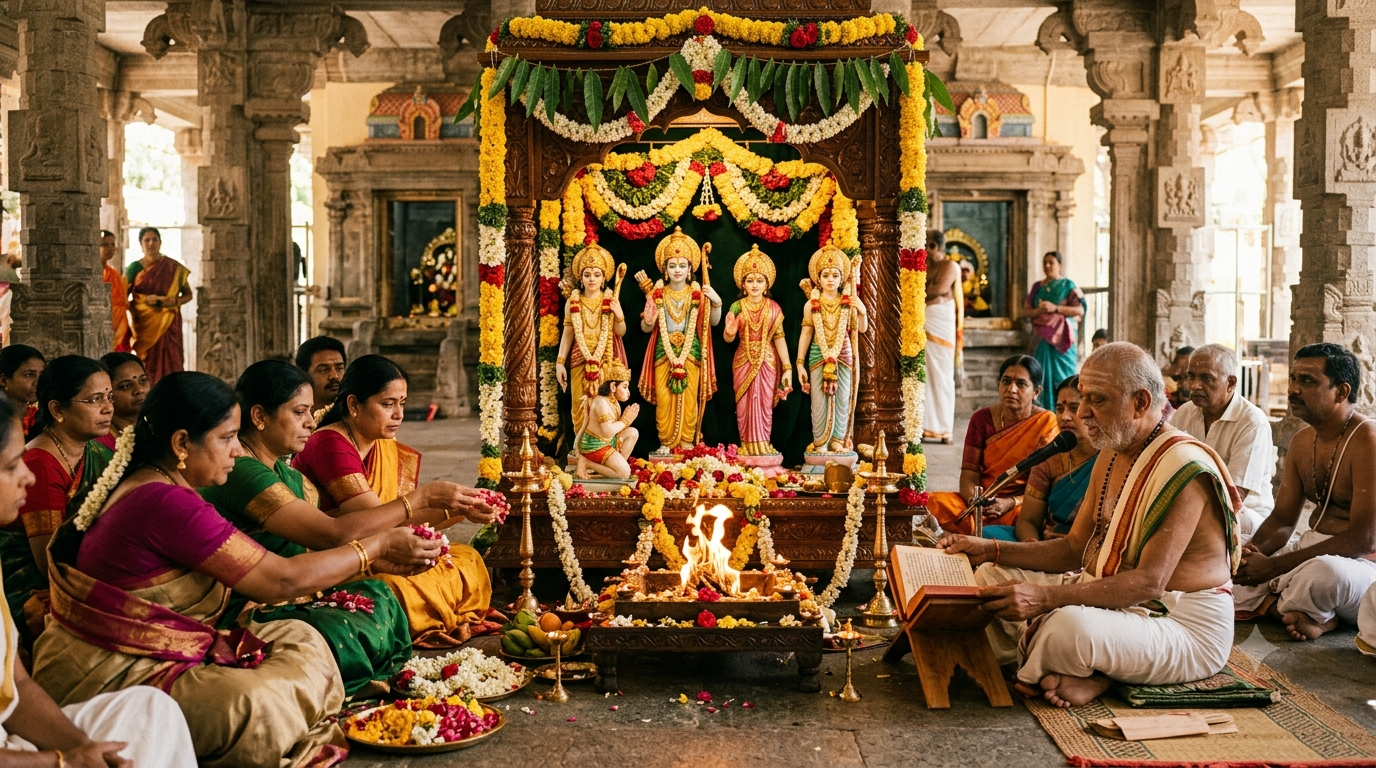
- At midday, some temples perform a ceremonial birth celebration and cradle worship.
- Give food or service in a way that protects recipients’ dignity.
- If joining a procession, follow public safety rules and avoid sectarian slogans or sound levels that harm others.
Food, offerings, and hospitality
Panakam, kosambari, fruit, neer mor, sweets, and simple vegetarian prasad appear in different regions. Some devotees fast until the midday celebration.
There is no single pan-Hindu menu. Local temple instructions, health needs, and hygienic preparation should guide the household.
Regional and community traditions
Ayodhya and north India
Temple worship, processions, Ramcharitmanas recitation, bathing, and large pilgrim gatherings are prominent.
South India
Temples celebrate Sita-Rama kalyanam, panakam, music, and readings through local Vaishnava and regional traditions.
Caribbean Ramayana traditions
Yajna, chowtal or bhajan, community recitation, and family storytelling preserve Rama devotion within Indo-Caribbean history.
Observing in Trinidad and Tobago or the wider diaspora
Rama Navami in Trinidad and Tobago often belongs to a broader Ramayana season, with mandir yajnas and public or family readings. Verify the translation and explain unfamiliar terms so younger listeners can participate.
A diaspora observance can honor both inherited Indian traditions and the courage of ancestors who preserved Ramayana practice under indentureship and migration.
A respectful home observance
- Place a Rama family image or murti in a clean prayer area.
- Read a selected passage aloud from a named Ramayana translation.
- Offer a brief puja, bhajan, and silent reflection on one duty you can perform more justly.
- Share prasad and support a food, education, or family-welfare cause.
- Close by acknowledging that dharma requires humility, listening, and accountability.
Good practice: Fasting is optional and should never override health. Protect children at crowded processions, keep lamps supervised, and avoid using devotional gatherings for partisan hostility or discrimination.
Frequently asked questions
Is Rama Navami Rama's birthday?
It is the sacred annual celebration of Rama’s birth on Chaitra Shukla Navami.
Which Ramayana should I read?
Choose a respected text or translation and name it. Valmiki, Ramcharitmanas, Kamba Ramayanam, and many regional traditions each have distinct histories.
Does Rama Navami always end Chaitra Navratri?
It commonly does in many North Indian calendars, though the emphasis and sequence vary by region and lineage.
Is fasting required?
No. Devotion, reading, charity, and ethical conduct are central; fasting should match health and tradition.
Sources and further reading
- Encyclopaedia Britannica – Rama – Background on Rama and the Ramayana tradition.
- Drik Panchang – Rama Navami – Location-sensitive date and midday timing.
- Valmiki Ramayana – IIT Kanpur – Searchable text and translation project.
- Hindu American Foundation – Rama – Community educational context.
Editorial and rights note: This educational overview is independently written from cross-checked facts and does not reproduce source text. External sources are cited for verification and further reading; citation does not imply endorsement. The hero is an illustrative AI-generated image created for HinduClarity, not a historical photograph or documentary record. This page is not a substitute for guidance from your temple, family tradition, qualified teacher, or licensed professional. Hindu calendars and practices vary by sampradaya, region, and location.
Back to the complete Hindu Festivals Calendar for 2026-2027
Continue with the Diwali guide or the Ganesh Chaturthi guide.