Kalki is Vishnu’s future avatar in several Hindu texts, expected near the end of Kali Yuga to confront corrupt rule and renew dharma. The Bhagavata Purana and Vishnu Purana provide influential accounts, but they do not authorize a verified modern birth date, a living claimant, or one universally accepted chronology.
.jpg)
Kalki avatar at a glance
| Question | Concise answer |
|---|---|
| Who is Kalki? | A future manifestation of Vishnu in influential Vaishnava and Puranic traditions |
| When does Kalki appear? | At the close of Kali Yuga in cyclical sacred time—not on a securely calculable modern date |
| Key textual witnesses | Bhagavata Purana 12.2.18–23; Vishnu Purana 4.24 |
| Named place and family | Shambhala and Vishnuyasha in the Bhagavata Purana and Vishnu Purana |
| Common iconography | A radiant warrior, a white horse or horse-form, and a raised sword |
| Main caution | Texts, images, sectarian readings, and modern claims must not be blended into one “exact prediction” |
What the Bhagavata Purana says
The Bhagavata Purana places its concentrated Kalki account in Book 12, Chapter 2, within a description of the deterioration and eventual transition of Kali Yuga. Verse 18 names Shambhala and says that Kalki will appear in the household of the brahmin Vishnuyasha.[1] This is textual prophecy inside a sacred cosmology; it is not a modern civil registry, map reference, or permission to identify a contemporary family.
Verses 19–20 portray Kalki mounted on the swift horse Devadatta, carrying a sword and confronting people who wear the appearance of kings while behaving as thieves.[2] The narrative’s target is corrupt and predatory rule. Readers differ on whether they emphasize literal future events, theological imagery, moral warning, or several levels at once. The text itself should be described before later interpretations are added.
The sequence does not end with destruction. Verses 21–23 move toward purification, renewed social life, and the beginning of Satya Yuga.[3] That movement from disorder to renewal is essential to Kalki’s narrative role. Presenting Kalki only as an apocalyptic fighter misses the restoration that gives the episode its place within Hindu cyclical time.
What the Vishnu Purana adds
Vishnu Purana Book 4, Chapter 24 also situates Kalki at the approach of Kali Yuga’s end. In the public-domain Manmatha Nath Dutt translation, based on H. H. Wilson’s work, Kalki is born in Vishnuyasha’s family in Shambhala, defeats thieves and wrongdoers, re-establishes virtue, and leaves purified survivors as the seed of a renewed age.[4]
The two Puranas overlap, but an overlap is not proof that every Hindu work supplies an identical biography. They embed Kalki in different surrounding discussions and transmitted textual histories. Other works, including the Mahabharata and later Kalki literature, expand or arrange end-of-age material differently. A responsible guide therefore names each witness rather than constructing a seamless “complete prophecy” from scattered passages.
Prophecy, sacred time, and later interpretation
What is securely textual?
In the named passages above, the secure core is a future Vishnu manifestation, Kali Yuga’s extreme decline, Shambhala, Vishnuyasha, force against corrupt rulers, and renewal of dharma. The white horse and sword are strongly established in the Bhagavata passage and later art. These details can be reported with chapter and verse.
What belongs to interpretation?
Claims about the modern location of Shambhala, the conversion of yuga measurements into a near-term calendar date, political identifications, and the decoding of present-day names are interpretations. Some may matter deeply within particular movements, but they are not neutral facts shared by all Hindus. Hindu cosmological calculations themselves have more than one interpretive history, so a confident day, year, or birthplace cannot be derived simply by repeating “end of Kali Yuga.”
Why the Bhavishya Purana requires special caution
The title Bhavishya Purana is sometimes translated as “Purana of the future,” leading viral posts to treat anything attributed to it as an ancient prediction. Puranic scholar Ludo Rocher’s survey describes the work’s complicated contents and textual history; surviving printed and manuscript forms contain strata from different periods.[5] The title alone cannot authenticate a quotation, date it, or prove that it refers to a modern person. See HinduClarity’s guide to the Bhavishya Purana’s textual history before using it as evidence.
Meaning within the Dashavatara
In common Dashavatara lists, Kalki is the future-facing final member. Earlier avatars respond to crises already narrated; Kalki projects the avatar principle into a horizon beyond the present age. The point is not that human beings should imitate end-time violence. Rather, the story insists that exploitative power is not permanent and that moral decline does not have the final word.
This role also connects Kalki to broader understandings of Lord Vishnu as the one who preserves order through forms appropriate to different crises. Yet Vaishnava schools do not all explain an avatar’s metaphysical status in exactly the same way. “Tenth avatar” is a useful list label, not a substitute for a tradition’s theology.
Kalki iconography in museum collections
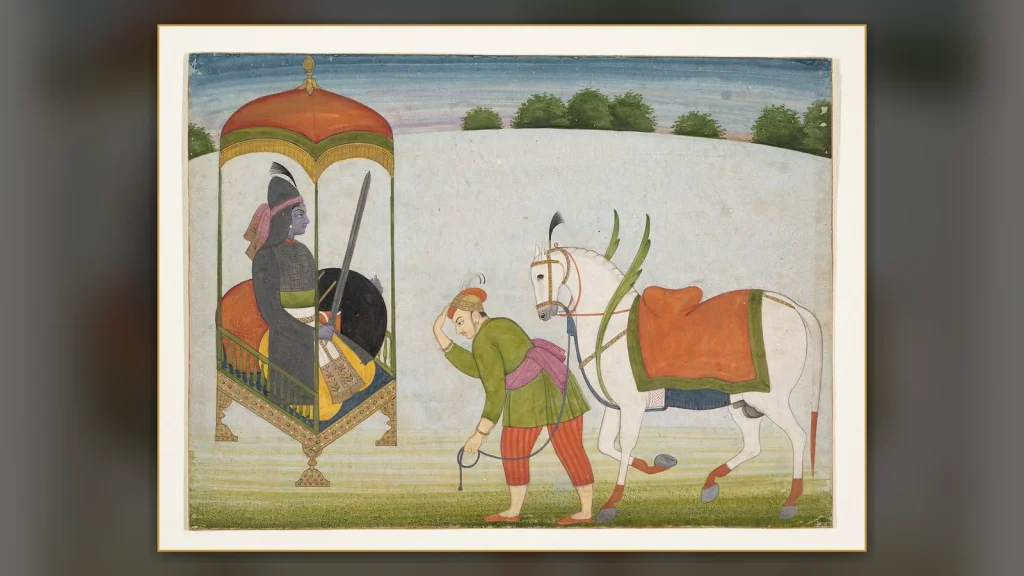
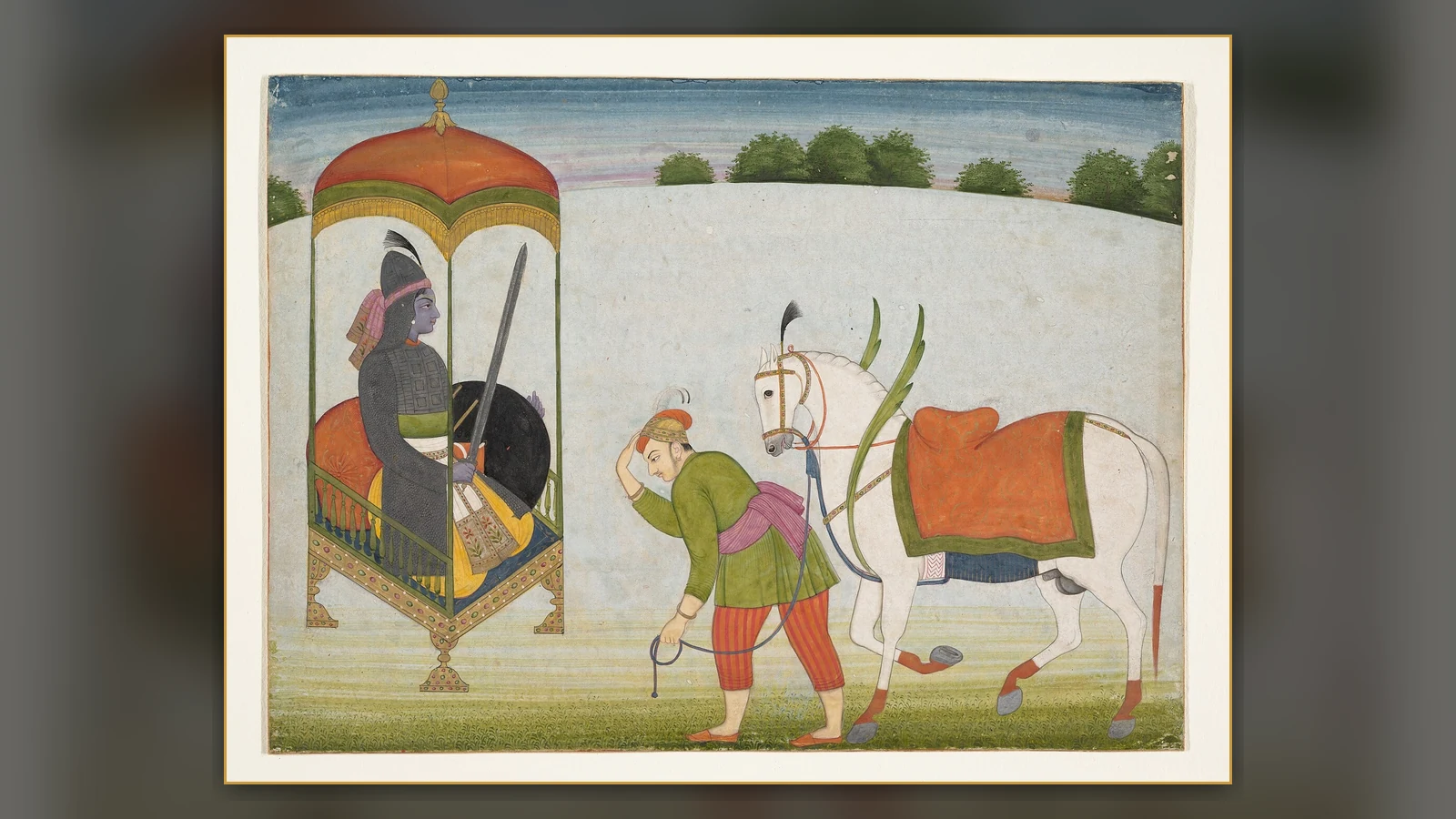
Sacred art does not provide a single diagram. A circa 1700–1710 Basohli folio at the Metropolitan Museum of Art presents “Kalki Avatar, the Future Incarnation of Vishnu”; its museum record gives date, region, medium, and manuscript context.[6] A V&A painting from about 1720 describes Vishnu as Kalki in a horse form, demonstrating that artists could visualize the horse relationship differently from the now-familiar mounted warrior.[7]
Other V&A works show a warrior riding a white horse or Vishnu beside a groom and horse. Across these examples, the sword communicates decisive action, while the horse conveys speed and eschatological arrival. Museum labels support what a particular object depicts; they do not prove that every temple, manuscript, or household uses the same form.
Tradition and regional variation
Kalki appears in Sanskrit Puranic reading, vernacular storytelling, Dashavatara painting sets, temple sculpture, performance, and modern religious movements. Emphasis varies. A Vaishnava teacher may focus on Vishnu’s promise to restore dharma; a storyteller may dwell on the cycles of yugas; an artist may depict Kalki as horse-headed, mounted, or accompanied by a horse. Some communities discuss Kalki mainly as future prophecy, while others treat the image as a present moral reminder.
These layers should remain visible. A Puranic passage is not evidence that a later shrine’s ritual is pan-Hindu. A regional painting is not a universal iconographic rule. A claimant movement’s testimony establishes what that movement believes—not the identity of Kalki for Hinduism as a whole.
Misconceptions and responsible reading
- “Kalki has a confirmed birth date.” No date has universal scriptural or institutional acceptance. Exact modern calculations depend on additional assumptions.
- “A living person has been proven to be Kalki.” Claimants may have followers, but this is not independent proof or a consensus Hindu conclusion.
- “Every online Kalki quotation is ancient.” A quotation needs a work, chapter or verse, edition, and translator. Fabricated and misattributed predictions are common.
- “The sword promises violence against groups we dislike.” The texts describe an end-of-age divine action, not a license for harassment or vigilantism.
- “There is one complete Kalki account.” Puranic passages, later literature, art, regional memory, and modern movements are related but distinct evidence classes.
Frequently asked questions
Has Kalki already been born?
The major passages discussed here place Kalki at Kali Yuga’s end. Assertions that Kalki has already been born belong to particular interpreters or claimant groups; they are not verified by a universally accepted date or identity test.
Where is Shambhala?
Shambhala is the village named in Bhagavata Purana 12.2.18 and Vishnu Purana 4.24. Proposals that equate it with a modern location should be attributed rather than presented as settled geography.
Is Kalki a man or a horse?
Influential texts describe Kalki riding a horse, while art also represents Kalki in equine or horse-associated form. The mounted warrior is common, but museum collections preserve more than one visual solution.
What happens after Kalki?
In Bhagavata Purana 12.2.21–23 and Vishnu Purana 4.24, the emphasis turns to purification, renewed virtue, and Satya or Krita Yuga. Renewal—not endless destruction—completes the narrative arc.
Sources and further reading
- Bhagavata Purana 12.2.18 — Shambhala and Vishnuyasha in an identified Vaishnava translation.
- Bhagavata Purana 12.2.19–20 — Devadatta, sword, and corrupt rulers.
- Bhagavata Purana 12.2.23 — Kalki and the transition to Satya Yuga; read with 12.2.21–22.
- Project Gutenberg: A Prose English Translation of Vishnupuranam — Book 4, Chapter 24; Manmatha Nath Dutt, based on H. H. Wilson.
- Ludo Rocher, The Puranas (1986) — academic survey of Puranic composition and the Bhavishya Purana’s textual complexity.
- The Met: Kalki Avatar, the Future Incarnation of Vishnu — Basohli folio, circa 1700–1710.
- V&A: Vishnu as Kalki — circa 1720 painting and object description.