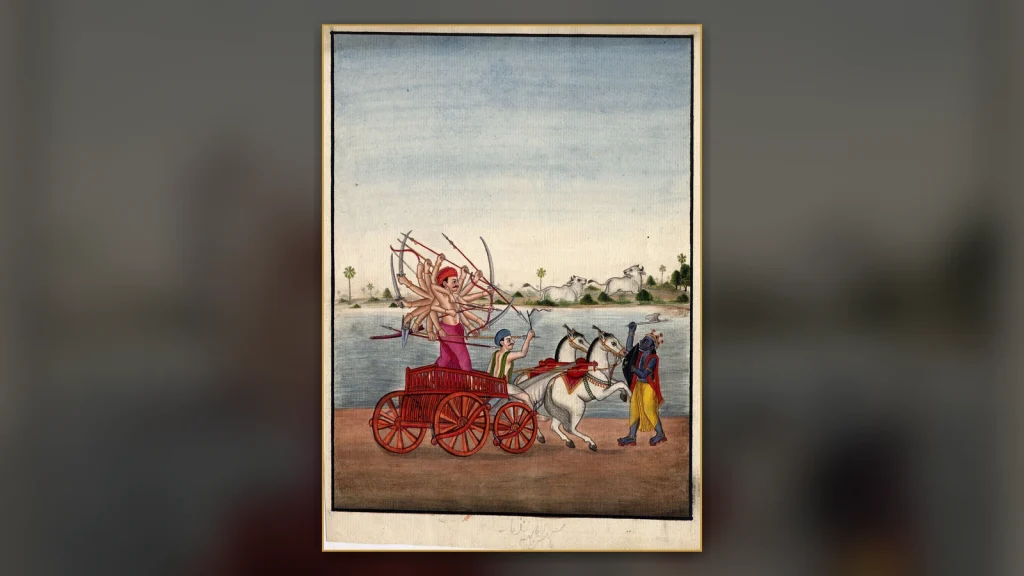
Parashurama—“Rama with the axe”—is a warrior-sage counted as an avatar of Vishnu in influential Hindu traditions. Puranic narratives connect him with Jamadagni, Renuka, Kartavirya Arjuna, and repeated violence against kshatriya rulers; the Ramayana stages his confrontation with Rama. These accounts raise difficult questions about vengeance, caste, authority, and restraint and should not be flattened into a simple celebration of punishment.
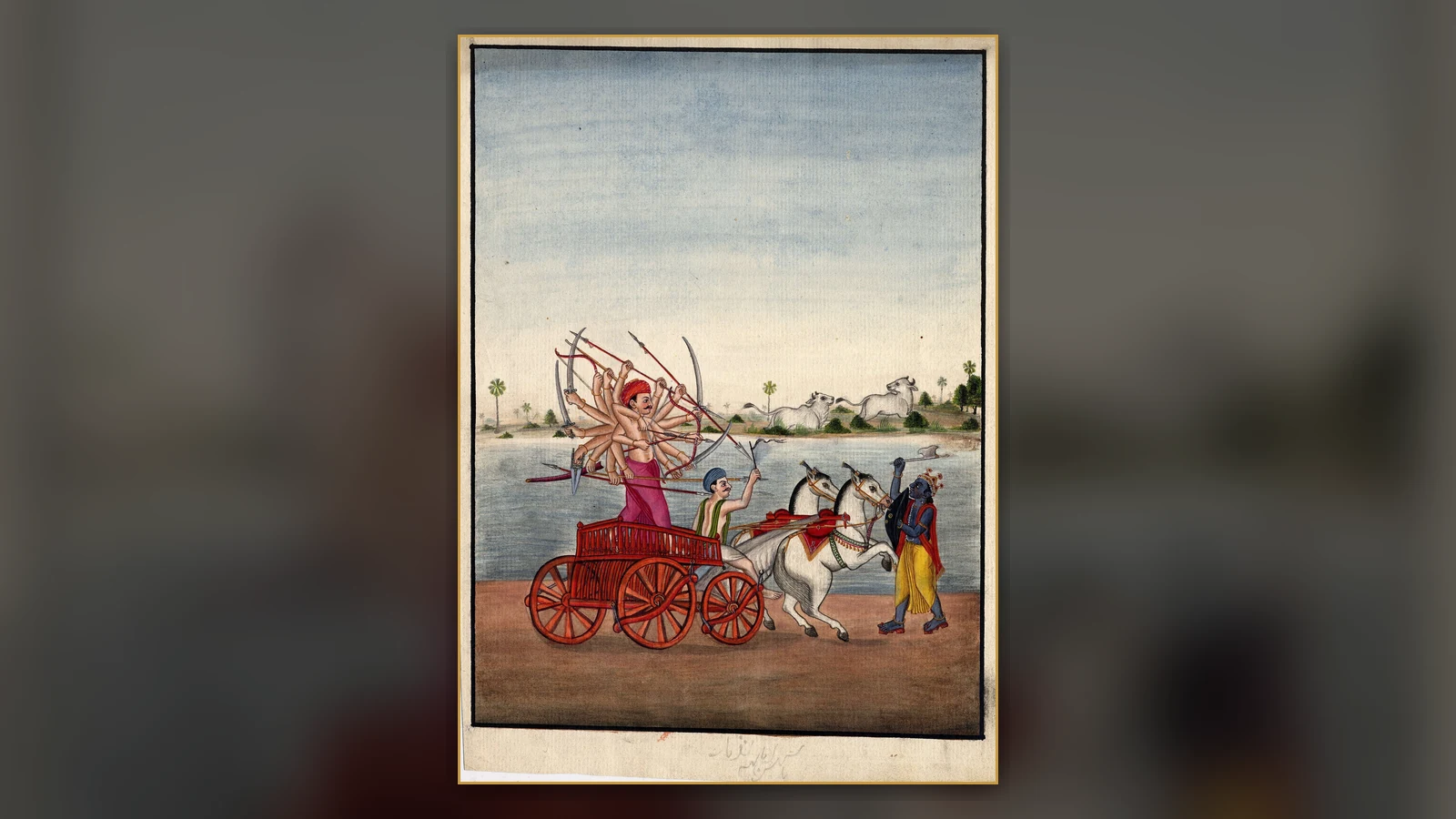

Parashurama at a glance
| Question | Concise answer |
|---|---|
| Name | Parashurama or Paraśurāma, “Rama with the axe”; also Rama Jamadagnya |
| Identity | A brahmin warrior-sage and a widely recognized avatar of Vishnu |
| Parents | The sage Jamadagni and Renuka |
| Principal opponent | Kartavirya Arjuna and, after Jamadagni’s death, kshatriya lineages in repeated campaigns |
| Common attribute | The parashu, or axe; bows and other warrior equipment may also appear |
| Major witnesses used here | Bhagavata Purana 9.15–16 and the Valmiki Ramayana, Bala Kanda 74–76 |
| Key caution | Violence, caste status, land origins, and immortality claims vary by text and region |
Who is Parashurama?
Parashurama joins social roles that modern summaries often treat as opposites. He is born into a brahmin sage’s family but acts as an armed combatant. That combination is not a license to define all brahmins or kshatriyas by one story. It creates the tension through which narratives ask who may wield force, what happens when rulers abuse power, and whether vengeance can remain just.
His axe makes him immediately recognizable, but the name is only a starting point. He belongs to multiple textual worlds: Puranic genealogies and revenge cycles, the Ramayana tradition, Mahabharata stories about martial teachers and pupils, regional sacred geographies, and later lists of beings who remain alive across ages. These materials were not composed as one modern chronological biography.
The Bhagavata Purana narrative: injury, revenge, and repetition
Bhagavata Purana 9.15 places Parashurama in the lineage of Bhrigu as the son of Jamadagni and Renuka. It also recounts a severe family episode in which Jamadagni orders his sons to kill their mother; Parashurama obeys, and she is later restored through a boon. Responsible readers should not turn this disturbing scene into moral instruction for family obedience or use it to excuse abuse. It is part of the text’s portrayal of extreme ascetic authority and demands ethical scrutiny.
The same chapter introduces Kartavirya Arjuna, a powerful kshatriya king. After a conflict involving Jamadagni’s hermitage and sacred cow, Parashurama kills Kartavirya. The king’s sons later murder Jamadagni. In chapter 16, Parashurama retaliates against kshatriyas repeatedly—traditionally twenty-one times—and performs rites for his father.
The scale of the vengeance is not a minor detail to sanitize. A summary that says only “he defeated evil kings” removes collective punishment, inherited conflict, and the possibility that retaliation exceeds its initiating wrong. The narrative can condemn royal abuse and still leave readers troubled by repeated exterminatory violence. Attribution matters: the Bhagavata narrates these acts; Hindu people as a whole are not thereby required to endorse caste violence.
What does “twenty-one times” establish?
Within the received narrative, the number emphasizes recurrence and completeness. It should not be converted into a confidently dated military chronology without historical evidence. Puranic sacred narrative, genealogy, and cosmology use literary and theological patterns that do not function like a modern campaign archive.
The cycle also complicates the label “restorer of justice.” If abusive power is the problem, vengeance can reproduce the same domination it opposes. Parashurama’s story is valuable partly because it does not allow an easy separation between righteous anger and destructive excess.
Parashurama meets Rama in the Ramayana
In the Bala Kanda of the Valmiki Ramayana, Parashurama confronts the younger Rama after the breaking of Shiva’s bow and the wedding at Mithila. He challenges Rama with another divine bow. Rama accepts the challenge, demonstrates his power, and asks what target his arrow should strike. Parashurama recognizes the significance of the encounter and withdraws.
This is not the same episode as Jamadagni’s death or Kartavirya’s defeat. The Ramayana scene places two figures named Rama—and in later Vaishnava understanding, two avatars—in a transfer of martial prominence. It can be read as the meeting of an older warrior-ascetic force with the prince whose narrative centers royal dharma. The Internet Archive scan of Ralph T. H. Griffith’s public-domain translation, Part 1 provides an accessible historical English witness, but its nineteenth-century language should be compared with newer scholarship.
Readers exploring the epic should distinguish Parashurama from Lord Ram. They share the name Rama, but their parentage, attributes, narrative roles, and ethical profiles differ.
Iconography: the axe and the avatar series
The Sanskrit name Parashurama means “Rama with the axe,” making the axe central to his literary identity. In the cited Cleveland Museum register, Parashurama is identified as one figure in a circa-1890 Bengal Dashavatara set. That object grounds his inclusion in this regional series but does not establish a universal list of hairstyles, garments, or weapons.
The Cleveland Museum of Art’s circa-1890 Kalighat woodcut, Das Avataras, Ten Incarnations of Vishnu, identifies Parashurama in the lower register of a ten-avatar set used in nineteenth-century Bengal. The record is especially useful for showing regional list variation: this set includes Jagannath where another chart might place the Buddha or Balarama. It grounds one artistic context; it does not establish a universal Dashavatara order or every detail of Parashurama’s appearance.
When viewing an unidentified avatar series, the axe helps distinguish Parashurama from bow-bearing Rama. Yet attributes can be damaged, simplified, or combined, so museum cataloguing, provenance, and the complete composition matter more than a single visual guess.
How to read the ethical tension
Parashurama cannot be responsibly reduced either to a flawless superhero or to a disposable villain. His narratives preserve anger at rulers who exploit religious households, grief after a father’s murder, and a demand that power face consequences. They also depict obedience that harms a mother, collective vengeance, and violence repeated beyond a single offender.
Different readers will weigh those elements differently. Some devotional interpretations emphasize Vishnu’s correction of arrogant rulers; ethical and historical readings may foreground caste power, patriarchy, and the danger of sacralized violence. Naming the disagreement is more accurate than claiming one uncontested “lesson.” No passage should be used to encourage attacks on a present caste or community.
Common misconceptions
- “Parashurama killed every kshatriya permanently.” The Puranic formula describes repeated campaigns within sacred narrative; kshatriya lineages continue in the texts themselves.
- “His violence is automatically righteous because he is an avatar.” Traditions affirm his avatar status while the stories still generate serious moral questions.
Frequently asked questions
Why does Parashurama carry an axe?
The axe, or parashu, gives him his name and signals his warrior role. The cited Bengal avatar register documents one artistic setting; individual images should be interpreted from their own provenance and catalogue record.
Is Parashurama a brahmin or a kshatriya?
Texts present him as born in a brahmin sage lineage while performing warfare commonly associated with kshatriyas. The tension is central to his identity; it should not be solved by erasing either side.
Are Parashurama and Rama the same person?
No. Parashurama is Rama Jamadagnya, son of Jamadagni; the Ramayana’s Rama is Dasharatha’s son. Their meeting is a major Bala Kanda episode.
Why did Parashurama fight kshatriyas?
The Bhagavata links his campaigns to Kartavirya’s abuse and the murder of Jamadagni. The retaliation expands far beyond the original offenders, which is why the story remains ethically difficult.
Related HinduClarity guides
- Dashavatara: the ten avatars of Vishnu
- Lord Vishnu
- Ramayana: story, structure, and versions
- Lord Ram
- Bhagavata Purana
Sources
- Bhagavata Purana 9.15 — lineage, Renuka episode, Kartavirya conflict; Gaudiya Vaishnava translation and commentary.
- Bhagavata Purana 9.16 — Jamadagni’s death, repeated campaigns, and rites; same translation tradition.
- Internet Archive: The Ramayana of Valmiki, Part 1, translated by Ralph T. H. Griffith — public-domain Bala Kanda witness; historical translation with dated language.
- NYU Press: Ramayana, Book One: Boyhood — modern scholarly translation of the Bala Kanda; publisher record used to complement the historical Griffith translation.
- Cleveland Museum of Art: Das Avataras, Ten Incarnations of Vishnu — object-specific evidence for a Bengal avatar set and regional list/iconography.
- Ludo Rocher, The Puranas — scholarly context for Puranic genre, transmission, and the limits of treating narratives as modern chronology.