Navagraha guide
Shukra Dev is the Hindu graha associated with Venus and a sacred teacher figure whose literary identity developed across Vedic, epic, Purāṇic, and Jyotiṣa traditions. Vedic material knows Uśanas Kāvya as an inspired ancient figure; the Mahabharata presents Uśanas, Kāvya, or Shukra as priest and teacher of the asuras; later Navagraha traditions connect Shukra with Venus. These layers belong together historically, but they should not be flattened into one timeless biography.
_-_relief_from_the_British_Museum_(cropped).jpg)
Shukra Dev at a glance
| Names | Shukra or Śukra; also Uśanas and Kāvya in epic narrative |
|---|---|
| Early textual background | Uśanas Kāvya appears as an ancient seer-like or inspired figure; later Vedic prose associates him with the asuras |
| Epic and later role | Priest, counsellor, and teacher of the asuras; father of Devayani in the Mahabharata |
| Celestial correspondence | Venus |
| Common Jyotiṣa associations | Attraction, relationship, art, pleasure, refinement, value, and material enjoyment |
| Weekday | Friday (Śukravāra) |
| Common iconographic features | Light or white colouring; book, rosary, staff, water pot, treasure, or blessing gesture; two or four arms; chariot descriptions vary |
Who is Shukra Dev?
Shukra is widely called the guru of the asuras and the deity of Venus. Both descriptions are useful if carefully qualified. “Guru of the asuras” reflects epic and later narrative traditions. “Venus deity” reflects the Navagraha and Jyotiṣa correspondence. Neither phrase fully explains the older Uśanas Kāvya material or the complexity of asuras in Hindu texts.
The Sanskrit adjective śukra can carry senses such as bright, clear, or radiant. That linguistic range is older and broader than one deity, so every occurrence of the word shukra in a Sanskrit text is not automatically the personal graha deity. Context determines whether the text means brightness, a substance, a name, a teacher, or the celestial power linked with Venus.
From Uśanas Kāvya to Shukra
Early Vedic references to Uśanas Kāvya do not provide the complete later biography commonly repeated online. Uśanas appears as a figure of inspired or ancient wisdom. Arthur A. Macdonell’s Vedic Mythology notes that later Vedic prose can present Kāvya Uśanas as connected with the asuras—for example, as their messenger—while other priestly functions belong to figures such as Agni or Brihaspati. This is evidence of development, not proof that every later Shukra story was already present in the earliest hymns.
By the Mahabharata’s Kacha and Devayani episode, the identity is much more personal and narrative. The Ganguli translation explicitly treats “Kavya or Usana himself called also Sukra” as one figure. Shukra is a Brahmin teacher of formidable knowledge, serves the asuras, cares for his daughter Devayani, accepts Kacha as a student, and possesses the knowledge called Sanjivani in that translation.
Shukra as teacher of the asuras
In Mahabharata Book 1, Section 76, the devas appoint Brihaspati as their priest, while their opponents appoint the learned Uśanas. Because Shukra can restore fallen asuras through his knowledge, the devas send Brihaspati’s son Kacha to study with him. Shukra accepts Kacha, even though he knows the student’s lineage. The asuras repeatedly kill Kacha to prevent the knowledge from being transferred, and Shukra repeatedly revives him at Devayani’s request.
The episode is dramatic, but “teacher of the demons” is a poor summary. Asura has its own Indian textual history and should not be automatically translated through Christian demonology. The story also refuses a simple moral split: Shukra honours the duties of a teacher; Kacha serves a strategic purpose; the asuras act violently; Devayani’s attachment drives the action; and secret knowledge creates competing obligations. The narrative asks what teachers and students owe each other when learning is entangled with conflict.
The Sanjivani element belongs to epic sacred narrative. It should not be presented as a recoverable medical technique, proof of literal biological resurrection, or support for health claims. Reading the story with respect does not require turning its extraordinary power into modern clinical advice.
Shukra, Venus, and Jyotiṣa: three distinct frames
Shukra as sacred teacher
In narrative and worship, Shukra is a devata, a Bhargava teacher, and a counsellor whose knowledge can challenge the devas’ advantage. Later genealogies commonly connect him with the sage Bhrigu. Exact family lists and stories should be attributed to their texts because Purāṇic and regional traditions do not always arrange details identically.
Venus in astronomy
Venus is a rocky planet similar in size to Earth but with a dense carbon-dioxide atmosphere and an extreme greenhouse environment. It appears exceptionally bright from Earth and is often visible near sunrise or sunset, which gives rise to “morning star” and “evening star” language. These are astronomical observations, not evidence that Venus physically causes romance, artistic ability, luxury, or marriage.
Shukra in Jyotiṣa
Jyotiṣa schools interpret Śukra through their own textual rules and complete-chart contexts. These readings belong to a traditional interpretive framework, not experimentally demonstrated celestial causation or a reliable predictor of a person’s marriage, sexuality, fertility, wealth, or character.
What Shukra can represent
- Value: asking what is genuinely worth seeking, preserving, or exchanging.
- Relationship: attending to reciprocity, consent, affection, and boundaries.
- Beauty and art: cultivating form, sensitivity, and skilled enjoyment.
- Material life: engaging pleasure and comfort without allowing them to rule every decision.
- Teaching across difference: recognizing knowledge even outside one’s own alliance.
- Resilience: the epic association with renewal, read ethically rather than as a medical promise.
These meanings become more responsible when joined with restraint. Shukra should not be reduced to sex, marriage, money, or glamour. The teacher in the Kacha story is not a mascot for instant attraction; he represents knowledge, obligation, strategy, and the serious consequences of desire and loyalty.
Iconography and variation
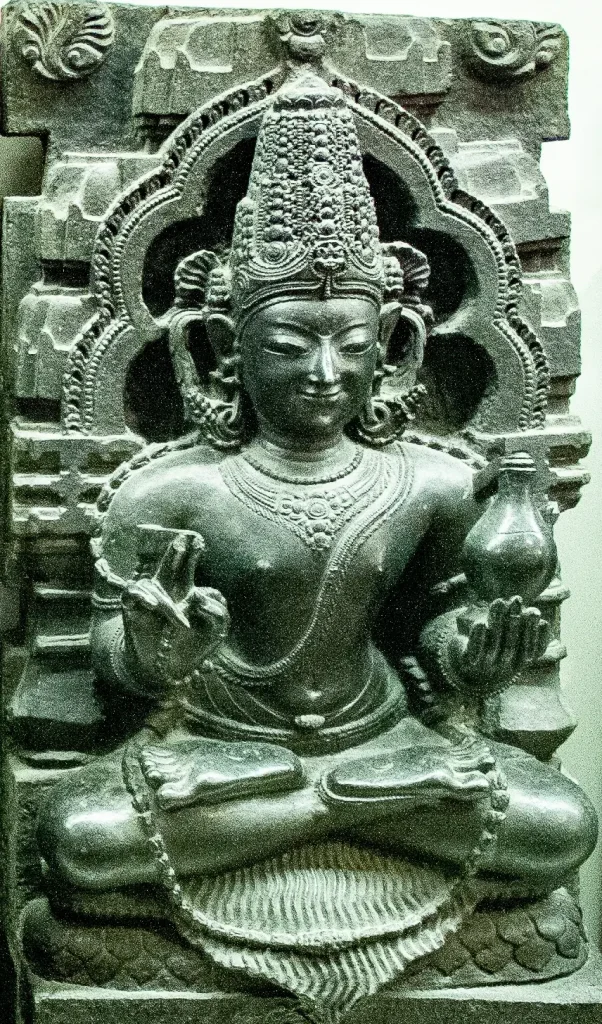
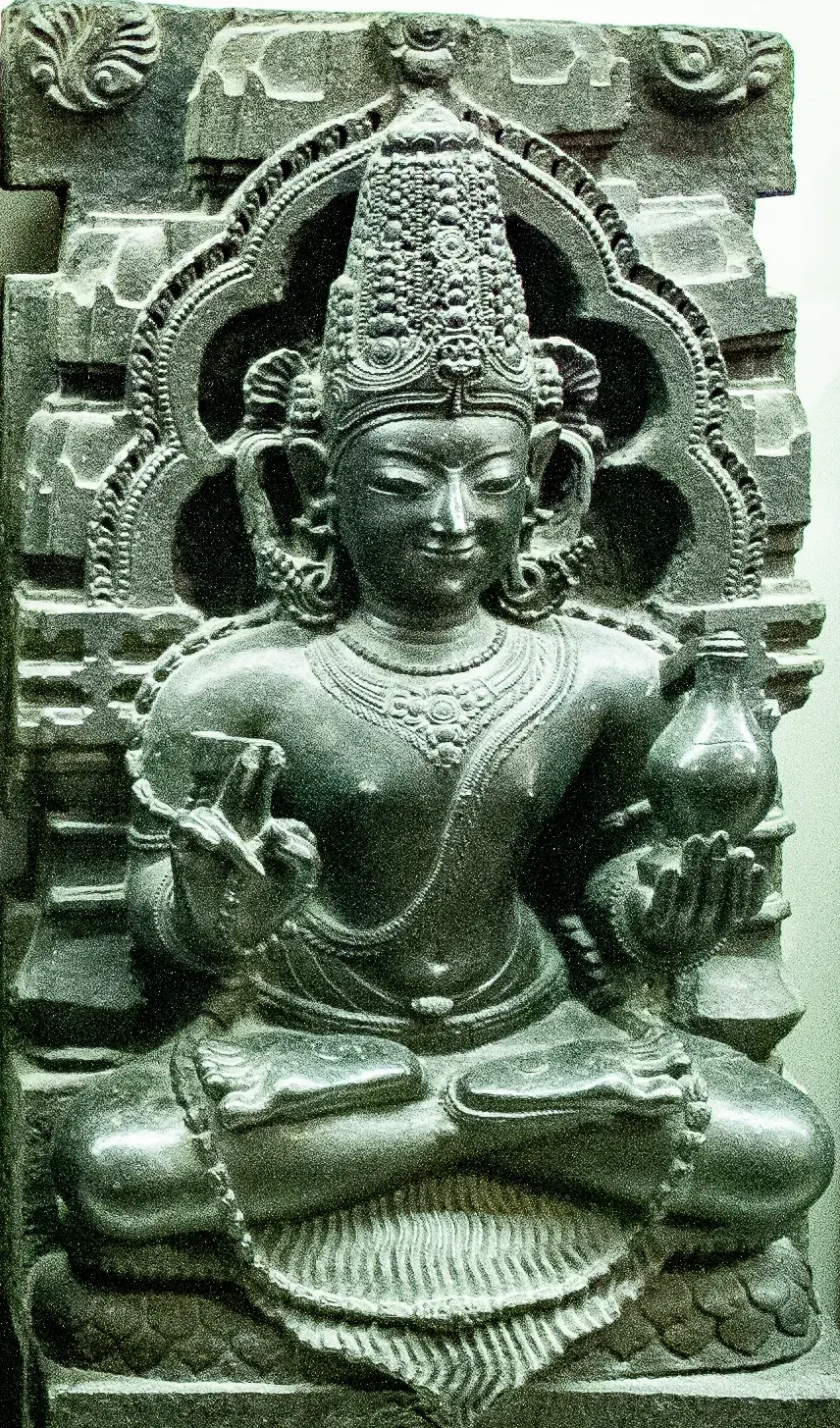
Shukra’s images vary. H. Krishna Sastri’s survey records prescriptions in which Shukra is born of Bhrigu and sits in a golden chariot drawn by eight horses or a silver chariot drawn by ten. One two-armed description gives him a treasure and a book; another four-armed form carries a staff, rosary, water pot, and varada gesture. Modern images may simplify these attributes or emphasize white clothing and a bright complexion.
The book and rosary foreground the teacher and ritual specialist. The water pot and staff can evoke disciplined religious life, while treasure may suggest value or resources. These are reasonable visual readings, not a universal iconographic dictionary. A temple murti, stone Navagraha panel, painted calendar image, and digital devotional artwork may each follow a different source or regional convention.
How Shukra Dev is worshipped
Śukra is honored within some Navagraha settings and through locally taught observances. Procedures vary by family, temple, region, and lineage, so a color, food, offering, or weekday practice should not be presented as one mandatory list for all Hindu communities.
- Clean the worship area and begin with a calm, respectful intention.
- Offer simple items appropriate to your household tradition and circumstances.
- Use a prayer learned through family, temple, or a qualified teacher; avoid online claims that a secret formula guarantees a desired person or outcome.
- Reflect on consent, gratitude, fairness, and responsible enjoyment.
- Conclude with an action that honours dignity—repairing a conversation, supporting an artist, sharing food, or reviewing spending honestly.
Devotion can frame reflection and ethical commitment. It cannot compel another person’s affection, secure a marriage, restore fertility, cure disease, or guarantee money. Relationship concerns may require honest conversation or qualified counselling; health and fertility questions require licensed care; financial problems require practical planning. Fasts, gemstones, and specialized remedies should be approached without pressure or promises and with appropriate guidance.
Shukra within the Navagraha
Navagraha worship places Shukra among a network of celestial powers centred in many shrines on Surya. His paired comparison with Brihaspati is especially important in epic narrative, but they are not merely astrological opposites. The complete group also includes Chandra, Mangala, Budha, Shani, Rahu, and Ketu.
Frequently asked questions
Is Shukra the same as Venus?
Shukra is the sacred graha traditionally corresponding to Venus. Venus is also a physical planet studied through astronomy. The religious, astrological, and scientific descriptions answer different questions.
Why is Shukra called the guru of the asuras?
Epic and later traditions portray Uśanas or Shukra as the priest and teacher serving the asuras, in contrast with Brihaspati’s service to the devas. The Kacha story in the Mahabharata is a major textual example.
Are asuras the same as demons?
Not exactly. “Demon” can import assumptions from other religions. Asuras are a varied category within Indian texts, and their portrayal changes across periods and narratives. Translation should preserve that complexity.
What is the Sanjivani knowledge associated with Shukra?
In the Mahabharata’s Kacha story, it is knowledge by which Shukra restores the slain. It belongs to epic narrative and is not a modern medical procedure or evidence for health guarantees.
Does Shukra worship guarantee love, marriage, or fertility?
No. Worship cannot override consent or guarantee marriage, conception, beauty, money, or reconciliation. Devotion may support reflection, but relationships and health require ethical action and appropriate care.
Sources and further reading
- Mahabharata, Adi Parva, Section 76, translated by Kisari Mohan Ganguli, for Uśanas/Kāvya/Shukra as priest of the asuras, Devayani’s father, Kacha’s teacher, and possessor of Sanjivani knowledge in this narrative.
- Arthur A. Macdonell — Vedic Mythology, for the older Uśanas Kāvya material and its distinction from later epic biography.
- H. Krishna Sastri — South-Indian Images of Gods and Goddesses, Chapter 7, for historical Navagraha placement and variant Shukra iconographic prescriptions.
- NASA Science — Venus, for the physical planet’s atmosphere, surface environment, orbit, and brightness.