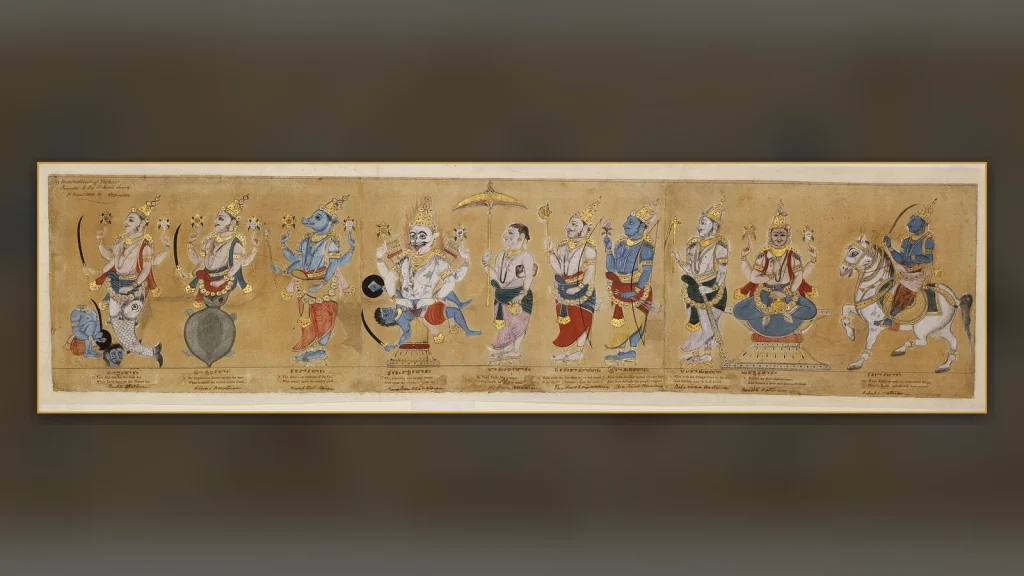
Some Hindu Dashavatara lists place the Buddha in a late position, while others count Balarama; neither arrangement is universal. The difference reflects distinct texts, Vaishnava theologies, regions, and devotional lineages. “Buddha as Vishnu’s avatar” is a Hindu classification, not Buddhist self-understanding, and Balarama’s place depends partly on how a tradition understands Krishna.
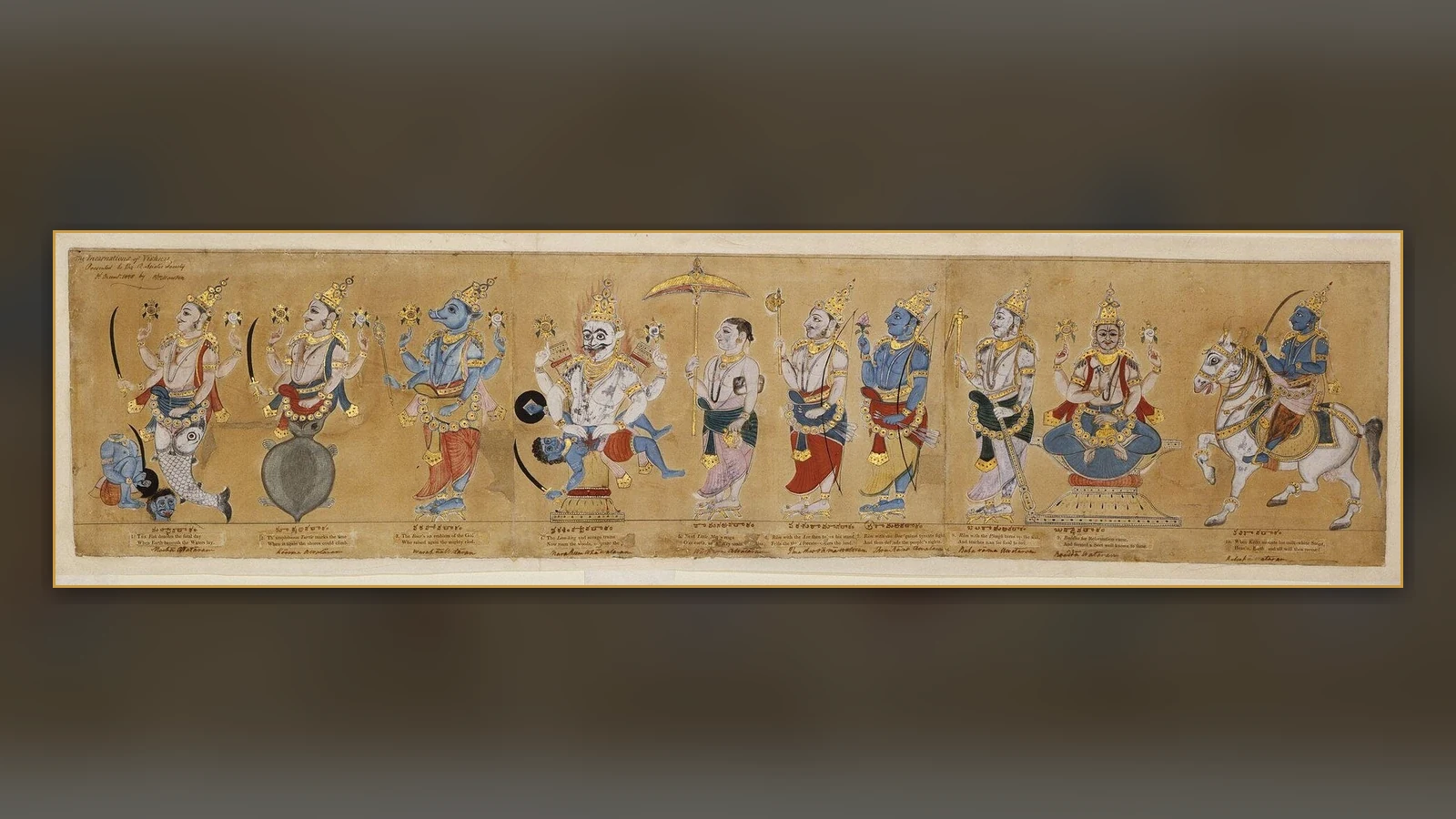

The difference at a glance
| Question | Buddha-list approach | Balarama-list approach |
|---|---|---|
| Who occupies the variable place? | A Buddha figure, often identified with Gautama Buddha in later reception | Balarama or Baladeva, Krishna’s elder brother |
| Whose classification is it? | A classification within certain Hindu texts and traditions | A classification within certain Hindu, especially Vaishnava or regional, traditions |
| Common theological issue | How a Hindu source incorporates the Buddha into Vishnu’s cosmic activity | Whether Krishna is counted as an avatar, understood as the source of avatars, or represented through Jagannath |
| Key textual evidence | Bhagavata Purana 1.3.24 names Buddha in a longer manifestation list | Bhagavata Purana 1.3.23 names Balarama and Krishna in that same longer list |
| Main caution | Do not present the avatar label as Buddhist doctrine | Do not call Balarama a recent “replacement” or assume every Krishna tradition numbers him identically |
There is no single universal Dashavatara list
Dashavatara means “ten avatars,” but Hindu literature contains lists of different lengths and purposes. A ten-name teaching chart is therefore a selection from a much larger theology of divine manifestations, not a closed creed administered by one central authority. The HinduClarity Dashavatara overview uses a common sequence while flagging this variation.
Bhagavata Purana Book 1, Chapter 3 makes the point especially clearly. Verse 23 names Balarama and Krishna as successive manifestations, and verse 24 then names Buddha.[1][2] Both occur in the same chapter because this is a longer avatara catalogue, not a ten-member list with one vacant slot. The chapter continues beyond them and even says the divine manifestations are innumerable. It cannot honestly be reduced to “the text chooses Buddha instead of Balarama.”
Why some Hindu lists include the Buddha
Bhagavata Purana 1.3.24 predicts Buddha, son of Anjana, in the region of Gaya and gives his mission as deluding those hostile to the faithful.[2] The wording belongs to this Vaishnava theological narrative. It should not be silently replaced with a modern, interfaith-friendly explanation, nor should it be treated as a complete biography of Siddhartha Gautama.
Other Hindu interpreters have emphasized nonviolence, compassion, or criticism of animal sacrifice when explaining Buddha’s inclusion. Those are real interpretive trajectories, but they are not interchangeable with every Puranic passage. The figure’s parentage and mission can also differ from Buddhist accounts of the historical Buddha. Saying “the Buddha is an avatar” therefore compresses several Hindu textual and later devotional identifications into one sentence.
In a tenfold scheme, including Buddha may place him after Krishna and before Kalki. Yet works of sacred art and devotional poetry can order or select the forms differently. The important question is not merely “Who is ninth?” but “Which text, school, region, and theological purpose produced this list?”
Why other lists include Balarama
Balarama—also called Baladeva, Rama, Balabhadra, and Sankarshana—is Krishna’s elder brother in major Vaishnava narratives. Bhagavata Purana 1.3.23 presents Balarama and Krishna together as manifestations who relieve the earth’s burden.[1] Book 10, Chapter 2, verse 13 explains the names Sankarshana, Rama, and Balabhadra, connecting them with his transfer to Rohini’s womb, his delighting Gokula, and his strength.[3]
Counting Balarama among ten can follow from a tradition’s treatment of Krishna. Bhagavata Purana 1.3.28, for example, is famously read in Krishna-centered Vaishnavism as distinguishing Krishna as the original Bhagavan from the preceding manifestations.[4] If Krishna is the source of avatars rather than simply one item in a row, a tenfold display may give Balarama an explicit place. Other communities still count Krishna within the ten. These are theological arrangements, not arithmetic errors.
Balarama also has a strong identity beyond list-making: he participates in Krishna narratives, carries associations with strength and agriculture, and is worshipped with Jagannath and Subhadra in Odisha as Balabhadra. A Dashavatara position should not flatten him into “the person who replaces Buddha.”
What Buddhists say about the Buddha
The Buddha-as-avatar claim must be attributed to Hindu classification. A Buddhist institutional introduction from The Buddhist Centre describes the Buddha as a human being who awakened and taught a path to awakening; it explicitly says he is not a god.[5] The Stanford Encyclopedia of Philosophy likewise presents the historical Buddha as the founder and teacher of the Buddhist tradition and examines teachings attributed to him within Buddhist philosophical sources.[6]
Buddhist traditions are themselves diverse. Theravada, Mahayana, and Vajrayana communities do not explain Buddhahood in one simple formula, and many Buddhist cosmologies recognize past and future Buddhas. Nevertheless, interpreting Gautama Buddha as Vishnu’s descent is not a standard Buddhist account of who he is. Respectful comparison states both classifications without forcing one community’s theology onto another.
Textual and theological comparison
| Evidence | What it establishes | What it does not establish |
|---|---|---|
| Bhagavata Purana 1.3.23–24 | Balarama, Krishna, and Buddha all occur in one Vaishnava manifestation catalogue | A fixed universal ten or a simple Buddha-versus-Balarama swap |
| Bhagavata Purana 1.3.28 | A Krishna-centered hierarchy within this text and its commentarial reception | That every Hindu school excludes Krishna from the ten |
| Buddhist institutional and scholarly accounts | The Buddha understood through awakening, teaching, and the Buddhist path | Acceptance of a Vishnu-avatar identity |
| Regional or museum objects | How one object or artistic setting selected and pictured forms | A pan-Hindu rule about list membership |
Art and regional lists make the variation visible
A V&A manuscript cover made in Bengal in 1733 depicts Parashurama, Rama, Balarama, Buddha, and Kalki together.[7] Its inclusion of both Balarama and Buddha is useful evidence against treating every visual series as a simple one-for-one substitution. Another nineteenth-century V&A painted wooden panel from Bengal places Balarama and Jagannath before Kalki.[8] These Bengal objects document their own artistic settings; they do not establish a rule for all Bengal, Odisha, or India.
Balarama’s independent iconography also varies. The Metropolitan Museum of Art identifies a circa fifth-century stone figure as “Standing Balarama or Nagaraja,” noting scholarly uncertainty in the title itself.[9] In better-attested Balarama images, a plough and club, robust form, and serpent associations may appear. The museum’s cautious identification is a reminder that iconographic labels are evidence-based interpretations, not infallible name tags.
How traditions and regions differ
Modern lists and regional artworks continue to vary. The objects cited here document particular Bengal and central or north Indian examples, not the prevalence of one sequence across whole regions. Broader claims about calendars, temple programs, or Vaishnava communities require representative regional evidence.
No single example should stand for an entire region. A museum panel establishes that one sequence existed in a particular artistic setting; a present-day temple establishes its own practice; a Purana establishes what its received text says. Good comparison keeps those evidence classes separate.
Common misconceptions
- “Buddha is always Vishnu’s ninth avatar.” He appears in many influential Hindu lists, but not all.
- “Balarama was inserted recently to reject Buddhism.” Balarama’s divine status is rooted in major Vaishnava texts and long-standing regional traditions; motives cannot be reduced to one modern explanation.
- “The Bhagavata chooses Buddha instead of Balarama.” Book 1, Chapter 3 names both in a longer catalogue.
- “Buddhists believe the Buddha is Vishnu.” That is a Hindu theological classification, not standard Buddhist self-description.
- “One list proves the Dashavatara predicts evolution.” List variation and theological selection make a strict biological sequence untenable; the evolution comparison is modern analogy, not ancient science.
Frequently asked questions
Who is the ninth avatar: Buddha or Balarama?
Either may appear, depending on the list. Ask which scripture, sampradaya, region, temple, or artwork is being followed rather than treating one answer as universally correct.
Does the Bhagavata Purana include Buddha?
Yes. Bhagavata Purana 1.3.24 names Buddha in a longer avatara catalogue. The same chapter names Balarama and Krishna in verse 23, so it is not a ten-place either-or list.
Why can Krishna be absent from a Dashavatara image?
Some Krishna-centered theology understands Krishna as the source of avatars, while some regional art represents him through Jagannath or gives Balarama a place. Other widely used lists count Krishna explicitly.
Is the Buddha-as-avatar idea disrespectful to Buddhists?
It can become disrespectful when presented as what Buddhists believe. It can be discussed accurately as a Hindu classification if Buddhist self-understanding is also stated clearly and without ridicule.
Sources and further reading
- Bhagavata Purana 1.3.23 — Balarama and Krishna in an identified Vaishnava translation.
- Bhagavata Purana 1.3.24 — the Buddha figure and stated Puranic mission.
- Bhagavata Purana 10.2.13 — Balarama’s names and narrative context.
- Bhagavata Purana 1.3.28 — Krishna’s status in the chapter’s theology.
- The Buddhist Centre: Essential Buddhism — Buddhist institutional self-description of the Buddha and awakening.
- Stanford Encyclopedia of Philosophy: Buddha — scholarly account of the historical Buddha and Buddhist philosophy.
- V&A: painted Bhagavata Purana manuscript cover — Bengal object depicting Balarama and Buddha together.
- V&A: Dashavatara and Matrika painted wooden panel — Bengal sequence including Balarama and Jagannath.
- The Met: Standing Balarama or Nagaraja — circa mid-fifth-century figure and cautious museum identification.