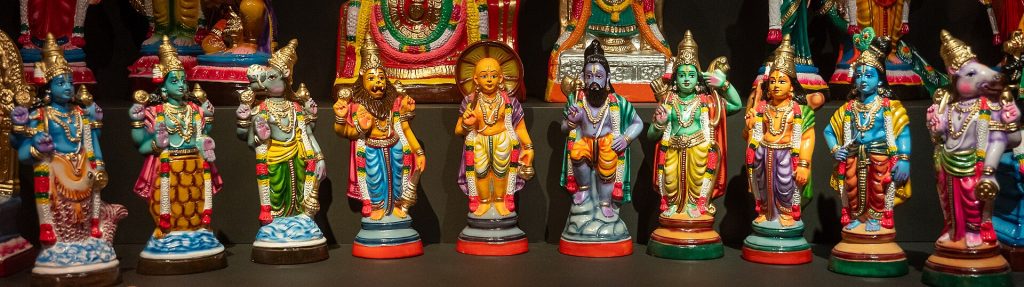
The Dashavatara are ten especially prominent avatars, or manifestations, of Vishnu. In widely used lists, they are Matsya, Kurma, Varaha, Narasimha, Vamana, Parashurama, Rama, Krishna, the Buddha, and Kalki. However, Hindu texts and communities do not all present exactly the same ten: some traditions include Balarama instead of the Buddha, and larger scriptural lists describe many more manifestations of Vishnu.
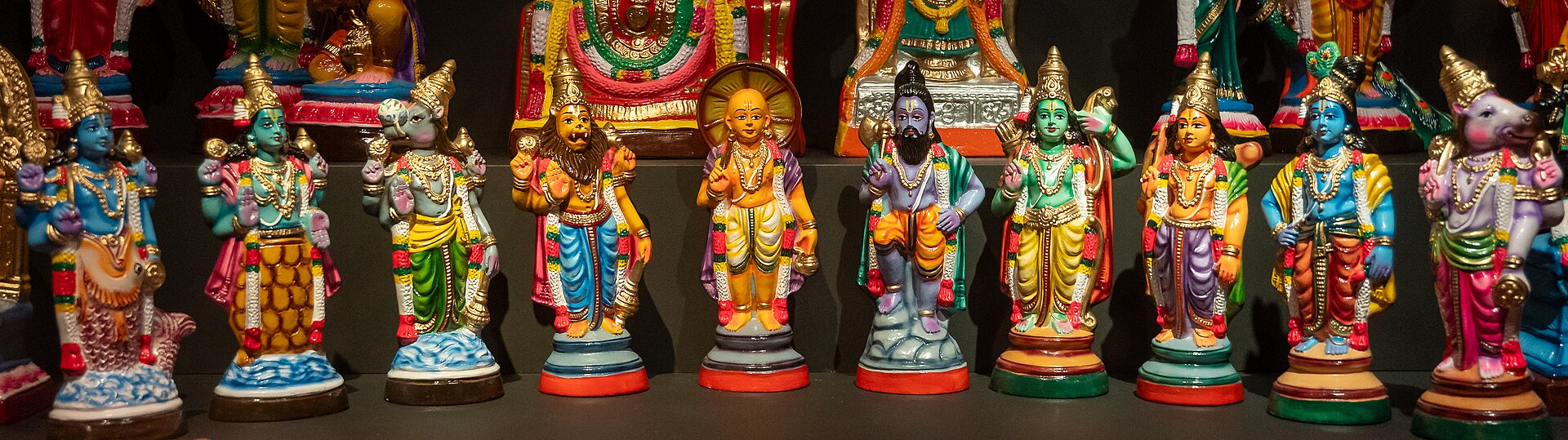
The idea behind the Dashavatara is therefore more important than treating one list as universally fixed. Vishnu is understood in Vaishnava traditions as sustaining cosmic order. When disorder threatens the world, he becomes present in a form suited to a particular crisis. Each avatar’s narrative explores a different dimension of dharma, including protection, courage, restraint, just rule, devotion, and the restoration of balance.
Dashavatara at a glance
| Avatar | Common form | Central narrative | Theme often emphasized |
|---|---|---|---|
| Matsya | Fish | Preserves life or sacred knowledge through a catastrophic flood | Protection and preservation |
| Kurma | Tortoise | Supports Mount Mandara during the churning of the ocean | Stability and cooperation |
| Varaha | Boar | Raises the Earth after the asura Hiranyaksha carries her into the cosmic waters | Rescue and cosmic restoration |
| Narasimha | Man-lion | Protects Prahlada and defeats Hiranyakashipu without violating the boon granted to him | Divine protection and the limits of power |
| Vamana | Dwarf brahmin | Requests three steps of land from King Bali and then spans the cosmos | Humility, sovereignty, and surrender |
| Parashurama | Warrior-sage with an axe | Confronts rulers who have abused their authority | Justice and the danger of violence |
| Rama | Prince and king of Ayodhya | Lives through exile, Sita’s abduction, and the war in Lanka | Dharma, duty, and ethical kingship |
| Krishna | Cowherd, prince, and teacher | Appears in many traditions, including the Mahabharata and Bhagavata Purana | Devotion, wisdom, love, and divine play |
| Buddha or Balarama | Teacher or elder brother of Krishna | Varies according to the text and community | Compassion, discernment, or strength |
| Kalki | Future rider on a white horse | Is expected at the end of Kali Yuga | Renewal after moral decline |
What does “avatar” mean?
The Sanskrit word avatāra conveys the idea of a “descent.” In theology, it describes the divine becoming present within the world without being exhausted by that particular appearance. An avatar is not simply a heroic person who becomes divine. Rather, the term generally points to the divine deliberately assuming a form in response to circumstances in the cosmos.
A famous expression of this principle appears in the Bhagavad Gita. Krishna tells Arjuna that whenever dharma declines and adharma rises, he manifests himself for the protection of the good, the defeat of destructive forces, and the re-establishment of dharma. Vaishnava theologians have interpreted this teaching in different ways, but it remains one of the clearest summaries of why divine manifestation matters.
The ten avatars and what their stories convey
Matsya: preservation through the flood
Matsya, the fish avatar, warns a human survivor—usually identified as Manu—of an approaching flood. Details differ across tellings: some emphasize the preservation of living beings, while others focus on rescuing the Vedas or other sacred knowledge. Matsya guides a vessel through the waters, making the episode a story about safeguarding life, memory, and order when an established world is overwhelmed.
Kurma: the foundation beneath a cosmic task
During the churning of the ocean of milk, devas and asuras use Mount Mandara as a churning rod. When the mountain begins to sink, Vishnu becomes Kurma, a great tortoise, and supports it on his back. The episode produces both dangers and treasures, including the nectar of immortality. Kurma’s role is quiet but indispensable: transformation requires a stable foundation.
Varaha: raising the Earth
Varaha descends into the cosmic waters to rescue the Earth, personified as the goddess Bhudevi, from Hiranyaksha. Temple sculptures often show the boar-headed Vishnu lifting Bhudevi safely upward. The image operates on several levels at once: the Earth is restored to her rightful place, destructive arrogance is checked, and the ordered cosmos is re-established.
Narasimha: protection beyond a tyrant’s calculations
Hiranyakashipu receives a boon designed to make his death almost impossible: he is not to be killed by human or animal, indoors or outdoors, during day or night, or by ordinary weapon. He persecutes his son Prahlada for remaining devoted to Vishnu. Vishnu appears as Narasimha—neither fully human nor fully animal—at twilight, on a threshold, and defeats the tyrant with his claws. The story celebrates Prahlada’s devotion while showing that power and clever wording cannot place injustice beyond accountability.
Vamana: three steps that encompass the universe
Vamana approaches the generous ruler Bali as a small brahmin and asks for as much land as he can cover in three steps. Once the promise is granted, Vamana assumes a cosmic form. With two steps he encompasses earth and heaven; Bali then offers himself as the place for the third. Some traditions focus on the limitation of royal pride, while others honor Bali’s generosity, truthfulness, and surrender. In Kerala, the Onam festival warmly remembers King Mahabali, illustrating how the same narrative may sustain several devotional emphases.
Parashurama: justice complicated by anger
Parashurama, “Rama with the axe,” is a brahmin warrior associated with conflicts against kshatriya rulers who misuse power. His stories are morally demanding rather than simple celebrations of force. They raise questions about vengeance, recurring violence, social responsibility, and what happens when punishment itself becomes excessive. He also appears in narratives connected with Rama and later heroes, linking different ages of sacred history.
Rama: dharma in a world of difficult choices
Rama is the central figure of the Ramayana and is revered as an embodiment of principled conduct, courage, and kingship. His exile, loyalty to his father’s word, alliance with Hanuman and Sugriva, and battle against Ravana have shaped Hindu worship, performance, literature, and political imagination. Yet the Ramayana also contains painful ethical tensions. Responsible reading does not erase questions surrounding Sita’s treatment, warfare, caste, or royal duty; Hindu commentators and retellings have debated these matters for centuries.
Krishna: divine presence in many relationships
Krishna’s traditions range from the playful childhood narratives of Gokul and Vrindavan to his role as statesman and spiritual teacher in the Mahabharata. In the Bhagavad Gita, Krishna instructs Arjuna about action, knowledge, devotion, discipline, and the nature of the self. In bhakti traditions, devotees may relate to Krishna as child, friend, beloved, teacher, or Supreme Being. His avatar narrative is consequently not confined to a single episode.
Buddha or Balarama: why the ninth position varies
Many modern charts name the Buddha as Vishnu’s ninth avatar. Puranic presentations of this figure do not always correspond neatly to how Buddhists understand the historical Buddha, and interpretations differ even among Hindu readers. Some accounts portray the avatar as teaching compassion or discouraging harmful sacrifice; others place the figure within a theological story about delusion. These claims should not be presented as Buddhist self-understanding.
Other established lists name Balarama, Krishna’s elder brother, instead. This is not an error or a recent correction. It reflects the fact that avatar lists developed across multiple texts and Vaishnava communities. Regional art may also group Krishna and Balarama differently or give special prominence to Jagannath traditions.
Kalki: the avatar yet to come
Kalki is described as a future manifestation who appears near the end of Kali Yuga, an age associated with moral and social deterioration. Iconography often depicts Kalki with a white horse and a raised weapon. The image expresses decisive renewal, but scriptural time cycles should not be converted into confident predictions about modern dates or individuals. Claims that a living person is certainly Kalki belong to particular movements, not to a universally accepted Hindu conclusion.
Is the Dashavatara an ancient theory of evolution?
A popular modern comparison reads the sequence as fish, amphibious tortoise, land animal, part-human being, small human, tool-using human, ethical ruler, spiritually developed teacher, and future transformation. The analogy can be memorable, and some modern Hindu writers use it symbolically. However, the traditional narratives were not composed as a scientific account of biological evolution. Lists also vary in ways that weaken a strict evolutionary sequence. It is more accurate to call this a modern interpretive comparison than an original statement of evolutionary science.
Why Dashavatara lists differ
Hindu sacred literature does not operate through one closed canon or a single central authority. The Mahabharata, several Puranas, regional traditions, temple communities, and theological schools preserve overlapping but non-identical accounts. The Bhagavata Purana, for example, celebrates numerous manifestations rather than limiting Vishnu to ten. The tenfold list became culturally influential, but it should be understood as a prominent organizing tradition rather than the only legitimate enumeration.
Frequently asked questions
Who is the first avatar of Vishnu?
Matsya is first in the most familiar Dashavatara sequence. Other lists of Vishnu’s manifestations may begin differently because they organize avatars by another theological or narrative principle.
Is Krishna the eighth or ninth avatar?
Krishna is usually eighth when the Buddha occupies the ninth position. In traditions that count Balarama separately, the numbering or relationship between the two can differ. Many Krishna-centered Vaishnavas also worship Krishna as the source of avatars rather than merely one avatar among others.
Are all ten avatars worshipped equally?
No. Rama, Krishna, and Narasimha have especially extensive living traditions, while other avatars may receive greater attention in particular temples, festivals, regions, or narrative settings.
Has Kalki already appeared?
Most traditional descriptions place Kalki in the future. Hindu communities do not share a verified date for Kalki’s appearance, and assertions that a particular contemporary person is Kalki should be attributed to the group making the claim.
Is the Buddha considered an avatar by Buddhists?
Buddhists understand the Buddha through Buddhist teachings, not as an avatar of Vishnu. The classification belongs to certain Hindu textual and theological traditions and should not be imposed on Buddhist belief.
Sources and further reading
- Encyclopaedia Britannica: Avatar — definition of avatar and an overview of Vishnu’s major manifestations.
- Encyclopaedia Britannica: Vishnu — Vishnu’s theological role and major avatar traditions.
- Gita Supersite, Indian Institute of Technology Kanpur — Sanskrit text and multiple translations and commentaries, including Bhagavad Gita 4.7–4.8.
- Bhagavata Purana, Book 1, Chapter 3 — a Vaishnava institutional translation illustrating an avatar list extending beyond ten.
- The Metropolitan Museum of Art: Hinduism and Hindu Art — educational context for Hindu deities, manifestations, and sacred art.
Related HinduClarity Guides
Explore the Dashavatara guides
Read the individual avatar guides and the explanation of why historical ten-avatar lists differ. Lord Ram and Lord Krishna continue to use their established HinduClarity pages.